
You have to be a huge Indian history nerd to enjoy this book. It is a waterfall of primary documents, mainly speeches by or about Subhash Chandra Bose. Its not light reading, and its probably not interesting to you if you aren’t fascinated by it’s highly focused subject matter. Even I had to remember that it is a collection of primary sources so it will get repetitive and boring at times. The pacing goes at life speed, not at the speed of a well-written novel.
Now for some interesting themes I picked up: Bose’s mission required the mobilization of Indians who lived outside of India, namely those living in East Asia. Those living abroad seemed more amenable to Bose’s brand of militant nationalism than those at home. His mission reminded me strongly of the Ghadar movement, and various modern Hindu, Sikh, and Tamil Nationalist organizations which had/have their bases of support located outside of India. Why is it that non-resident South Asians seem consistently more nationalist and militant than those living in India? (Note: I think that Bose and the Ghadars show that the linked article provides an unsatisfactory answer to this question since this is evidently a very old phenomenon, and therefore is not attributable to the post 1960s growing NRI middle class)
However, unlike the aforementioned communalist or regionalist movements, the Azad Hind government was strongly Pan-South-Asian (Pan-Bharatvarashi? Pan-Gurkani?) and emphatically inclusory. Bose was firmly in favor of a united India (including Lanka) and opposed to regionalism, classism, and caste. I seriously doubt he would have appreciated modern India’s federal structure which leaves states a degree of autonomy.
This inclusory spirit is evident in the composition of his organization. The majority of the soldiers in his army were Muslims, and the variant of Hindustani used by the organization was heavily slanted towards Urdu for their benefit Tamils played a huge role in his organization as well due to their large numbers in Southeast Asia. Females were also included in combat roles (As a side note, the U.S. just got on board with this 4 days ago.) Sometimes Bose goes a bit overboard in the pursuit of unity. For example: at the time there was a conflict over the Hindustani language. Should the new government use Devanagari script, or Persian script? Or retain both and have the resultant communication problems and social fragmentation? Bose proposed solving this by ditching both Devanagari and Persian script in favor of Latin script, in a conscious imitation of Ataturk. This is why all Indian National Army documents were written using Latin characters.
His passion for a united India informed his stance on Jinnah and the Muslim League. Needless to say, he was virulently and morally opposed to the notion of Pakistan and seems to have disliked Jinnah as a person. This is exacerbated by what Bose identifies as Jinnah’s traitorous behavior at the Simla conference, wherein the Muslim League allegedly promised to support the British war effort in exchange for Pakistan.
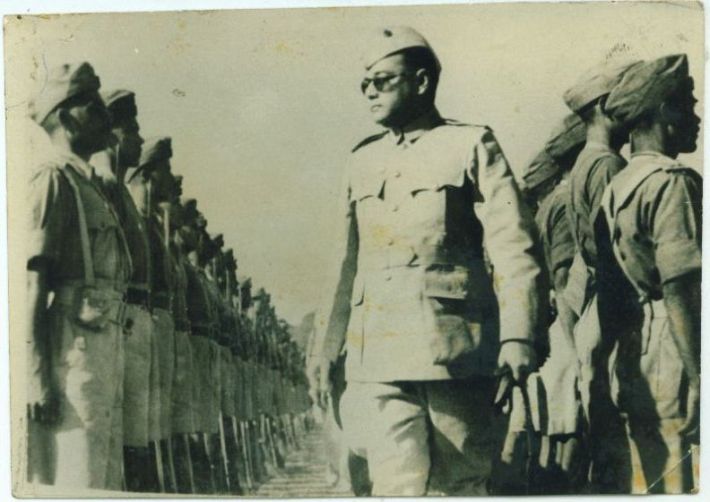
There were a few select essays, such as “Gandhiji’s Part in India’s Fight” which are great examples of Bose’s rhetorical abilities and skill in propagandizing. In that essay he repeatedly praises Gandhi’s character and dedication, referring to his many prior interactions with the man while never commenting on his diametrically opposed tactics. He thus associates himself with Gandhi’s personality cult while obfuscating Gandhi’s opposition to the Indian National Army’s violent strategy. Then in the last paragraph he throws in a direct Gandhi quote “If India has the sword today, she will draw the sword”, and asserts that Gandhi was only opposed to revolution in the past because the time wasn’t right. Now the time is right, so Gandhi supporters should listen to their hero and join the Indian National Army. Clever, no?
Another clever rhetorical tool, which I noticed, was his persistent use of vague religious language. He often refers to his revolution as a “holy war”, a vague enough term to fit into the paradigm of Islamic Jihad, Hindu Dharmayudha, or Sikh divine command to defend the innocent.
It is difficult to say how accurate his impressions of World War 2 were, given that these speeches were intended for a general audience and are thus necessarily propagandistic. Morale, to Bose was a more important military factor than technology or supplies. This is probably his most important misapprehension since it governed his military strategy. He continued to claim that Germany’s victory was obvious until the Red Army was almost in Berlin. The same claim was bade about the Japanese until late in the British-American re-conquest of Burma. However, his predictions about the post-war situation were pretty good. Bose understood that it would be an “American Century” and that the Soviets and the west would not remain allies for long. A notable error was his mistaken assumption that Britain would never “voluntarily” India after the war. Perhaps it is unfair to call that a “mistake” though, because Bose’s own actions led to the British losing faith in their Indian troops, a contributing factor to their peaceful withdrawl from the subcontinent.
One can imagine that if Hitler died prior to World War 2, or if Stalin had died while fighting the Nazis their modern reputations would have been greatly improved. In that sense, it is wonderful for Bose that he died before ever achieving a position of power. Those who admire Bose (and I am one of them) might want to acknowledge is that he was basically a Fascist. He repeatedly speaks glowingly National Socialism, Italian Fascism, Communism and the Japanese imperial state. He clearly indicates that he has no problem with dictatorship, and that India’s government should not be a democracy, but would rather be a state blending the positives of Nazi Germany and Stalinist Russia. If Japan had won the war and Bose’s army had actually made it to Delhi, India would probably have been a Fascist dictatorship with Neetaji as the head autocrat. Judging by his harsh actions when his army faced the stressors of defeat and retreat, political freedom would not exist and political purges would have been the norm. Based on his economic theories, starvation would have been widespread as the result of central agricultural planning. For the sake of his legacy, Bose is lucky he died early.
I picked this up in Calcutta for 500 rupees but its a lot more expensive to buy in the west. Anyway, if this review interested you then you are probably this book’s target audience.


.svg)