Frogs

Frogs occupy a strange and specific position in Indic religious history. They aren’t gods (mostly), they have no cult. But they show up in the Rig Veda chanting like Brahmins, in the Śatapatha Brāhmaṇa as the literal runoff of the primordial Agni, in the Atharvan ritual manuals as a receptacle for fever, in the Mahābhārata as a kingdom with a king and ambassadors, and in both Buddhist and Jain scripture as creatures with minds, with souls, who can take vows, and who can get to heaven. What follows is an attempt to lay out the references, and point out some patterns which emerge.
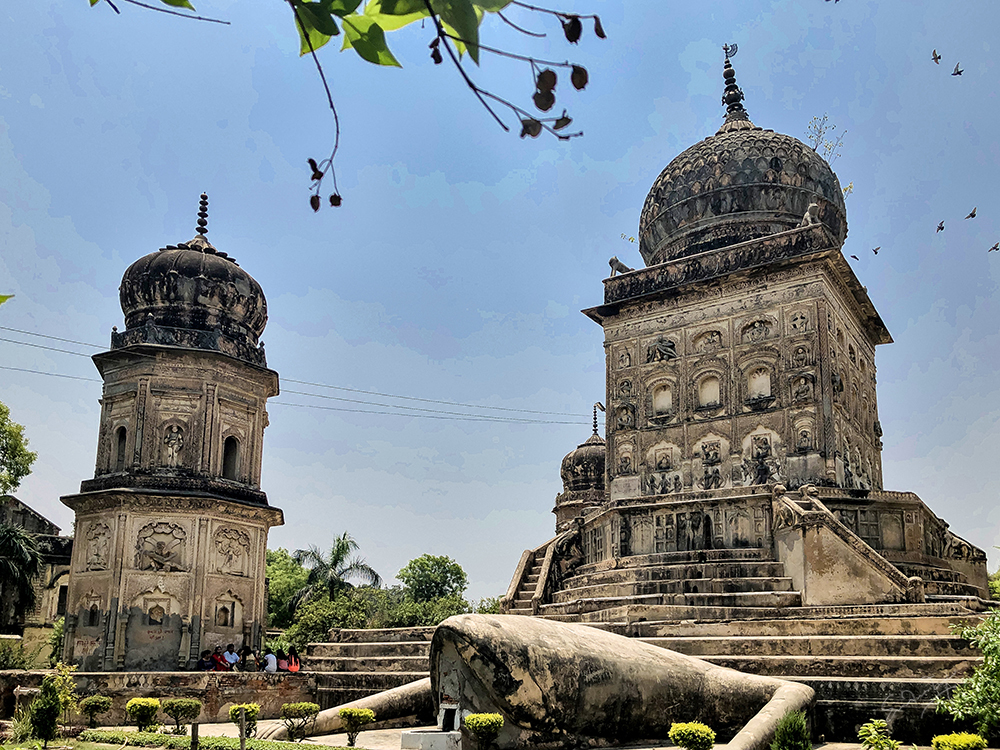
Source and you really should go check out that source. It has a lot more pics of this temple, and a writeup. It is the Manduk Mandir in Lakhimpur Kheri district, UP. Built by the Raja of Oel between 1860 and 1870, dedicated to Shiva, and constructed on the back of what appears to be a giant stone frog. In this whole post I do talk about how there really are no major frog deities or cults in Indic religion. This is an exception to that, though it comes way later than anything I talk about here.

Satapatha Brahmana 

Here’s an interesting Vedic passage referencing frogs, from the Śatapatha Brāhmaṇa (of the Śukla Yajurveda):

19. ‘The widely-shining by name,’–for the gods then called those bricks to them by their names, and in the same way in which they called them, they turned unto them; but the ‘space-fillers’ alone stood with averted faces discharging water, having no names applied to them. They called them by the name ‘the widely-shining,’ and they turned unto them. Hence, each time he has laid down ten bricks, he addresses them with the ‘space-filling 1 (verse)’: he thereby makes them widely-shining (virâg), for the Virâg (metre) consists of ten syllables:–‘wish-milking, never-failing,’–he thereby makes them wish-milking and never-failing.

20. He then draws a frog, a lotus-flower, and a bamboo-shoot across (the central part of the altar). For the gods having now appeased him by the Satarudriya and the water, and having driven out his pain and evil, thereby still further appeased him; and in like manner does this (Sacrificer), now that he has appeased him by the Satarudriya and the water, and driven out his pain and evil, still further appease him thereby. In every direction he draws them: he thus appeases him everywhere.

21. And, again, as to why he draws them across. Now, in the beginning, when the Rishis, the vital airs, made up that Agni 2, they sprinkled him with water: that water dripped off and became the frogs.

22. They (the waters) said to Pragâpati, ‘Whatever moisture 1 we had, has gone down.’ He said, ‘This tree shall know it!’–he shall know (vettu), he shall taste it (sam vettu)–that one, indeed, they mystically call ‘vetasa’ (bamboo), for the gods love the mystic. And because they said, ‘Down (avâk) has gone our moisture (ka),’ they became avâkkâs;–‘avâkkâs,’ they mystically call ‘avakâs (lotuses),’ for the gods love the mystic. These, then, are those three kinds of water, to wit, the frog, the lotus-flower, and the bamboo-shoot: by means of these three kinds of water he appeases him.

23. And, again, why he draws them across it;–when he (Agni, the fire-altar) is built up, he is being born, and he is born for every kind of food; and these are every kind of food, to wit, the frog, the lotus-flower, and the bamboo-shoot, for these, indeed, are animals, water, and trees: with all this food he gratifies him.

Continue reading

Company Painting

Here is an example of the style of painting which emerged in India under the British East India Company:

Great Indian Fruit Bat

hb_2008.312
Date: ca. 1777–82
Geography: India, Calcutta
Culture: Colonial British
Medium: Pencil, ink, and opaque watercolor on paper
Dimensions: Mat size: Ht. 27 1/4 in. (69.2 cm)
W. 35 1/2 in. (90.2 cm)

“In 1777, Sir Elijah Impey, chief justice of Bengal between 1774 and 1782, and his wife, Lady Mary, hired local artists to record the specimens of Indian flora and fauna they collected at their estate in Calcutta. Over the next five years, at least 326 paintings of plants, animals, and birds were made for the Impeys. On most of these works, the name of one of three artists—Bhawani Das, Shaykh Zayn al-Din, or Ram Das—appears along with the Hindi name of the animal and the phrase, in English, “In the collection of Lady Impey at Calcutta.” Although this painting bears no such inscription, it is closely related to another painting of a bat by Bhawani Das, and it has always been associated with Impey patronage. One can imagine Bhawani Das and the anonymous artist of this painting working side by side, observing the animals, but whereas Bhawani Das’ painting depicts a tawny-colored female bat centered on the page with both wings outstretched, his fellow artist has created an asymmetrical composition in shades of gray and black of an emphatically male bat with one wing dramatically unfurled.” (Source: Metropolitan Museum of Art)

Quite a looker isn’t he? I recently saw an interesting corner of the Metropolitan Museum of Art which I hadn’t seen before. It was a room labeled “Company Painting in Nineteenth-Century India.” For some reason I just hadn’t come across this room in prior wanderings. I decided to show you all some of the drawings and paintings I saw, with some historically related works interspersed for comparison.

The Company paintings are worthy of our notice because they reflect Indian aesthetic culture in this fascinating, relatively narrow slice of time between the Mughal state and the British state, when India was under Company rule. Mughal trained painters were able to modify their craft to suit British tastes, but this slight change  put them (generally speaking) out of the genre of imaginative, decorative court art and into the genre of scientific sketches, administrative records, or more rarely, a sort of elite tourist kitsch. The Indian artists in this collection have been forced by circumstance to depict less conventionally beautiful plants and animals, and in a more realistic style. The cultural change from luxuriant Mughal court system into the impersonal knowledge aggregating machine of the colonial period is reflected in painting. Its pretty cool.

They are also fascinating because it shows us a period in Indian history where British artists suddenly join Hindus, Muslims in a shared aesthetic genre depicting the Indic subject matter. Take a look at these scientific drawings of plants for example:

Ashoka Tree Flower, Leaves, Pod, and Seed

Date: first half 19th century
Geography: India, probably Calcutta
Culture: Colonial British
Medium: Opaque watercolor on paper
Dimensions: Page: H. 23 1/4 in. (59.1 cm) W. 17 5/8 in. (44.8 cm)
DP273291.jpg

Continue reading