Frogs

Frogs occupy a strange and specific position in Indic religious history. They aren’t gods (mostly), they have no cult. But they show up in the Rig Veda chanting like Brahmins, in the Śatapatha Brāhmaṇa as the literal runoff of the primordial Agni, in the Atharvan ritual manuals as a receptacle for fever, in the Mahābhārata as a kingdom with a king and ambassadors, and in both Buddhist and Jain scripture as creatures with minds, with souls, who can take vows, and who can get to heaven. What follows is an attempt to lay out the references, and point out some patterns which emerge.
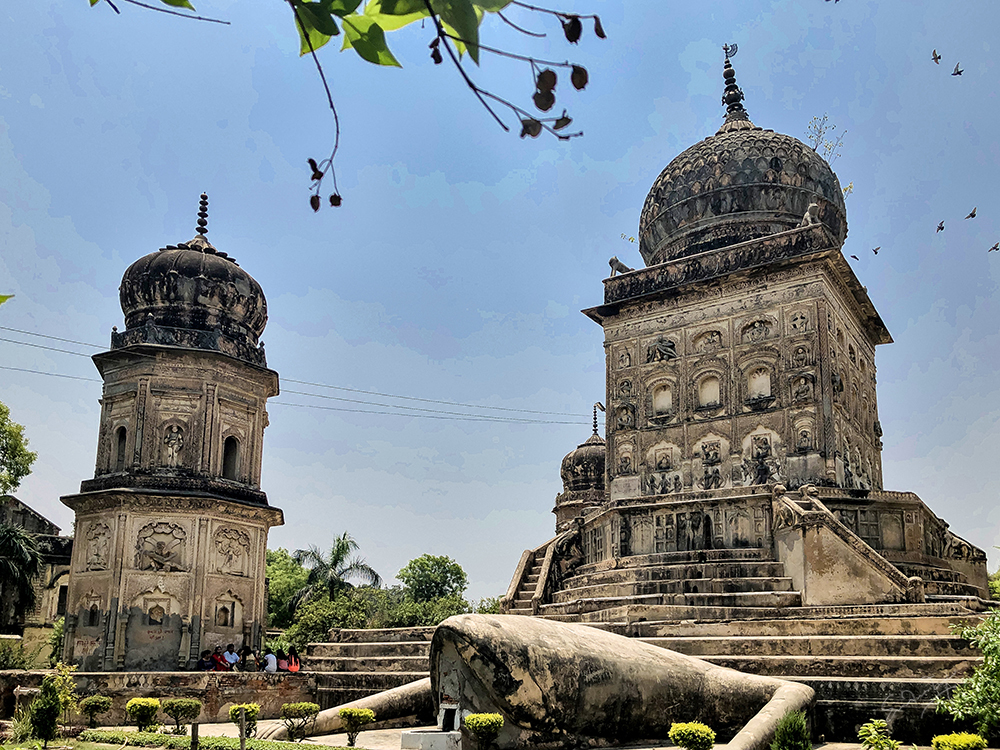
Source and you really should go check out that source. It has a lot more pics of this temple, and a writeup. It is the Manduk Mandir in Lakhimpur Kheri district, UP. Built by the Raja of Oel between 1860 and 1870, dedicated to Shiva, and constructed on the back of what appears to be a giant stone frog. In this whole post I do talk about how there really are no major frog deities or cults in Indic religion. This is an exception to that, though it comes way later than anything I talk about here.

Satapatha Brahmana 

Here’s an interesting Vedic passage referencing frogs, from the Śatapatha Brāhmaṇa (of the Śukla Yajurveda):

19. ‘The widely-shining by name,’–for the gods then called those bricks to them by their names, and in the same way in which they called them, they turned unto them; but the ‘space-fillers’ alone stood with averted faces discharging water, having no names applied to them. They called them by the name ‘the widely-shining,’ and they turned unto them. Hence, each time he has laid down ten bricks, he addresses them with the ‘space-filling 1 (verse)’: he thereby makes them widely-shining (virâg), for the Virâg (metre) consists of ten syllables:–‘wish-milking, never-failing,’–he thereby makes them wish-milking and never-failing.

20. He then draws a frog, a lotus-flower, and a bamboo-shoot across (the central part of the altar). For the gods having now appeased him by the Satarudriya and the water, and having driven out his pain and evil, thereby still further appeased him; and in like manner does this (Sacrificer), now that he has appeased him by the Satarudriya and the water, and driven out his pain and evil, still further appease him thereby. In every direction he draws them: he thus appeases him everywhere.

21. And, again, as to why he draws them across. Now, in the beginning, when the Rishis, the vital airs, made up that Agni 2, they sprinkled him with water: that water dripped off and became the frogs.

22. They (the waters) said to Pragâpati, ‘Whatever moisture 1 we had, has gone down.’ He said, ‘This tree shall know it!’–he shall know (vettu), he shall taste it (sam vettu)–that one, indeed, they mystically call ‘vetasa’ (bamboo), for the gods love the mystic. And because they said, ‘Down (avâk) has gone our moisture (ka),’ they became avâkkâs;–‘avâkkâs,’ they mystically call ‘avakâs (lotuses),’ for the gods love the mystic. These, then, are those three kinds of water, to wit, the frog, the lotus-flower, and the bamboo-shoot: by means of these three kinds of water he appeases him.

23. And, again, why he draws them across it;–when he (Agni, the fire-altar) is built up, he is being born, and he is born for every kind of food; and these are every kind of food, to wit, the frog, the lotus-flower, and the bamboo-shoot, for these, indeed, are animals, water, and trees: with all this food he gratifies him.

Continue reading

Earliest Glimpses of Colorado Hinduism

The early 20th century in Denver marks a fragmented period for the presence of Hinduism, a time when authentic Hindu philosophy and spirituality began to emerge alongside a flurry of sensationalist and dubious claims. The Vedanta Society made a brief but notable appearance, attempting to establish a foothold for genuine Hindu teachings, though its influence appears to have been transient. More dominant in this period, however, were hucksters and lecturers who used Hindu concepts and imagery in ways that blended Western spiritualism, occultism, and commercial opportunism. Even among these figures, it is difficult to discern where genuine spiritual intent ended and snake-oil salesmanship began. These fragments highlight a historical moment where the public’s fascination with the exotic and mysterious often overshadowed earnest efforts to introduce Hindu traditions, creating an ambiguous and complicated legacy that warrants further exploration.

The absolute earliest fragments are some scattered references (2) in very early (1894) newspaper about Hindu beliefs or publications, but they are very sparse, and view the subject hazily and at a distance.

Some other very early articles contextualizing the extremely early Vedantic and Theosophical period in the context of the concern, anxiety, or even panic surrounding New Thought, occult, and other novel turn of the century religious movements are as follows:

Older Christian Science (1899)

Age of Spiritual Hunger (1903)

Mixture of Odd Beliefs (1910)

Wrongly Blamed (1906)

But for where there is more meat to the story, I will start with something a little more concrete:

The earliest reference I’ve been able to find of a Hindu actually visiting Colorado is actually a Brahmo Sajami, B. B. Nagarkar, who visited in 1894, having previously represented that tradition at the Chicago Congress of Religions the previous year. Despite the Brahmo Samaj being one of the first to bring Hindu thought to Denver and perhaps the US in general, its influence would eventually be eclipsed by the Ramakrishna movement, which gained prominence in the early 20th century, particularly through the work of Swami Vivekananda. Nevertheless, Nagarkar’s visit marks an important early moment of direct engagement between Hinduism and Colorado, predating the later widespread interest in Vedanta and other aspects of Hinduism that would follow with the Ramakrishna Mission and other movements.

Continue reading

“My Body = My Property”?

I recently saw some Libertarian women carrying a sign which said “My Body = My Property”. I suppose they were doing this as a sort of alternative permutation of “My Body, My Choice” to lend themselves an explicitly Libertarian flare to their pro-abortion rights advocacy. This is also a common sentiment and justification for abortion rights which I have heard from many Libertarians. However then I thought…. “Is it really property though?” This actually seems somewhat contentious. Let me go over some perspectives in order from least to most persuasive to me. Unlike a lot of what I post here, this will just be a few spur of the moment thoughts rather than something deeply researched and considered. This shouldn’t be construed as implying any particular stance on abortion.

The sign in question

On one hand, on a Marxist critique, for instance, one might argue that by viewing the body as “property,” we’re objectifying it, treating it as an object subject to public decision over ownership and control, a thing to be utilized and exploited, an form of alienation splitting the integrated self upon itself. You can also see how this would flow into a feminist critique where the body is now becoming an object or a commodity to be controlled, purchased or exchanged.

Continue reading

World Leaders React to Death of Castro

I won’t be doing this kind of post often. This isn’t even related to South Asia at all except that I’m starting the list with South Asian leaders, but I’m posting it because I was annoyed at how bad the media is at doing this extremely simple job. I couldn’t find a single complete list of immediate reactions of foreign leaders to the death of Castro. They all exclude some major leaders, chop up the quotes, or even make comical errors like this ABC article which refers to “Rashtrapati Bhavan, the president of India…”  So here I’m presenting all the quotes I could find from all world leaders on this topic in as complete a manner as possible. If you find an error or one I missed, add it in the comments and I’ll edit the post.
Reactions to Fidel Castro’s death from Narendra Modi, Maithripala Sirisena, Imran Khan, Vladimir Putin, Dmitri Medvedev, Michael Gorbachev, Donald Trump, Barack Obama, Jimmy Carter, Justin Trudeau, Xi Jinping, Bashar Al Assad,  Boris Johnson, Jeremy Corbyn, Pope Francis, Rafael Correa, Enrique Peña Nieto, Nicolás Maduro, Salvador Sánchez, Michelle Bachelet, Michael Higgins, Alexis Tsipras, Francois Hollande, Seyed Ali Khamenei, Jean-Claude Junker and Ban Ki-moon:
———————————

fidel-castro-with-indira-gandhi.jpg

Fidel Castro and Indira Gandhi. Image Source: India.com

Narendra Modi (India):
“Fidel Castro was one of the most iconic personalities of the 20th century. India mourns the loss of a great friend.” “
“I extend my deepest condolences to the Government & people of Cuba on the sad demise of Fidel Castro. May his soul rest in peace.”
We stand in support with the Cuban Government and people in this tragic hour.”
(And President Pranab Mukherjee also said: Heartfelt condolences on sad demise of Cuba’s revolutionary leader, former President & friend of India, Fidel Castro)