Frogs

Frogs occupy a strange and specific position in Indic religious history. They aren’t gods (mostly), they have no cult. But they show up in the Rig Veda chanting like Brahmins, in the Śatapatha Brāhmaṇa as the literal runoff of the primordial Agni, in the Atharvan ritual manuals as a receptacle for fever, in the Mahābhārata as a kingdom with a king and ambassadors, and in both Buddhist and Jain scripture as creatures with minds, with souls, who can take vows, and who can get to heaven. What follows is an attempt to lay out the references, and point out some patterns which emerge.
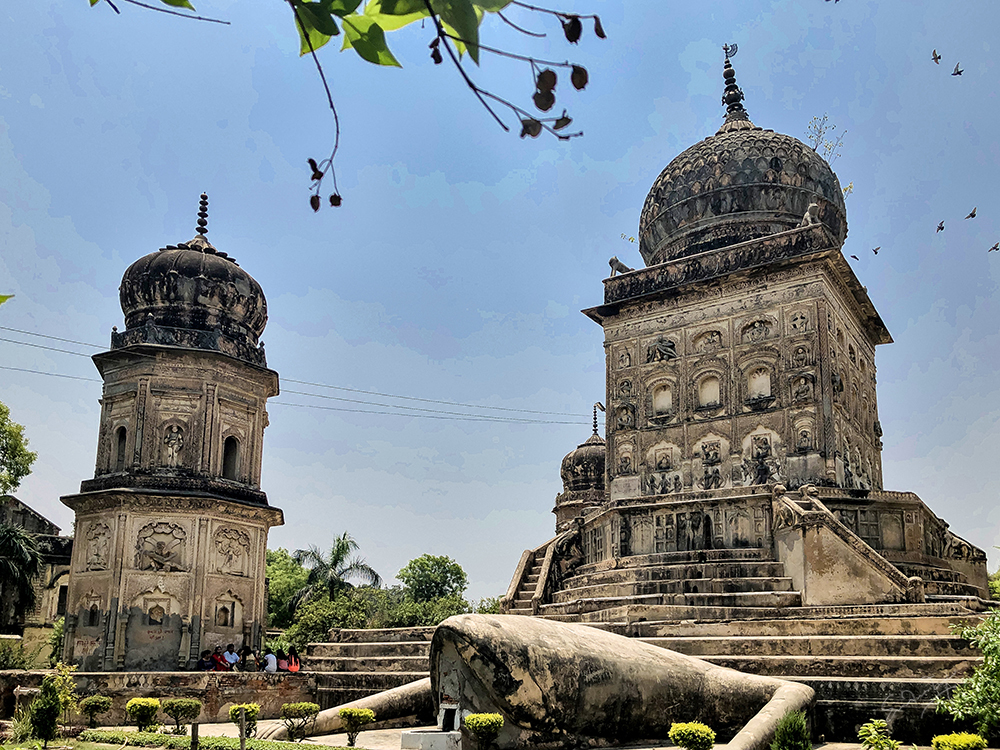
Source and you really should go check out that source. It has a lot more pics of this temple, and a writeup. It is the Manduk Mandir in Lakhimpur Kheri district, UP. Built by the Raja of Oel between 1860 and 1870, dedicated to Shiva, and constructed on the back of what appears to be a giant stone frog. In this whole post I do talk about how there really are no major frog deities or cults in Indic religion. This is an exception to that, though it comes way later than anything I talk about here.

Satapatha Brahmana 

Here’s an interesting Vedic passage referencing frogs, from the Śatapatha Brāhmaṇa (of the Śukla Yajurveda):

19. ‘The widely-shining by name,’–for the gods then called those bricks to them by their names, and in the same way in which they called them, they turned unto them; but the ‘space-fillers’ alone stood with averted faces discharging water, having no names applied to them. They called them by the name ‘the widely-shining,’ and they turned unto them. Hence, each time he has laid down ten bricks, he addresses them with the ‘space-filling 1 (verse)’: he thereby makes them widely-shining (virâg), for the Virâg (metre) consists of ten syllables:–‘wish-milking, never-failing,’–he thereby makes them wish-milking and never-failing.

20. He then draws a frog, a lotus-flower, and a bamboo-shoot across (the central part of the altar). For the gods having now appeased him by the Satarudriya and the water, and having driven out his pain and evil, thereby still further appeased him; and in like manner does this (Sacrificer), now that he has appeased him by the Satarudriya and the water, and driven out his pain and evil, still further appease him thereby. In every direction he draws them: he thus appeases him everywhere.

21. And, again, as to why he draws them across. Now, in the beginning, when the Rishis, the vital airs, made up that Agni 2, they sprinkled him with water: that water dripped off and became the frogs.

22. They (the waters) said to Pragâpati, ‘Whatever moisture 1 we had, has gone down.’ He said, ‘This tree shall know it!’–he shall know (vettu), he shall taste it (sam vettu)–that one, indeed, they mystically call ‘vetasa’ (bamboo), for the gods love the mystic. And because they said, ‘Down (avâk) has gone our moisture (ka),’ they became avâkkâs;–‘avâkkâs,’ they mystically call ‘avakâs (lotuses),’ for the gods love the mystic. These, then, are those three kinds of water, to wit, the frog, the lotus-flower, and the bamboo-shoot: by means of these three kinds of water he appeases him.

23. And, again, why he draws them across it;–when he (Agni, the fire-altar) is built up, he is being born, and he is born for every kind of food; and these are every kind of food, to wit, the frog, the lotus-flower, and the bamboo-shoot, for these, indeed, are animals, water, and trees: with all this food he gratifies him.

Continue reading

Hindu Devas take a (silk) road trip to Japan!

(Note: If you are only interested in pictures, skip past this and hit “Continue Reading”)

This is a historical phenomenon, which entertains and fascinates me to no end. Buddhism had a huge impact on all East Asian cultures, especially on their pantheons of deities. On first glance it might seem odd that a reform movement, which rejected many of the core tenants of Vedic religion would transmit a belief in Vedic deities. This apparent oddity is a misunderstanding of Buddhism’s “atheism,” and a misunderstanding of what a “Deva” actually is. Most forms of Buddhism, while rejecting the concept of all-powerful gods or creator deities, openly accept the existence of powerful supernatural beings. This includes yakshas (nature spirits) rakshasas (demons) gandharvas (celestial musicians) nagas (supernatural snakes) and many other beings, including Devas (deities.) In Hindu and Buddhist cosmology, Devas are created beings that roam around the universe seeking the divine, albeit very powerful ones with much greater spiritual capabilities than humans. Hindu traditions tend to accord Devas much more power and divinity than Buddhism, and worship them as manifestations of The Supreme. In the Buddhist pantheon, the Devas have generally converted to Buddhism and now serve as his protectors, the protectors of his teachings, or as helpers to mortals who are trying to achieve enlightenment.

The reader should be aware that in Japanese mythology and theology the below deities freely interact with native Shinto deities, and deities imported from China. I am isolating the Indian derived deities for the purpose of this bog post, but do not be deluded into thinking that they are unintegrated with the rest of Japanese mythology.

The more popular of these deities are used in non-esoteric Mahayana Buddhism (the bulk of Buddhist sects in Japan.) However, most of these are relatively obscure deities because they are only used in the Shingon school, an esoteric (tantric) school of Buddhism. As such, the bulk of these Devas achieved full development in Japan around the late 700s or early 800s, as a result of the rise in popularity (especially amongst the political elite) of esoteric and Shingon Buddhism.

Last note: There are a lot of different names involved here, because (among other reasons) Sanskrit and Japanese don’t transliterate very well. For deities in which two names are listed, the first is Sanskrit, and the second is Japanese. In cases where, for some reason, I’ve listed many names, I will specify with an (S) or a (J) which language it is from.

(S) Ganesha/ (S) Vinayaka / (J) Binayaka / (J) Shoten/ (J) Kangiten: Ganesha was one of the first Indian deities to transit to Japan, and as in India, is one of the most popular in both esoteric and non-esoteric sects. Perhaps this is because his association with worldly prosperity has been retained, or perhaps amplified into a general association with pleasure. Thus, actors, geishas, gamblers, restaurant proprietors, etc offer him worship. Shoten has retained the association for removing obstacles, although his ancient association with creating obstacles which has long since been expunged from the Hindu tradition is still mildly active in Japan for reasons which will become clear later.

Ganesh (musée d'art indien de Berlin)

Dancing Ganesha from North Bengal, 11th Century. Image From Vikram Kharvi’s blog “My Lord Ganesha”


Kangiten

Contemporary Kankiten Statue from Fukuoka Japan. Image from this Japanese Website

He is often depicted in (implicitly erotic) embrace with another elephant headed figure. In that iconography, his name is “Kangiten” or “Binayaka.” This is an allusion to a Japanese myth about Kangiten’s “evil” origins, wherein his mother, Uma births 1,500 evil children onto her left (collectively called Binayakas), the first of which was Binayaka. On her right side she births 1,500 good children the first of which was Avalokiteśvara/Kannon (the Bodhisatva of compassion) incarnated as Idaten (Skanda or Murugan in India.) In order to win Binayaka over to goodness, Idaten reincarnates as a female binayaka and becomes Kangiten’s wife. The bliss generated by their union turns Kangiten good. According to this myth therefore, the embracing Kangiten figures actually represent Kangiten in sexual union with his brother reincarnated as his wife/sister. There are other myths, which seek to explain this iconography, but all of them involve some sort of gender reversal, usually by means of reincarnation.[1]  There is a huge corpus of Japanese Ganesha myths, which do not exist at all in India, but the initial one just mentioned seems to almost reference Ganesha’s actual historical development in India. Ganesha probably evolved from the set of demons called Vinayakas/Binayakas who were known for erecting obstacles and creating divisions between allies. However, they were easily appeased. So easily appeased in fact that over time they evolved into positive forces, and merged into one deity—Ganesha.[2]

embrace 2

Embracing Kangiten. Image from onmarkproductions.com

However, the aforementioned Japanese myths all seem to be trying to explain the dual figured Kangiten iconography by posing, as it’s mythological basis. The real basis lies elsewhere, probably in the translations of Amoghavajra, a half Indian half Sogdian monk living in China in the early 700s. He was a founder of the “Chen-Yen” school of esoteric Buddhism (a precursor to the Shingon school,) and his translations of various tantric texts entail repeated references to the “dual-bodied Vinayaka” which is an obstacle removing and prosperity inducing deity described as looking exactly like modern embracing Kangiten figures, including the erotic embrace. There was also a pre-Buddhist Japanese deity named N-io, which took the form of a male and female in embrace, which could have contributed, or facilitated the popularity of the embracing Kangiten figures.[3]

Continue reading