Frogs

Frogs occupy a strange and specific position in Indic religious history. They aren’t gods (mostly), they have no cult. But they show up in the Rig Veda chanting like Brahmins, in the Śatapatha Brāhmaṇa as the literal runoff of the primordial Agni, in the Atharvan ritual manuals as a receptacle for fever, in the Mahābhārata as a kingdom with a king and ambassadors, and in both Buddhist and Jain scripture as creatures with minds, with souls, who can take vows, and who can get to heaven. What follows is an attempt to lay out the references, and point out some patterns which emerge.
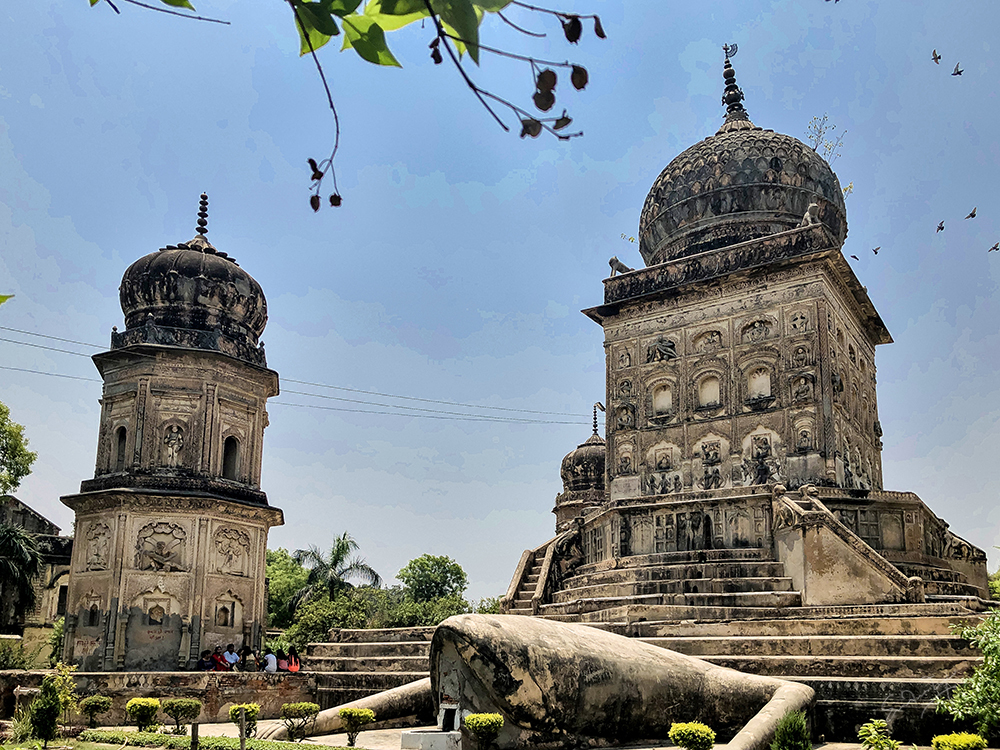
Source and you really should go check out that source. It has a lot more pics of this temple, and a writeup. It is the Manduk Mandir in Lakhimpur Kheri district, UP. Built by the Raja of Oel between 1860 and 1870, dedicated to Shiva, and constructed on the back of what appears to be a giant stone frog. In this whole post I do talk about how there really are no major frog deities or cults in Indic religion. This is an exception to that, though it comes way later than anything I talk about here.

Satapatha Brahmana 

Here’s an interesting Vedic passage referencing frogs, from the Śatapatha Brāhmaṇa (of the Śukla Yajurveda):

19. ‘The widely-shining by name,’–for the gods then called those bricks to them by their names, and in the same way in which they called them, they turned unto them; but the ‘space-fillers’ alone stood with averted faces discharging water, having no names applied to them. They called them by the name ‘the widely-shining,’ and they turned unto them. Hence, each time he has laid down ten bricks, he addresses them with the ‘space-filling 1 (verse)’: he thereby makes them widely-shining (virâg), for the Virâg (metre) consists of ten syllables:–‘wish-milking, never-failing,’–he thereby makes them wish-milking and never-failing.

20. He then draws a frog, a lotus-flower, and a bamboo-shoot across (the central part of the altar). For the gods having now appeased him by the Satarudriya and the water, and having driven out his pain and evil, thereby still further appeased him; and in like manner does this (Sacrificer), now that he has appeased him by the Satarudriya and the water, and driven out his pain and evil, still further appease him thereby. In every direction he draws them: he thus appeases him everywhere.

21. And, again, as to why he draws them across. Now, in the beginning, when the Rishis, the vital airs, made up that Agni 2, they sprinkled him with water: that water dripped off and became the frogs.

22. They (the waters) said to Pragâpati, ‘Whatever moisture 1 we had, has gone down.’ He said, ‘This tree shall know it!’–he shall know (vettu), he shall taste it (sam vettu)–that one, indeed, they mystically call ‘vetasa’ (bamboo), for the gods love the mystic. And because they said, ‘Down (avâk) has gone our moisture (ka),’ they became avâkkâs;–‘avâkkâs,’ they mystically call ‘avakâs (lotuses),’ for the gods love the mystic. These, then, are those three kinds of water, to wit, the frog, the lotus-flower, and the bamboo-shoot: by means of these three kinds of water he appeases him.

23. And, again, why he draws them across it;–when he (Agni, the fire-altar) is built up, he is being born, and he is born for every kind of food; and these are every kind of food, to wit, the frog, the lotus-flower, and the bamboo-shoot, for these, indeed, are animals, water, and trees: with all this food he gratifies him.

Continue reading

Covert Lokayata II: Proto-Materialism in Vedic and Tantric Traditions

(Click to go back to Part I: Doctrines)


lokayatachartfiddled_2Proto-Materialism in early Indian thought:

           Dr. Chattopadhyaya has done a wonderful job presenting the theory that in the earliest days proto-Tantra and proto-Lokayata were a single system, which either originated or was most prevalent in northeast India.[1] His argument rests on a theory of magic as a necessary precondition of religion, similar to the theories of anthropologists such as Andrew Lang and J.G. Frazer: [2] [3]

The theory goes as follows: magic precedes, and then accompanies religion in early human societies. Magic does not necessitate Gods; it is simply an attempt for early humans to manipulate the forces of nature without knowing the actual mechanisms of how nature works. For example, it makes sense for someone ignorant of physics, chemistry and the hydrologic cycle to attempt to generate rain by ritualistically pouring water on the ground and calling to the sky. It is worth experimenting with at the very least. In this sense, magic is a sort of proto-science.

The problem is that when these magic practices are empirically tested over generations, most of them will be found ineffective. Yet still perceiving order and regularity, the population generally will infer that other conscious agents called Gods are in control, and will adapt their magical beliefs and practices into a theistic system. By this process the magic becomes a religion, and “experimental” processes ossify into religious rituals.

The magic underlying Hindu religion is evident in all the early texts. The Rig Veda contain a huge number of passages asking the Gods for purely material things such as cattle, crops, prosperity, or protection from the elements. [4] [5] [6] These are likely magic rituals to induce crops, or protect cattle adapted into a theistic framework. Other passages frequently identify the Gods as a “powerful chief” “foremost amongst men,” “the bravest among all humans” (In the case of the Rbhus, this is made explicit: being mortals they earned immortality”, RV, I.110.4) which is perhaps a clue that these first Gods were in fact God-kings or the deified spirits of ancestors, who were perhaps thought to be able to control physical processes from the next world. The Arthava Veda consists almost entirely of magic techniques, mantras and rituals, not dissimilar from what we find in Tantra. Several early Upanishads also espouse a belief in the magic power of breath manipulation. [7] [8] It seems likely that many of these writings exist because early experimenters with meditation found them to be materially effective in inducing samadhi states. In other words, early meditative practices can be thought of as successful early attempts at quasi-scientific experimentation with the human body and brain. Sinha argues that the materialist trend represented in the Vedas culminated in Lokayata in the 7th century BC. As evidence he cites many examples similar to those above, but also emphasizes the fact the in the Vedic canon, the progenitor of materialist philosophy is the deified guru named Brihaspati.[9] Another word for Lokayata is Brihaspati Darsana.

Brihaspati_graha

According to the Vedas, Brihaspati invented materialism in order to fool the Asuras into incorrect beliefs and practices. Image source: Wikimedia Commons

Continue reading