Frogs occupy a strange and specific position in Indic religious history. They aren’t gods (mostly), they have no cult. But they show up in the Rig Veda chanting like Brahmins, in the Śatapatha Brāhmaṇa as the literal runoff of the primordial Agni, in the Atharvan ritual manuals as a receptacle for fever, in the Mahābhārata as a kingdom with a king and ambassadors, and in both Buddhist and Jain scripture as creatures with minds, with souls, who can take vows, and who can get to heaven. What follows is an attempt to lay out the references, and point out some patterns which emerge.
Satapatha Brahmana
Here’s an interesting Vedic passage referencing frogs, from the Śatapatha Brāhmaṇa (of the Śukla Yajurveda):
19. ‘The widely-shining by name,’–for the gods then called those bricks to them by their names, and in the same way in which they called them, they turned unto them; but the ‘space-fillers’ alone stood with averted faces discharging water, having no names applied to them. They called them by the name ‘the widely-shining,’ and they turned unto them. Hence, each time he has laid down ten bricks, he addresses them with the ‘space-filling 1 (verse)’: he thereby makes them widely-shining (virâg), for the Virâg (metre) consists of ten syllables:–‘wish-milking, never-failing,’–he thereby makes them wish-milking and never-failing.
20. He then draws a frog, a lotus-flower, and a bamboo-shoot across (the central part of the altar). For the gods having now appeased him by the Satarudriya and the water, and having driven out his pain and evil, thereby still further appeased him; and in like manner does this (Sacrificer), now that he has appeased him by the Satarudriya and the water, and driven out his pain and evil, still further appease him thereby. In every direction he draws them: he thus appeases him everywhere.
21. And, again, as to why he draws them across. Now, in the beginning, when the Rishis, the vital airs, made up that Agni 2, they sprinkled him with water: that water dripped off and became the frogs.
22. They (the waters) said to Pragâpati, ‘Whatever moisture 1 we had, has gone down.’ He said, ‘This tree shall know it!’–he shall know (vettu), he shall taste it (sam vettu)–that one, indeed, they mystically call ‘vetasa’ (bamboo), for the gods love the mystic. And because they said, ‘Down (avâk) has gone our moisture (ka),’ they became avâkkâs;–‘avâkkâs,’ they mystically call ‘avakâs (lotuses),’ for the gods love the mystic. These, then, are those three kinds of water, to wit, the frog, the lotus-flower, and the bamboo-shoot: by means of these three kinds of water he appeases him.
23. And, again, why he draws them across it;–when he (Agni, the fire-altar) is built up, he is being born, and he is born for every kind of food; and these are every kind of food, to wit, the frog, the lotus-flower, and the bamboo-shoot, for these, indeed, are animals, water, and trees: with all this food he gratifies him.
24. With the frog, on the part of animals, whence, of animals, the frog is the one affording least subsistence, for he is used up;–with the lotus-flower, on the part of water, whence of the kinds of water (plants), lotus-flowers are those affording least subsistence, for they are used up;–and with the bamboo-shoot, on the part of trees; whence, of trees, the bamboo is the one affording least subsistence, for it is used up.
25. Having tied them to a cane, he, in the first place, draws them eastwards along the right (south) part of the (body of the) altar inside the enclosing-stones,with (Vâg. S. XVII, 4), ‘With the lotus-flower of the ocean we encompass thee, O Agni: be thou bright and propitious unto us!’ that is, ‘With the waters of the ocean we appease thee.’
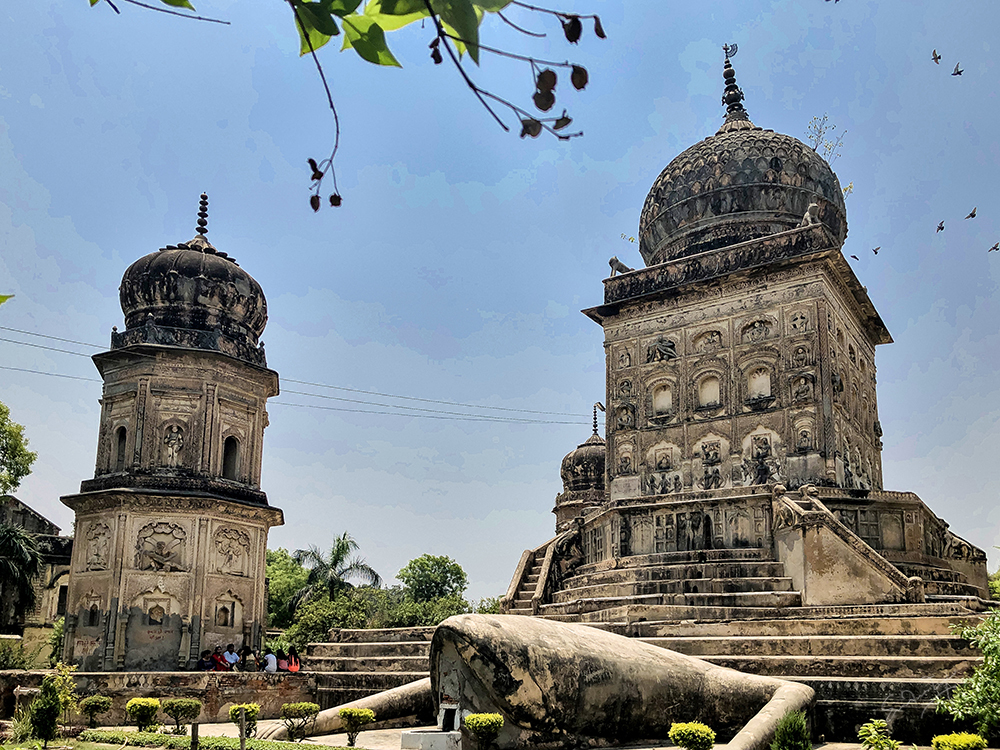
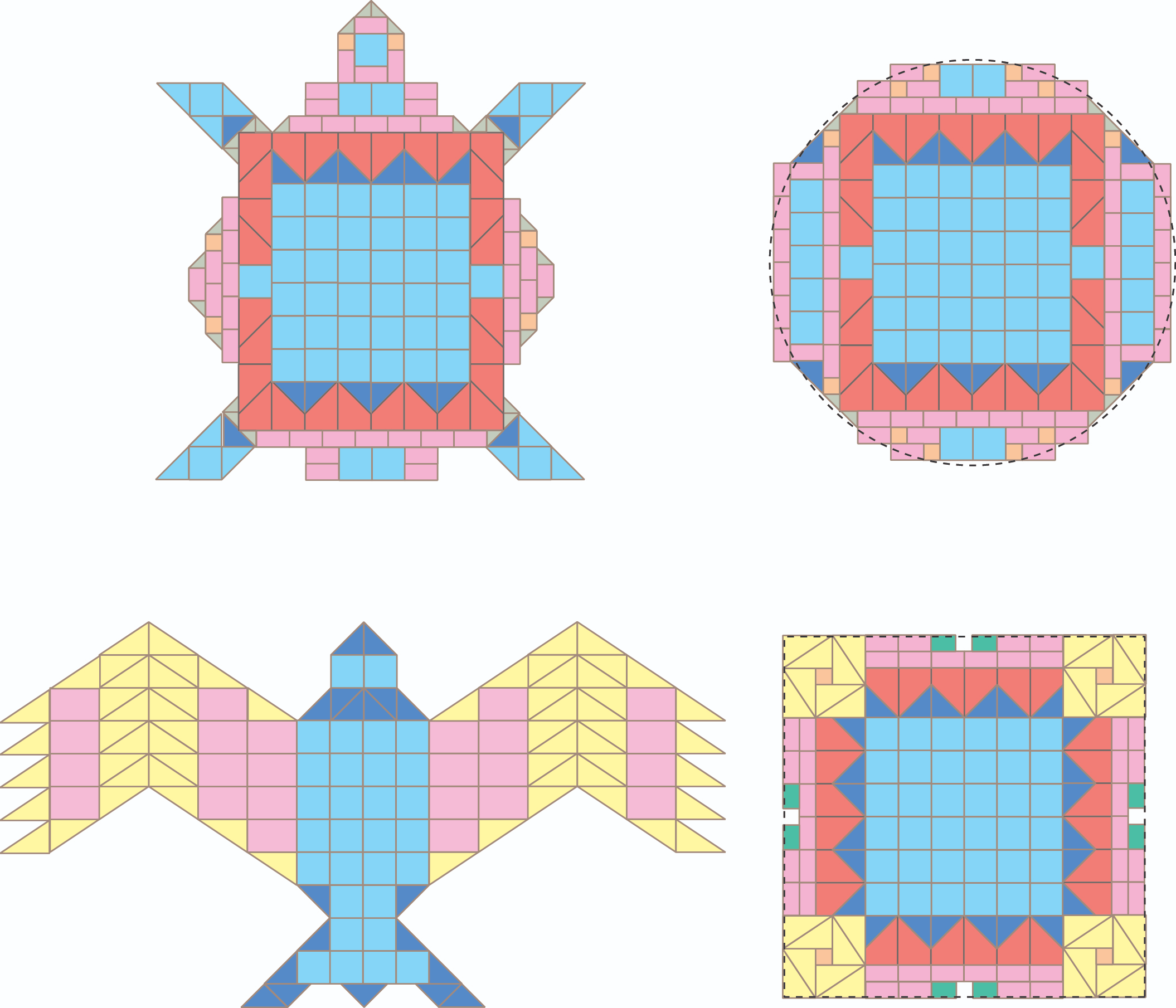
This is a really interesting passage which is doing multiple things at once. This verse starts off once a huge bird shaped sacrificial altar has been constructed. Here we are at the end of the construction, and the laid bricks are being consecrated. It can take up to a year to build this thing. The Soma has yet to be pressed though. There may or may not have been a smaller fire burning within a smaller altar within the giant bird shaped altar, we aren’t totally sure about that. But whether from physical fire, or from a metaphorical / spiritual “heat” which now exists, as a result of Agni coming into instantiation in the form of the completed altar itself. Therefore Agni needs to be “cooled” down, by water, and just generally receive water and water-themed offerings. Also notably, these are all “food” for Agni, but they are the minimal possible most diminutive versions of their respective offerings, possibly so as to merely satiate Agni’s hunger rather than driving it further.
The most interesting thing here to me is that verse 21 explains the actual creation of frogs, as being created from the drops of water which dropped off of the primordial Agni when the Rishis made the sacrifice “in the beginning”. This accords Frogs a very special cosmological position.
There’s a related nearby passage referencing tortoises, for any tortoise or turtle fans out there, but this post is not about turtles:
Atharvaveda
This one is just kind of random. A frog is used in some sort of ritual designed to divert a regularly recurring fever (into the frog):
Atharva-Veda Samhita/Book VII/Hymn 116 (121)
1. Homage to the hot, stirring, pushing, bold one; homage to the cold, former-desire-performing one.
2. He that attacks (abhi-i) every other day, on both [intermediate] days, let him, baffled (avratá), attack this frog.
Or in another translation:
1. Homage (be) to the deliriously hot, the shaking, exciting, impetuous (takman)! Homage to the cold (takman), to him that in the past fulfilled desires!
2. May (the takman) that returns on the morrow, he that returns on two (successive) days, the impious one, pass into this frog!
Takman is essentially an Atharvan only word, which by context we can discern refers to a series of symptoms including chills and fever, shaking, and notably that the illness returns on a regular interval. I’ve seen it referred to simply as a weird fever, but also as specifically malaria (I buy the malaria interpretation, I think).
The next one is a little different and needs more elaboration.
Atharva-Veda Samhita/Book III/Hymn 13
If you just read the verses themselves, there’s no frog reference. The frog comes in from somewhere else. Namely Kauśika. The frog here is used as bait for the river, using these verses.
The Kauśika Sūtra is the ritual manual for the Atharvaveda; it tells you what to physically do while reciting a given hymn. Bloomfield’s 1890 edition is Sanskrit only, with no translation. The usable version is Caland’s Altindisches Zauberritual (1900), a German translation of the important parts with the rite reconstructed from the commentators Dārila and Keśava. Free here. His index lists three frog rites, at Kauśika 32.17, 40.4, and 48.40. Now with the powers of Google Translate and AI, you can translate them into english (which I did to make this post). Of course, do that with caution but its the best I can do with what I’ve got…
40.1–7 is the river guiding / creation ritual. You walk the course you want the river to take, pouring water ahead of yourself and reciting the verses from AV III.13. You plant three plants into the intended riverbed. Then as you go through verse 7: gold is laid down, then a green striped frog bound at the feet with blue and red thread (very specific and rude to the frog); then the frog covered with the avakā plant, then water poured over the whole thing. It finishes with a porridge of black rice cooked in black cow’s milk, offered three times over a reed fire.
Verse 7 is addressed to the waters: this is your heart, this is your calf. So the frog is being staked out as the calf, and the river is supposed to come to it.
32.17 is the fever rite, and it helps tell us how AV VII.116 was actually used. A green striped frog once again is bound by the feet with blue and red thread underneath the bedstead. The patient lies on the bed above it. Water consecrated with the hymn is then poured over the patient. It runs off the patent and drips down onto the frog. The fever is moved from the patient into the frog.
48.40 is a third rite, in the sorcery section, and it uses a hymn nobody talks about. AV VII.95 in the some numberings VII.100 in others:
Atharva-Veda Samhita/Book VII/Hymn 95 (100)
95 (100). A spell against someone.
Notes: Not found in Pāipp. Used by Kāuç. (48. 40) in a witchcraft rite against enemies, with tying up a striped frog with two blue and red strings under the forelegs, putting it in hot water, and poking and squeezing it at each offering (pratyāhuti).
- Up have flown his two dark-brown (çyāvá) quiverers (? vithurá), as two vultures to the sky—up-heater-and-forth-heater, up-heaters of his heart.
- I have made them (dual) rise up, like (two) weary-sitting kine, like (two) growling dogs, like (two) lurking (? ud-av) wolves.
- The (two) on-thrusters, down-thrusters, also together-thrusters: I shut up his urinator who bore [away] from here—[whether] woman [or] man.
So this is really bizarrely written and hard to understand. It appears to be a witchcraft or a black magic rite. Not good! It seems like a binding or impotence curse aimed at an enemy who has carried off someone else. I.e. a man who has carried off (kidnapped? Absconded with?) a woman. Although Whitney notes that Roth read the second half of verse 1 as the heat and passion of love, to be driven out of some woman’s heart. So the exact situation this would be used in is somewhat unclear to me.
Sāyaṇa’s original commentary takes the two “quiverers” to be either the lips or breathing apparatuses of the enemy, who is represented by the frog. The frog is boiled and acts like a voodoo doll, to transmit the spell’s force to the target. Though again, this is all pretty speculative and obscure.
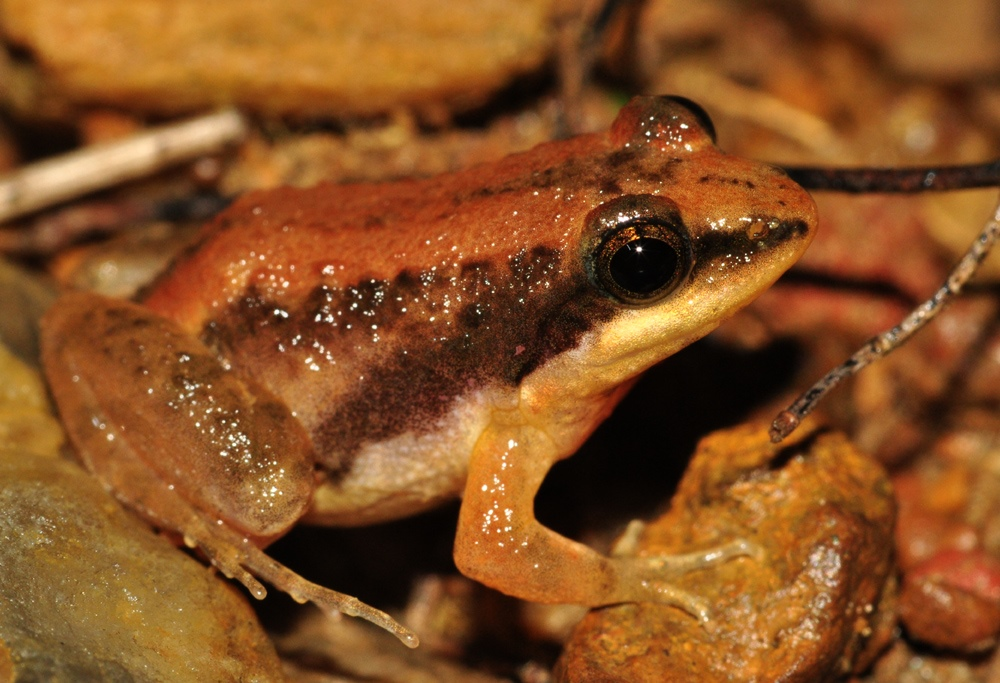
Worth noticing that it’s the same frog every time: green, striped, bound at the feet, blue and red thread. I tried to track down what actual frog species was being used here but there are so many frogs which look like this that it could be anything.
Then there’s the frog reference in the funeral material.
Atharva-Veda Samhita/Book XVIII/Hymn 3
- Let the mist be weal for thee; let the frost fall down [as] weal for thee; O cool one, possessing cool ones; O refreshing one, possessing refreshing ones; mayest thou be with weal a she-frog in the waters; kindly pacify thou this fire.
The core of this verse is also Rig Veda X.16.14, the last verse of the great cremation hymn, so it belongs to the Rig Vedic material below as much as here. Its immediate neighbour, AV XVIII.3.6 = RV X.16.13, commands Agni to extinguish what he has consumed and calls up water plants to grow over the burnt ground. Whitney’s note takes both verses as expiatory for Agni’s disturbing job of burning a corpse. Agni’s fire is not only to be put out, but to be really cleared off with water plants and the frogs that come with them.
Rig Veda
There is a verse to Frogs in the Rig Veda which I’ll quote in its entirety:
1. THEY who lay quiet for a year, the Brahmans who fulfil their vows,
The Frogs have lifted up their voice, the voice Parjanya hath inspired.
2 What time on these, as on a dry skin lying in the pool’s bed, the floods of heaven descended,
The music of the Frogs comes forth in concert like the cows lowing with their calves beside them.
3 When at the coming of the Rains the water has poured upon them as they yearned and thirsted,
One seeks another as he talks and greets him with cries of pleasure as a son his father.
4 Each of these twain receives the other kindly, while they are reveling in the flow of waters,
When the Frog moistened by the rain springs forward, and Green and Spotty both combine their voices.
5 When one of these repeats the other’s language, as he who learns the lesson of the teacher,
Your every limb seems to be growing larger as ye converse with eloquence on the waters.
6 One is Cow-bellow and Goat-bleat the other, one Frog is Green and one of them is Spotty.
They bear one common name, and yet they vary, and, talking, modulate the voice diversely.
7 As Brahmans, sitting round the brimful vessel, talk at the Soma-rite of Atiratra,
So, Frogs, ye gather round the pool to honour this day of all the year, the first of Rain-time.
8 These Brahmans with the Soma juice, performing their year-long rite, have lifted up their voices;
And these Adhvaryus, sweating with their kettles, come forth and show themselves, and none are hidden.
9 They keep the twelve month’s God-appointed order, and never do the men neglect the season.
Soon as the Rain-time in the year returneth, these who were heated kettles gain their freedom.
10 Cow-bellow and Goat-bleat have granted riches, and Green and Spotty have vouchsafed us treasure.
The Frogs who give us cows in hundreds lengthen our lives in this most fertilizing season.
There has been a lot written about this verse. The croaking of the frogs is likened to the chanting of Brahmins. They learn chants from one another, as the Brahmins learn chants from their teachers. As the frogs’ voices come with the rains, so do the Brahmin’s chants come with the gifts of heaven. It could also imply some sort of syncretism between the Aryan clans, and some indigenous group which had some monsoon-rain related belief? Who knows. There is also potentially an against the grain interpretation of this which is a sort of satire of the Brahmins, who croak out their verses ritualistically and unknowingly, like frogs. Perhaps similar to the Udgita of the Dogs verses in Chandogya Upanishad, though I think the case for this interpretation here is much weaker than for the Chanting Dogs.
A Point
In any case, I think we can see the pattern here. Agni is in the body (in the form of fever)? Pacify it / redirect it / dampen it using a frog. Agni in the fire altar is hot? Cool it down with a frog. Agni is residing in the cremation ground? You can clear it out, with frogs. And why do frogs have this special relationship with Agni? Because they were created “in the beginning” when the rishis put water on Agni. I guess this could also go some way to explaining why frogs have such a special relationship with water. They basically have the power to resolve droughts and bring water forth. Maybe because of their special origin, and special connection with both The Waters, and with Agni.
But lets not go overboard with it. There is no exalted supreme Frog Deva. The frog is runoff. It is magical ashy water come to life. It is a tool to navigate a boundary, more than it is a respected being. You need to kill it to do certain rituals.
This is at least one general point, which sort of shows why frogs have a special role. But this schema doesn’t necessarily fully carry all the way through to every reference, usage, or symbolic slot occupied by frogs.
Mandoukya Upanishad
There is also the Mandoukya Upanishad. This translation is from Sri Aurbindo.
The actual text of this doesn’t refer to frogs at all. There are a lot of unfounded speculations linking this text somehow directly to frogs, but I can find no means of validating any of those claims. The fact that it has this name is more likely indicative of the fact that it was written by a Brahmin lineage with that name. Brahmins having random animal names as lineages is not uncommon, and Upaniṣads are usually named after schools and teachers: Aitareya, Kauṣītaki, Taittirīya, Kaṭha, Jaiminīya.
But there still is something sort of unusual here, which may just be a coincidence but I’ll mention it anyway. The Upanishad deals with language and sounds. It is about Om (or Aum), the actual sound, what each component of the sound means and represents in relation to consciousness, etc.
We know of another author by the name of Hrasva Māṇḍūkeya, whose views on the semivowels are discussed here. And a Māṇḍūkeya appears in the neighbouring section as well. This looks like a father and son, and most of the references to their material pertain to phonetics and sound. The Māṇḍūkeyas are also listed as one of the five Rig Vedic śākhās in the Caraṇavyūha, and there’s a Māṇḍūkī Śikṣā, a phonetic treatise, attached to the name.
It’s just kind of suspicious that this family worked on the Veda which contains the frog chanting hymn, the only real substantial action the Vedas ascribe to frogs, and then went on to become a Brahmin lineage concerned with sound and phonetics? There’s no proof of anything here. Just an interesting coincidence.
Mahabharata
This is a strange and fascinating story. The story follows Parikshit, A king of the Ikṣvāku line (so this is not the Pandava Parikshit, just to be clear), hunting far from any human settlement, hears singing beside a forest tank and finds an unbelievably beautiful woman gathering flowers. He asks who she is, and she answers vaguely. She agrees to marry him on one condition: he must never make her look upon water. He agrees, brings her home, and disappears from public life.
His chief minister, unable to reach him, learns of the pledge and builds an artificial forest with a hidden water tank, and tells the king the place has no water. The king finds the tank and tells his wife to bathe. She goes in and does not come out. He has the tank drained and finds a frog at the mouth of a hole.
In fury he orders frogs slaughtered throughout his kingdom, and decrees that anyone seeking an audience must bring a tribute of dead frogs. The frogs appeal to their king, Āyu, who comes before Parikṣit in the garb of an ascetic and pleads for them in verse. When the king refuses, Āyu reveals that the woman was his daughter Suśobhanā, that she has deceived many kings this way, and hands her back. He then curses her: because of her untruthfulness, her children will be disrespectful to Brahmins (These are also his own grandchildren, so that’s weird).
They are. Two generations later the curse kills her eldest son and her grandson at the hands of the sage Vāmadeva, over a borrowed pair of horses. Eventually the (unnamed) wife of one of the other sons resolves the curse by her humble actions.
(Side note, if this Ikṣvāku is an the ancestor of Rama, then that would mean that Rama is partially genetically frog?)
The story has implications outside of anything frog related, but staying on topic: I think its a little interesting that Suśobhanā is first discovered singing, considering the repeated emphasis of frogs as vocal creatures. Also, frogs have a kingdom? And killing them is an atrocity? And they can show up looking like Brahmins, chanting verses? This is all pretty unique material.
The text also flags Āyu’s speech as implicitly quoted material embedded in a different distinctive register. That suggests the existence of some sort of aphorisms against killing frogs, which I suspect were freestanding originally, and incorporated into this story. Though this is speculation.
Dharmashastras
Picking up on that, frogs appear in the Dharmaśāstra penance lists. Manu 11.132 (or 11.131 depending on version) as:
Having killed a cat, a mongoose, a blue jay, a frog, a dog, an iguana, an owl, or a crow, one performs the penance prescribed for killing a Śūdra.
Other Dharmashastras mention punishments for killing frogs as well. Gautama 22.19 puts the frog a step higher, at the Vaiśya killing penance, grouped with mongoose, crow, chameleon, musk-rat, mouse and dog. Baudhāyana 1.19.6 agrees with Manu and puts it at the Śūdra level, alongside flamingo, peacock, Brāhmaṇī duck, crow, owl, musk-rat and dog.
The rationale for all of this was initially a little unclear to me, but I think it comes out of the composition of the lists. Every animal on all three is a “commensal” animal (I learned this category). These are the animals which live around your house, thatch, granary, yard, well, water tank. They are the creatures you are statistically likely to kill by accident or in irritation in the course of ordinary domestic life. Wild animals you don’t encounter. Cattle have their own vastly heavier category. Genuine vermin are often licensed. The frog is on the list because the frog is in your well or your water tank.
It’s still a little low compared to what I’d expect, especially set against the Mahābhārata story above, where mass frog killing is narrated as a royal atrocity grave enough to require a formal settlement. So that’s weird.

Vimāna Vatthu: Maṇḍakadevaputta Sutta
Supreme Buddha:
Dear Deva, you are very mighty with many psychic powers. Your beautiful body shines in all directions. Now you are honoring my feet. Who are you?
Devata:
In my previous life, I was a frog living in a lake. One day I was listening to you preach. At that time a boy who was looking after cows while listening to you preach, accidentally killed me.
For just a brief moment, my mind was very pleased in hearing your voice. But now look at my psychic powers, fame, and beautiful body that I have earned from that very small act of merit.
By the way, this exact verse is often cited as textual Buddhist proof that animals can reach heaven.
This is a common Indian formula. Someone incidentally touches, thinks about, says the name of, etc. a divine figure. This leads to some positive outcome, an advantageous rebirth, liberation, etc. And apparently, a sub-genre of this formula is specifically, this happening to a frog. I found 2 similar stories from the Jain tradition:
Nanda Maṇikāra
Jñātādharmakathāḥ, the sixth Aṅga, chapter 13. The chapter’s own title is Maṇḍukka / Daddura — “The Frog.” Prakrit with Hindi and English translation:
A jeweler in Rājagṛha hears Mahāvīra preach and takes the twelve lay vows, then loses contact with any ascetics and drifts back into wrong belief. Midway through a three day fast one summer, tormented by thirst, he decided to build a public water tank. It is huge. Around it he planted groves, a pillared picture gallery, a public kitchen, a hospital, a barber shop, performances by dancers. Everyone loves it and praises him for it, and he enjoys being praised. Then he falls ill. No doctor can help him, and he dies with his mind fixated on the tank. As a result, he is reborn as a frog in that very tank.
One day he overhears bathers praising Nanda Maṇikāra (i.e. himself in the prior birth) for building the place, thinks where have I heard that before, and recovers the memory of his past life. He concludes that he is meritless and fallen from the teaching, retakes the twelve vows, and adds a lifelong resolve on top: continuous two-day fasts, and on the eating day nothing but the flecks of dead skin rubbed off by bathers and left floating in the water at the pool’s edge. Which is, if you think about it, the only food available to a frog that contains no living thing. I love this idea. A tiny little frog adhering as best he possibly can to the Jain vows.
Then he hears people saying Mahāvīra has arrived, climbs out, and sets off down the highway to go worship him. Śreṇika is riding to the same assembly, and one of his horses steps on the frog and disembowels it. The frog drags itself off the road, salutes, upgrades its vows, renounces food for the remainder of its life, and dies correctly. It is reborn as the god Dardura in the Saudharma heaven.
The Seṭuka Story
A completely different origin story for the same god, from the Āvaśyaka commentary tradition. The version I read is in the anonymous Prakrit Maṇipati-carita, translated in R. Williams, Two Prakrit Versions of the Maṇipati-carita (Royal Asiatic Society, 1959), pp. 161–169
A leper turns up at Mahāvīra’s assembly, worships him, and then smears his feet with pus. Śreṇika decides to have him killed once he’s outside the enclosure. Then Mahāvīra sneezes and the leper says “die.” Śreṇika sneezes: “live.” Abhaya: “either live or die.” Kālaśaukarika: “neither live nor die.” Śreṇika sends men after him with swords, and the leper flies off into the sky. Mahāvīra explains that he isn’t a leper, he’s a god, and tells the story.
Seṭuka was an illiterate brahmin in Kauśāmbī who happened to spot an enemy king fleeing a siege, reported it, and was rewarded with a lifetime allowance of free food from the royal kitchens. He ate himself into leprosy, was quarantined as contagious, and was bullied by his own sons into a hut outside the house. His revenge was to have a goat tied up in a pit, feed it his own leavings and his own discharge until the goat was leprous, and then hand it over to be cooked, thereby infecting the entire family. He then accidentally cured himself by drinking foul stagnant water in the forest while trying to die, came home to gloat about it, admitted to infecting them, and was run out of town.
He ended up in Rājagṛha living off the offerings left at the city gate’s yakṣiṇī shrine (bad). Left alone there one day, he ate all of them, wandered off thirsty with the food stuck in his throat, and died of colic thinking blessed are the creatures whose home is in the water. So he was reborn a frog in a tank, heard people heading off to worship Mahāvīra, remembered everything, set out, and was killed by Śreṇika’s horse on the road.
I don’t like this one as much. I think he gets off way too easy. But in any case these are two completely unrelated lives, two frogs, but the same god at the end of both. Williams thought the frog god probably predates both stories and belongs to older folklore, which seems right to me.
Frog weddings
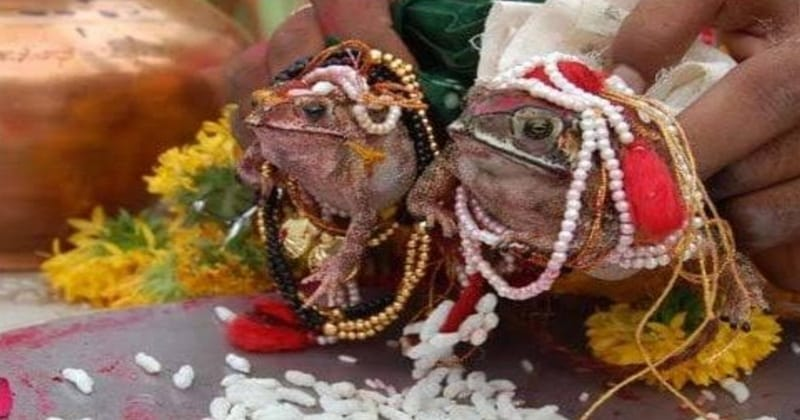
I won’t go into this too far but I’ll leave some links here. These are still performed. Assamese bhekuli biya, banger biye in Tripura, maṇḍūka pariṇaya in the south. A male and female frog (how can they tell?) are bathed, dressed, seated on a platform, joined with red thread, vermilion applied, a pūjā performed, and then released.
- https://en.wikipedia.org/wiki/Bhekuli_Biya
- https://www.sentinelassam.com/north-east-india-news/assam-news/assam-frog-wedding-ritual-conducted-by-villagers-to-desperately-seek-rain
- https://www.deccanherald.com/amp/story/india%2Fkarnataka%2Ffrog-marriage-donkey-procession-please-2072034
- https://www.deccanherald.com/amp/story/india/frog-wedding-held-in-ups-gorakhpur-to-get-rains-1128351.html
Frogs across eastern India, the eastern Himalaya, and mainland Southeast Asia.
The Khamti Ung (Arunachal Pradesh). A pha yantra, a magic cloth fixed above a doorway. Its figures split cleanly between two systems: the Buddha and Phra Sivalee for Buddhism; the two Nāga, the frog man, and the gourd for the indigenous fertility gods.
In one of the villages we visited, there was some kind of pha yantra, called Ung by the Khamti. This is a magic cloth placed on the top part of the door. The pictures on the cloth depict various figures — for example, the Buddha and Phra Sivalee representing Buddhism; the two Nāga, the frog-man and the gourd symbolizing the indigenous beliefs in Gods of Fertility.
— Siraporn Nathalang, “Khamti Shan Buddhism and Culture in Arunachal Pradesh, India,” Contemporary Buddhism 10:1 (2009), p. 116. DOI: 10.1080/14639940902969184
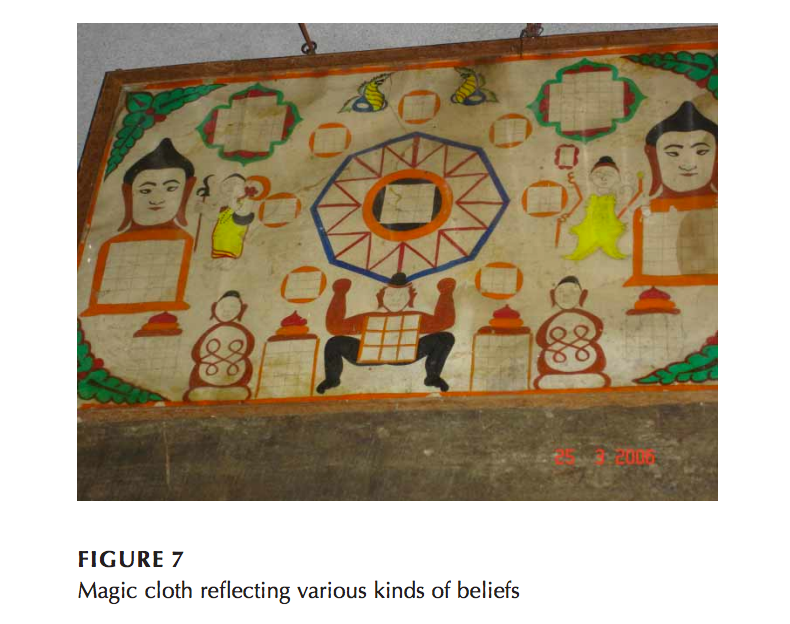
The frog here is explicitly coded as belonging to the older layer, and it is anthropomorphic, like the Cambodian talking frog below and the Mahābhārata’s frog king in ascetic dress.
The Jarai tunic rite (Cambodia). Post Angkorian kings paid tribute to the Jarai every three years and received forest products in return, including rhinoceros horn and wax made into candles held to protect the country from epidemic, flood and war.
It seems that the post-Angkorian kings paid tribute to the tribe every three years, and the Jarai reciprocated with gifts of forest products, including rhinoceros horn and wax. The latter was used to make special candles deemed efficacious in protecting the country from epidemic, flood, and war.
Other gifts from this same source were held to have mysterious powers. A tunic sent by the two kings to the royal court was employed in rain-making rites. After addressing the five protectors of the kingdom, the king sprinkled the tunic with water while four priests squatted, imitating the call of the frog (Hickey 1982b, 139).
— Ian Charles Harris, Cambodian Buddhism: History and Practice (Honolulu: University of Hawaii Press, 2014), p. 50 and p. 255 n.7.
This is the closest analogue to the Vedic material anywhere in this section, though it almost certainly has an independent origin. Frog chanting voices performed by priests literally.
The golden frog of Stung Treng (1925). This sits in a period rife with ecstatic former monk risings against the French:
At the beginning of King Sisowath’s reign (1904–1927), an ex-monk and miracle worker named Ang Snguon adopted the identity of one of the king’s uncles and declared himself the rightful ruler of Cambodia. However, after attacking the French résidence at Thala-Borivet, he and his followers appear to have evaporated into the mountainous Dangrek region to the north of the country and were not heard of again. In 1909 another wizard and ex-monk called Khieu had his rebellion successfully quelled by the French authorities, while Ouch, a messianic “Robin Hood figure” guided by supernatural forces and commanding a force of around a hundred tattooed and amulet-protected followers, caused official concern in early 1913 when he attacked the Apostolic Mission’s plantation at Chhlong, shooting its director, Father David, in the chest (Tully 1996, 133–142).
In 1925 an ex-monk in Stung Treng managed to stir up a rebellious following through the intervention of “a golden frog with a human voice” (Chandler 1996, 148).
— Harris, Cambodian Buddhism, p. 133 and p. 276 n.8.
I find it amusing how little Harris makes of it. Just a footnote, as though a talking frog were an ordinary enough item in the repertoire of Cambodian supernatural authority. It’s just common knowledge!
Dong Son drums. Heger Type I, Red River delta, roughly 600 BCE–300 CE, spread across the mainland and into Indonesia: frogs or toads modelled in the round on the rim of the tympanum. Commonly called rain drums, both for the imagery and for the sound monsoon rain makes when it strikes them.
Karen frog drums. Heger Type III, Burma and northern Thailand, hpa-si, also pam klo’. Frogs stacked atop one another around the tympanum perimeter, symbolising water and rain, described as the most powerful ritual object of the Karen, its sound believed to please the nats of trees and water and to draw rain. Ownership conferred status. (https://sites.duke.edu/dumic/instruments/percussion/south-asia/rain-drum/ and https://wmic.net/burma-karen-pam-klo-frog-drum/)
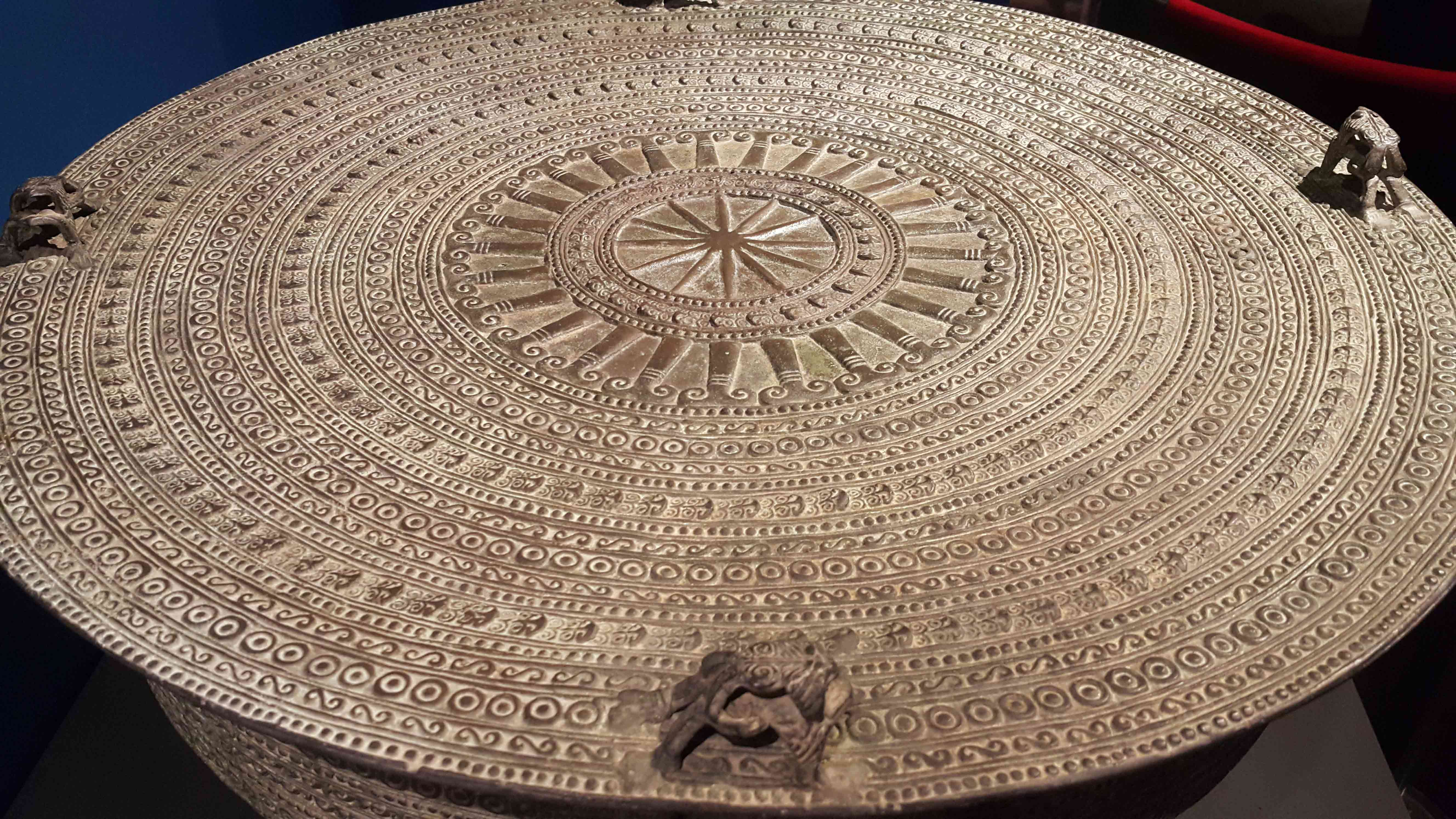
Zhuang frog cult, Guangxi. Frogs are maguai and are held to be children of the thunder god. Around Donglan County the Maguai Festival runs the first thirty days of the first lunar month, praying for weather and harvest; Zhuang bronze drums are themselves rain praying, thunder-god objects. Qin Yisheng argues the festival’s core is a funeral for the dead frog, with rites resembling mourning a human, and reads the squatting figures of the Huashan cliff paintings as the thunder frog god. (http://english.cssn.cn/focus/culture/202301/t20230105_5578303.shtml)
Across this whole zone the frog is strongly associated with rain, and the ability to produce rain. Not usually a god itself, but has some association with a god. Often it is given a human voice or a form, or its voice is accorded special properties.
This is a different system from the Vedic one though. The Vedic frog is theorised is Agni’s runoff, it is the calf of the waters, it has its own symbolic status and stories. The Southeast Asian frog is not seemingly associated with fire in this opposite-relation sense. But they both seem like products of a shared natural world. The monsoon zone. Arrived independently, and probably blended.
🐸🐸🐸🐸🐸🐸🐸🐸🐸🐸


