Frogs

Frogs occupy a strange and specific position in Indic religious history. They aren’t gods (mostly), they have no cult. But they show up in the Rig Veda chanting like Brahmins, in the Śatapatha Brāhmaṇa as the literal runoff of the primordial Agni, in the Atharvan ritual manuals as a receptacle for fever, in the Mahābhārata as a kingdom with a king and ambassadors, and in both Buddhist and Jain scripture as creatures with minds, with souls, who can take vows, and who can get to heaven. What follows is an attempt to lay out the references, and point out some patterns which emerge.
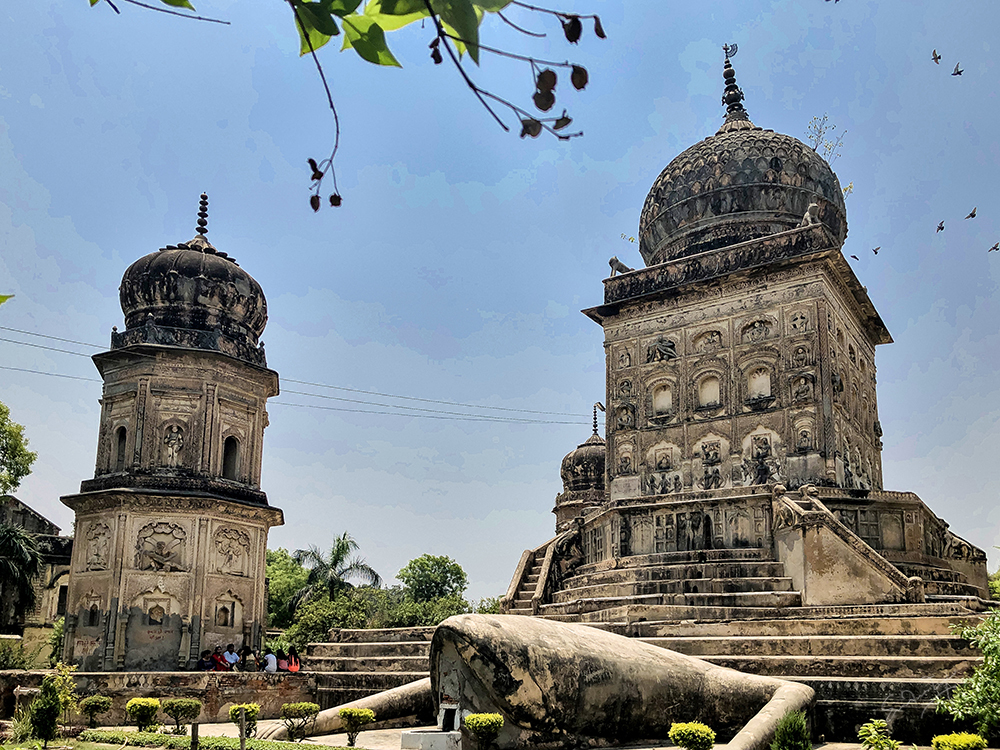
Source and you really should go check out that source. It has a lot more pics of this temple, and a writeup. It is the Manduk Mandir in Lakhimpur Kheri district, UP. Built by the Raja of Oel between 1860 and 1870, dedicated to Shiva, and constructed on the back of what appears to be a giant stone frog. In this whole post I do talk about how there really are no major frog deities or cults in Indic religion. This is an exception to that, though it comes way later than anything I talk about here.

Satapatha Brahmana 

Here’s an interesting Vedic passage referencing frogs, from the Śatapatha Brāhmaṇa (of the Śukla Yajurveda):

19. ‘The widely-shining by name,’–for the gods then called those bricks to them by their names, and in the same way in which they called them, they turned unto them; but the ‘space-fillers’ alone stood with averted faces discharging water, having no names applied to them. They called them by the name ‘the widely-shining,’ and they turned unto them. Hence, each time he has laid down ten bricks, he addresses them with the ‘space-filling 1 (verse)’: he thereby makes them widely-shining (virâg), for the Virâg (metre) consists of ten syllables:–‘wish-milking, never-failing,’–he thereby makes them wish-milking and never-failing.

20. He then draws a frog, a lotus-flower, and a bamboo-shoot across (the central part of the altar). For the gods having now appeased him by the Satarudriya and the water, and having driven out his pain and evil, thereby still further appeased him; and in like manner does this (Sacrificer), now that he has appeased him by the Satarudriya and the water, and driven out his pain and evil, still further appease him thereby. In every direction he draws them: he thus appeases him everywhere.

21. And, again, as to why he draws them across. Now, in the beginning, when the Rishis, the vital airs, made up that Agni 2, they sprinkled him with water: that water dripped off and became the frogs.

22. They (the waters) said to Pragâpati, ‘Whatever moisture 1 we had, has gone down.’ He said, ‘This tree shall know it!’–he shall know (vettu), he shall taste it (sam vettu)–that one, indeed, they mystically call ‘vetasa’ (bamboo), for the gods love the mystic. And because they said, ‘Down (avâk) has gone our moisture (ka),’ they became avâkkâs;–‘avâkkâs,’ they mystically call ‘avakâs (lotuses),’ for the gods love the mystic. These, then, are those three kinds of water, to wit, the frog, the lotus-flower, and the bamboo-shoot: by means of these three kinds of water he appeases him.

23. And, again, why he draws them across it;–when he (Agni, the fire-altar) is built up, he is being born, and he is born for every kind of food; and these are every kind of food, to wit, the frog, the lotus-flower, and the bamboo-shoot, for these, indeed, are animals, water, and trees: with all this food he gratifies him.

Continue reading

Bengal in Global Concept History: Book Response

9780226734941

Purchasable on Amazon

(Skip the first 4 paragraphs if you don’t care about the book, and just want the general narrative of how Bengali culturalism evolved and declined)

For those who are tempted to pick up this book as a primer on Bengali cultureput the book down. This is really a book not on culture, but culuralism, that is to say the social and political ideology that encompasses most of the Bengal Renaissance.

Without reservations I applaud Andrew Sartori for making good on his promise to deliver a explanation of the rise of Bengali culturalism and related thought systems such as Bengali classical liberalism, and to a lesser degree, early Bengali Hindu nationalism, Bengali Muslim nationalism, and Bengali Marxism. His analysis is grounded in the particular local intellectual and economic changes taking place in Bengal. He does not place a disproportionate weight on formal chains of intellectual influence, nor does he fall into the vulgar Marxist trap of economic determinism. Kudos!

However, in the first two chapters of the book, he lays out (in excruciatingly jargon laden and difficult to read prose) several other promises, which are either unelaborated and/or left unproven. I’ll zero in on one illustrative example, which he phrases as a sort of thesis for the whole book: Sartori claims to show that Bengali culturalism is rooted in a fundamental “misrecognition” of the structures of global capitalist society.

This perplexes me, as the main thrust of his work seems to imply the opposite. He broadly argues that culturalism was in essence, a rational permutation of Bengali liberalism, in response to the altered conditions of capitalism in Bengal after the collapse of the native bourgeois class. How could such a natural ideological evolution rest on fundamentally misrecognizing the surrounding economic structures? The following is his basic narrative, with my own interpretive spin put on it of course:

Continue reading

Hariti: Saraswati’s Persian Cousin

Image

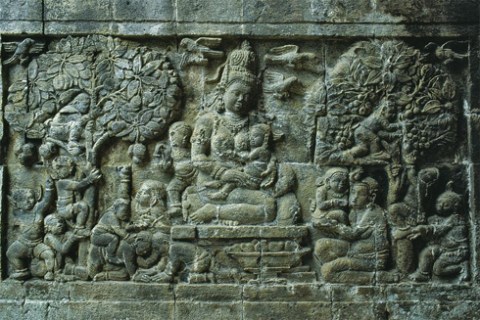
Hariti Relief Panel at Candi Mendut, Java. What is an Iranian deity doing in Java?

Hariti’s history goes way back. I’m taking pre-Vedic. Something like 2500 BC or maybe even earlier. At that time the Iranians and Indo-Aryans were still one people– the Indo-Iranians. They worshipped two classes of deities: Devas and Asuras in Sanskrit, or Daevas and Ahuras in Avestan. After the Indo-Iranians split into two distinct civilizations, Vedic civilization (eventually) adopted the Devas as Gods. The Devas were engaged in a perpetual war with the Asuras, which evolved into evil-ish demigods. Ancient East Iranian civilization did the reverse, deifying the Ahuras and demonizing the Daevas (hence words like demon and devil.) The reasons for this reversal is not entirely clear. I’d like to imagine there was a fascinating, but long lost clerical-political drama involved, but who knows. The mystery of this era is half the appeal.

To reiterate and simplify:

Vedic civilization: Devas- Good guys, Asuras- Bad guys

East Iranian civilization: Ahuras- Good guys, Daevas- Bad guys

Vedic civilization had a Devi, a fertility/mother goddess by the name of Saraswati. She was the personification of a main river of Indo-Iranian culture. Therefore, her Iranian equivalent, Harauhuti, or Hariti was a Daevi, and a fertility/mother demon as odd as that sounds.* Hariti was believed to be a highly prolific mother with hundreds of children. The problem is that she would also steal other peoples children in order to cannibalize them and feed them to her young. In practical worship, she was treated as a demon of pestilence who needed to be appeased, probably because disease was a big killer of children.

That was the story, at least until Buddhists came out of the core Indian subcontinent and into modern Afghanistan. The Buddhists modified the original tale to fit better into the Indian cosmology. For instance, they transformed Hariti from a “Daeva” into a Yaksha (nature spirit), and gave her a backstory involving reincarnation. More importantly, they also extended the original tale to include a fateful interaction with the Buddha.**

Image

Hariti with children.”House of Naradakha,” Found in Shaikhan Dheri, Charsada, Khyber Pakhtunkhwa, Pakistan. This is a Gandharan piece.

According to the Buddhist legends, the childless victims of Hariti beg the Buddha to save them from her cruelty.*** To help, Buddha waits until Hariti leaves the house and traps her smallest child, Priyankara under his alms bowl. When she returns and cannot find her son she weeps and panics. She scours every city, village, mountain, lake, and forest on Earth. She franticly soars into the hells and into the divine realms in search of her son, even going so far as to demand entrance into the abode of Indra. After exhausting all other options, she too appeals to the Buddha for help. He points out that her suffering is minor compared to the combined suffering of all the mothers whose children she has killed. She agrees, and (although seemingly under duress) agrees to protect those who she formerly devoured if only Buddha renders his assistance. At that, Buddha lifts up his alms bowl and Priyankara hops out safe and sound. Thereafter Hariti converts to Buddhism, quits cannibalism, and becomes a spirit of fertility, childbirth, motherhood, and the protection of children (and also of healing in some areas, such as Southeast Asia where the top image is from.)

One might imagine that this was part of a marketing strategy by the Buddhists. Brand localization. Thats speculation. Anyway, from Afghanistan, Hariti was exported back to India, and the rest of the Buddhist world as a mother goddess and defender of children.

But isn’t this an odd progression? First there was an Indo-Iranian fertility deity which split into Saraswati and Harauhuti/Hariti. Two figures which are basically the same, only one is deified and the other is demonized. From the Indian point of view, Harauhuti is a reversal of Saraswati. Fast forward a few thousand years, the Indian Buddhists come back and adopt the reversed Saraswati, and reverse her once again into Hariti, a fertility spirit (Yaksha.) How many times can this character switch sides? Furthermore, now the Hindu and Buddhist pantheons have a duplication problem. They’ve got two deities with the same origin and function. Saraswati and Hariti both fertility deities based on the same river. I know I know, over time their backstories changed enough to be perceptibly different figures, but its still an interesting mythological duplication.

Image

Saraswati with her veena. Over time she lost a lot of her more blatant “motherly” traits and became more associated with knowledge and the arts.

Image

Hariti: Saraswati’s long lost cousin? You can see she’s crawling with children. Clearly the more blatant fertility/mother deity out of the two.


Continue reading