Duryodhana II: Hated by the World

“King Duryodhana was born from a portion of Kali, he of evil mind, of evil counsel, dishonour of the Kurus; he who, being a man of dissension, was hated by the whole world.” -Mahabharata1.16.60-81[1]

“The wise man beholds all beings in the Self and the Self in all beings; for that reason he does not hate anyone.” –Isa Upanishad [2]

Duryodhana_showing_his_army_to_Drona

Duryodhana showing his army to Drona. Image source: Wikimedia

This will be a relatively diffuse postscript to a prior post I made: Playing Duryodhana’s Advocate. Duryodhana is one of the more despised characters in Hindu mythology. This is a shame.

The basic message is this: While Duryodhana is clearly a villain, dismissing him wholly or decrying him as evil incarnate would be to miss the point of the text. The Mahabharata is nuanced, and represents an unresolved tension between on one hand, the counterrevolutionary, materialist, tradition upholding Kshatriya: Duryodhana— and on the other hand, the devotionalist Pandavas, who uphold a newer system of ethics rooted in idealism and theism rather than tradition and pragmatism. Just because modern Hindu discourse is permeated with devotionalism does not mean that always was the case, or always must be the case.

Bhasa’s Depiction of Duryodhana: 

Duryodhana may be hated by the world, but at least one respectable writer offered him a charitable representation as a consistent practitioner of Kshatriya Dharma. In Bhasa’s writings, Duryodhana’s virtues, particularly his earthly “master morality” are more pronounced than it is in the epic. Take the following line from the play Duta-Vakya. This is how Duryodhana responds when asked to return part of his kingdom to the Pandavas:

Continue reading

Imaginary Indias

Today I’m taking a break from the more serious, intellectual type of thing I normally do. How about we explore some alternative histories which have struck my fancy as of late?

I’ll start this off with the most interesting, thorough, and beautiful alternative history scenario I’ve ever read:

Gurkani Alam

mughal_world_map_india5

India in the year 2000. Click map for full size image.

Gurkani Alam (by Tony Jones) is premised on the historical theory that Aurangzeb’s incompetent reign was the turning point in Mughal history, which led to it’s decline and the ease of British domination starting in the 18th century. In some ways, the reality is more surprising than the alternative history. Aurangzeb was not Shah Jahan‘s chosen successor, and had to pull off a protracted coup d’etat in order to become ruler. His older brother, Dara Shikoh (who was killed at the conclusion of the coup), was extremely religiously tolerant. Shikoh had fostered a close relationship with the Sikh community, had 50 Upanishads translated into Persian under the title “Sirr-e-Akbar” or “The Greatest Mysteries” the “Kitab al-maknun” or “hidden book” referred to in the Koran, and authored a title called “Majma-ul-Bahrain” or  “The Confluence of the Two Seas,” which is an exploration of Sufi and Vedanta mysticism. In my estimation, Dara Shikoh’s religious pluralism outshines even that of Akbar.

To contrast, Aurangzeb’s leadership style diverged tremendously from prior rulers, especially in regards to religion. Akbar had established a set of policies designed to foster religious liberalism. He revoked the jizya tax on non-muslims, intermarried with Hindu kingdoms, and appointed non-Muslims to high administrative posts. Either out of the practical realities of ruling a mostly non-muslim population, or out of ideological sympathy, religious liberalism was largely retained by Jahangir  and Shah Jahan (with the notable exception of anti-Sikh violence perpetrated by the former.) These policies were scrapped by Aurangzeb in favor of a cartoonishly evil theocratic Islamic approach. This combined with his overly rapid (and very expensive) conquest, undermined the stability of Mughal rule. The empire became a soft target for Sikh, Pashtun, Rajput, and Bengali revolts, as well as Maratha, and eventually British incursions.

Gurkani Alam departs from reality in 1644, with the unexpected death of Aurangzeb in battle. Dara Shikoh becomes emperor, and continues in the old liberal Mughal tradition, while not weakening the empire with reckless expansion. The more stable outcome is a long lasting Mughal state in the north, in which Sikhism plays a much larger role, an independent South Indian federation, and a subcontinent which, while highly prosperous is not particularly permeable to Western imperialism.

I won’t spoil the details of the universe for you, but check out the concluding world map:

mughal_world_map14

Gurkani Alam in the year 2000. Click the map to see it full size.

Mughalstan

Ok, so when I said “alternate history” at the start of this post I was using the term perhaps too loosely. Mughalstan is more of an alternate future for the Indian subcontinent dreamed up by Islamic nationalists, possibly in cooperation with Dalit nationalists. It is amusing for two reasons:

mughalstan

Most detailed version of Mughalstan map

Continue reading

Hariti: Saraswati’s Persian Cousin

Image

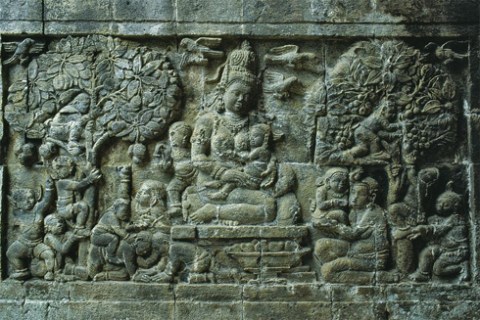
Hariti Relief Panel at Candi Mendut, Java. What is an Iranian deity doing in Java?

Hariti’s history goes way back. I’m taking pre-Vedic. Something like 2500 BC or maybe even earlier. At that time the Iranians and Indo-Aryans were still one people– the Indo-Iranians. They worshipped two classes of deities: Devas and Asuras in Sanskrit, or Daevas and Ahuras in Avestan. After the Indo-Iranians split into two distinct civilizations, Vedic civilization (eventually) adopted the Devas as Gods. The Devas were engaged in a perpetual war with the Asuras, which evolved into evil-ish demigods. Ancient East Iranian civilization did the reverse, deifying the Ahuras and demonizing the Daevas (hence words like demon and devil.) The reasons for this reversal is not entirely clear. I’d like to imagine there was a fascinating, but long lost clerical-political drama involved, but who knows. The mystery of this era is half the appeal.

To reiterate and simplify:

Vedic civilization: Devas- Good guys, Asuras- Bad guys

East Iranian civilization: Ahuras- Good guys, Daevas- Bad guys

Vedic civilization had a Devi, a fertility/mother goddess by the name of Saraswati. She was the personification of a main river of Indo-Iranian culture. Therefore, her Iranian equivalent, Harauhuti, or Hariti was a Daevi, and a fertility/mother demon as odd as that sounds.* Hariti was believed to be a highly prolific mother with hundreds of children. The problem is that she would also steal other peoples children in order to cannibalize them and feed them to her young. In practical worship, she was treated as a demon of pestilence who needed to be appeased, probably because disease was a big killer of children.

That was the story, at least until Buddhists came out of the core Indian subcontinent and into modern Afghanistan. The Buddhists modified the original tale to fit better into the Indian cosmology. For instance, they transformed Hariti from a “Daeva” into a Yaksha (nature spirit), and gave her a backstory involving reincarnation. More importantly, they also extended the original tale to include a fateful interaction with the Buddha.**

Image

Hariti with children.”House of Naradakha,” Found in Shaikhan Dheri, Charsada, Khyber Pakhtunkhwa, Pakistan. This is a Gandharan piece.

According to the Buddhist legends, the childless victims of Hariti beg the Buddha to save them from her cruelty.*** To help, Buddha waits until Hariti leaves the house and traps her smallest child, Priyankara under his alms bowl. When she returns and cannot find her son she weeps and panics. She scours every city, village, mountain, lake, and forest on Earth. She franticly soars into the hells and into the divine realms in search of her son, even going so far as to demand entrance into the abode of Indra. After exhausting all other options, she too appeals to the Buddha for help. He points out that her suffering is minor compared to the combined suffering of all the mothers whose children she has killed. She agrees, and (although seemingly under duress) agrees to protect those who she formerly devoured if only Buddha renders his assistance. At that, Buddha lifts up his alms bowl and Priyankara hops out safe and sound. Thereafter Hariti converts to Buddhism, quits cannibalism, and becomes a spirit of fertility, childbirth, motherhood, and the protection of children (and also of healing in some areas, such as Southeast Asia where the top image is from.)

One might imagine that this was part of a marketing strategy by the Buddhists. Brand localization. Thats speculation. Anyway, from Afghanistan, Hariti was exported back to India, and the rest of the Buddhist world as a mother goddess and defender of children.

But isn’t this an odd progression? First there was an Indo-Iranian fertility deity which split into Saraswati and Harauhuti/Hariti. Two figures which are basically the same, only one is deified and the other is demonized. From the Indian point of view, Harauhuti is a reversal of Saraswati. Fast forward a few thousand years, the Indian Buddhists come back and adopt the reversed Saraswati, and reverse her once again into Hariti, a fertility spirit (Yaksha.) How many times can this character switch sides? Furthermore, now the Hindu and Buddhist pantheons have a duplication problem. They’ve got two deities with the same origin and function. Saraswati and Hariti both fertility deities based on the same river. I know I know, over time their backstories changed enough to be perceptibly different figures, but its still an interesting mythological duplication.

Image

Saraswati with her veena. Over time she lost a lot of her more blatant “motherly” traits and became more associated with knowledge and the arts.

Image

Hariti: Saraswati’s long lost cousin? You can see she’s crawling with children. Clearly the more blatant fertility/mother deity out of the two.


Continue reading

King Akbar’s Mahabharata, or the Razmnama (Book of Wars)

Image

The battle of Duryodhana and Bhima (among others.) From the 1616-1617 edition of the Razmnama. By Kamal.
Image source: Simon Ray


When I was little I used to come across prints (much less elaborate than the above) in my house of scenes from the Mahabharata—with (what I assumed to be) Urdu writing on them! It confused me. I looked it up. Turns out, the Mughal king Akbar had a copy of the Mahabharata translated into Persian. Mystery solved. I put it to the back of my mind until recently when, while trying to plug gaps in my knowledge base I found out that there is actually a pretty interesting cast of characters behind this translation. An impassioned, suicidal artist, and his apollonian counterpart! An Islamic fundamentalist tasked with translating infidel texts! A king motivated by both religious toleration, and the maintenance of his regime’s legitimacy! Plus, it’s a good focal point around which to examine Indian art history which gives me the opportunity to post pretty pictures. Swiftly onwards–

Akbar’s Translation movement:

Akbar has a well-earned reputation as the most tolerant and humane of the Mughal kings. His formal policies towards non-muslims displayed liberality, and the composition of his court bespeaks of inclusivity. The range of art and music he chose to patronize also knew no religious bounds.[1] He even founded “Din-e-Ilahi,” a new syncretistic religion that earned the scorn of the orthodox Muslim intelligentsia.

Given these tolerant and syncretistic tendencies, it is no surprise that Akbar was interested in gaining access to the literature of the non-Persian speaking world. During his reign Akbar’s scholars translated works from Sanskrit, Hindi, Arabic, Greek, and Latin into Persian, and also did substantial translation work from Persian into Hindi. Though the Mahabharata was the center of his project, Akbar also had the Ramayana, the Artha Veda, the Lilavati (a treatise on mathematics), and other Sanskrit texts translated into Persian.[2] [3]

Court historian Mulla Daud writes that Akbar “ordered, that the rational contents of different religions and faiths should be translated in the language of each, and that the rose garden of the traditional aspects of each religion should, as far as possible, be cleared of the thorns of bigotry.” Akbar’s reputation for tolerance has helped this explanation for the translation movement stick.[4] However, one should treat anything explanation given by court historians as suspicious. The Razmnama’s text has an array of strangely translated passages, additions, or omissions which justify this suspicion. While I’m sure that Akbar was genuinely interested in reading Hindu texts and spreading knowledge of them amongst his nobility, I also think that the translation project had distinctly fetishistic and propagandistic elements to it.

But First—

The Translation Process:

Ok, here’s the basic process. First, Sanskrit literate Brahmans (many of whom were converts to Islam) translated a common North Indian variant of the Mahabharata from Sanskrit into Hindi both in text, and verbally. Then the Hindi text was translated into Persian by a staff of Muslim, Persian speaking scholars. [5] Then that raw translation was converted into poetic verse by the project’s head, a scholar named Abu al-Fazl. [6] So obviously “translation” is a very loose term. It’s really more of a retelling.

script

A folio from a 1616 copy of the Razmnama in which: “Asvatthama Fires the Narayana Weapon (Cosmic Fire) at the Pandavas.” You’ll notice I have so far posted no images from the 1587 manuscript which is under discussion here. That is because it sits in the City Palace Museum in Jaipur off limits to all historians. So thanks for nothing City Palace Museum in Jaipur.
Image source: Metropolitan Museum of Art

(If on the main page, hit “Continue Reading” for more [theres pretty pictures ahead {do it}])

Continue reading

Hindu Devas take a (silk) road trip to Japan!

(Note: If you are only interested in pictures, skip past this and hit “Continue Reading”)

This is a historical phenomenon, which entertains and fascinates me to no end. Buddhism had a huge impact on all East Asian cultures, especially on their pantheons of deities. On first glance it might seem odd that a reform movement, which rejected many of the core tenants of Vedic religion would transmit a belief in Vedic deities. This apparent oddity is a misunderstanding of Buddhism’s “atheism,” and a misunderstanding of what a “Deva” actually is. Most forms of Buddhism, while rejecting the concept of all-powerful gods or creator deities, openly accept the existence of powerful supernatural beings. This includes yakshas (nature spirits) rakshasas (demons) gandharvas (celestial musicians) nagas (supernatural snakes) and many other beings, including Devas (deities.) In Hindu and Buddhist cosmology, Devas are created beings that roam around the universe seeking the divine, albeit very powerful ones with much greater spiritual capabilities than humans. Hindu traditions tend to accord Devas much more power and divinity than Buddhism, and worship them as manifestations of The Supreme. In the Buddhist pantheon, the Devas have generally converted to Buddhism and now serve as his protectors, the protectors of his teachings, or as helpers to mortals who are trying to achieve enlightenment.

The reader should be aware that in Japanese mythology and theology the below deities freely interact with native Shinto deities, and deities imported from China. I am isolating the Indian derived deities for the purpose of this bog post, but do not be deluded into thinking that they are unintegrated with the rest of Japanese mythology.

The more popular of these deities are used in non-esoteric Mahayana Buddhism (the bulk of Buddhist sects in Japan.) However, most of these are relatively obscure deities because they are only used in the Shingon school, an esoteric (tantric) school of Buddhism. As such, the bulk of these Devas achieved full development in Japan around the late 700s or early 800s, as a result of the rise in popularity (especially amongst the political elite) of esoteric and Shingon Buddhism.

Last note: There are a lot of different names involved here, because (among other reasons) Sanskrit and Japanese don’t transliterate very well. For deities in which two names are listed, the first is Sanskrit, and the second is Japanese. In cases where, for some reason, I’ve listed many names, I will specify with an (S) or a (J) which language it is from.

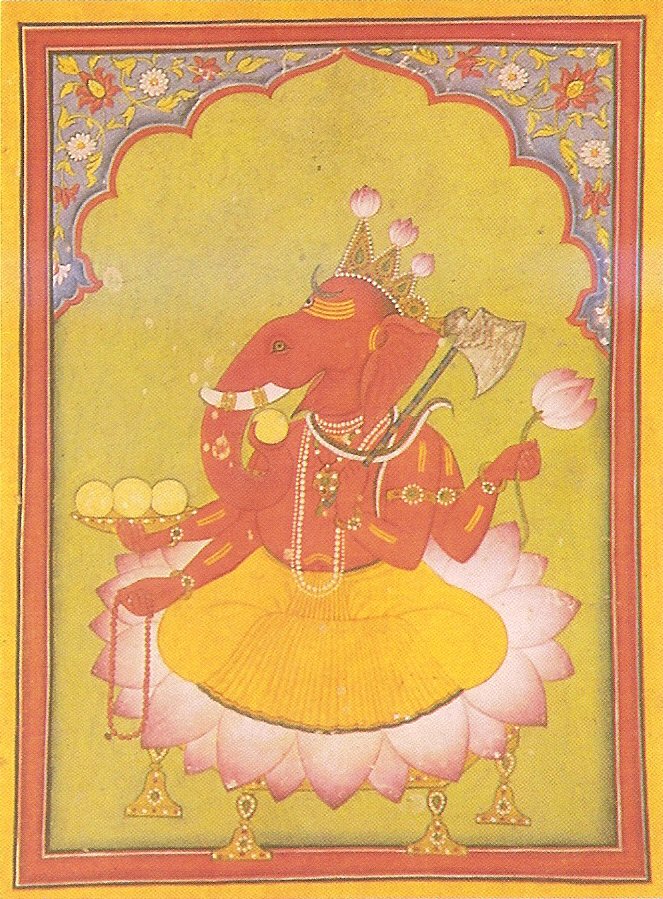
(S) Ganesha/ (S) Vinayaka / (J) Binayaka / (J) Shoten/ (J) Kangiten: Ganesha was one of the first Indian deities to transit to Japan, and as in India, is one of the most popular in both esoteric and non-esoteric sects. Perhaps this is because his association with worldly prosperity has been retained, or perhaps amplified into a general association with pleasure. Thus, actors, geishas, gamblers, restaurant proprietors, etc offer him worship. Shoten has retained the association for removing obstacles, although his ancient association with creating obstacles which has long since been expunged from the Hindu tradition is still mildly active in Japan for reasons which will become clear later.
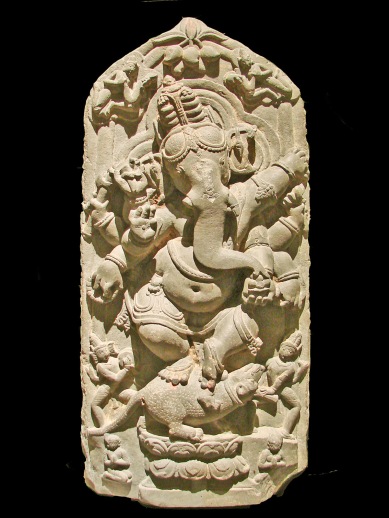
Ganesh (musée d'art indien de Berlin)

Dancing Ganesha from North Bengal, 11th Century. Image From Vikram Kharvi’s blog “My Lord Ganesha”


Kangiten

Contemporary Kankiten Statue from Fukuoka Japan. Image from this Japanese Website

He is often depicted in (implicitly erotic) embrace with another elephant headed figure. In that iconography, his name is “Kangiten” or “Binayaka.” This is an allusion to a Japanese myth about Kangiten’s “evil” origins, wherein his mother, Uma births 1,500 evil children onto her left (collectively called Binayakas), the first of which was Binayaka. On her right side she births 1,500 good children the first of which was Avalokiteśvara/Kannon (the Bodhisatva of compassion) incarnated as Idaten (Skanda or Murugan in India.) In order to win Binayaka over to goodness, Idaten reincarnates as a female binayaka and becomes Kangiten’s wife. The bliss generated by their union turns Kangiten good. According to this myth therefore, the embracing Kangiten figures actually represent Kangiten in sexual union with his brother reincarnated as his wife/sister. There are other myths, which seek to explain this iconography, but all of them involve some sort of gender reversal, usually by means of reincarnation.[1]  There is a huge corpus of Japanese Ganesha myths, which do not exist at all in India, but the initial one just mentioned seems to almost reference Ganesha’s actual historical development in India. Ganesha probably evolved from the set of demons called Vinayakas/Binayakas who were known for erecting obstacles and creating divisions between allies. However, they were easily appeased. So easily appeased in fact that over time they evolved into positive forces, and merged into one deity—Ganesha.[2]

embrace 2

Embracing Kangiten. Image from onmarkproductions.com

However, the aforementioned Japanese myths all seem to be trying to explain the dual figured Kangiten iconography by posing, as it’s mythological basis. The real basis lies elsewhere, probably in the translations of Amoghavajra, a half Indian half Sogdian monk living in China in the early 700s. He was a founder of the “Chen-Yen” school of esoteric Buddhism (a precursor to the Shingon school,) and his translations of various tantric texts entail repeated references to the “dual-bodied Vinayaka” which is an obstacle removing and prosperity inducing deity described as looking exactly like modern embracing Kangiten figures, including the erotic embrace. There was also a pre-Buddhist Japanese deity named N-io, which took the form of a male and female in embrace, which could have contributed, or facilitated the popularity of the embracing Kangiten figures.[3]

Continue reading

Book Review: Chalo Delhi: Writings and Speeches 1943-1945 By Subhash Chandra Bose

Image

You have to be a huge Indian history nerd to enjoy this book. It is a waterfall of primary documents, mainly speeches by or about Subhash Chandra Bose. Its not light reading, and its probably not interesting to you if you aren’t fascinated by it’s highly focused subject matter. Even I had to remember that it is a collection of primary sources so it will get repetitive and boring at times. The pacing goes at life speed, not at the speed of a well-written novel.

Now for some interesting themes I picked up: Bose’s mission required the mobilization of Indians who lived outside of India, namely those living in East Asia. Those living abroad seemed more amenable to Bose’s brand of militant nationalism than those at home. His mission reminded me strongly of the Ghadar movement, and various modern Hindu, Sikh, and Tamil Nationalist organizations which had/have their bases of support located outside of India. Why is it that non-resident South Asians seem consistently more nationalist and militant than those living in India? (Note: I think that Bose and the Ghadars show that the linked article provides an unsatisfactory answer to this question  since this is evidently a very old phenomenon, and therefore is not attributable to the post 1960s growing NRI middle class)

However, unlike the aforementioned communalist or regionalist movements, the Azad Hind government was strongly Pan-South-Asian (Pan-Bharatvarashi? Pan-Gurkani?) and emphatically inclusory. Bose was firmly in favor of a united India (including Lanka) and opposed to regionalism, classism, and caste. I seriously doubt he would have appreciated modern India’s federal structure which leaves states a degree of autonomy.

This inclusory spirit is evident in the composition of his organization. The majority of the soldiers in his army were Muslims, and the variant of Hindustani used by the organization was heavily slanted towards Urdu for their benefit  Tamils played a huge role in his organization as well due to their large numbers in Southeast Asia. Females were also included in combat roles (As a side note, the U.S. just got on board with this 4 days ago.) Sometimes Bose goes a bit overboard in the pursuit of unity. For example: at the time there was a conflict over the Hindustani language. Should the new government use Devanagari script, or Persian script? Or retain both and have the resultant communication problems and social fragmentation? Bose proposed solving this by ditching both Devanagari and Persian script in favor of Latin script, in a conscious imitation of Ataturk. This is why all Indian National Army documents were written using Latin characters.

His passion for a united India informed his stance on Jinnah and the Muslim League. Needless to say, he was virulently and morally opposed to the notion of Pakistan and seems to have disliked Jinnah as a person. This is exacerbated by what Bose identifies as Jinnah’s traitorous behavior at the Simla conference, wherein the Muslim League allegedly promised to support the British war effort in exchange for Pakistan.

Image

There were a few select essays, such as “Gandhiji’s Part in India’s Fight” which are great examples of Bose’s rhetorical abilities and skill in propagandizing. In that essay he repeatedly praises Gandhi’s character and dedication, referring to his many prior interactions with the man while never commenting on his diametrically opposed tactics. He thus associates himself with Gandhi’s personality cult while obfuscating Gandhi’s opposition to the Indian National Army’s violent strategy. Then in the last paragraph he throws in a direct Gandhi quote “If India has the sword today, she will draw the sword”, and asserts that Gandhi was only opposed to revolution in the past because the time wasn’t right. Now the time is right, so Gandhi supporters should listen to their hero and join the Indian National Army. Clever, no?

Another clever rhetorical tool, which I noticed, was his persistent use of vague religious language. He often refers to his revolution as a “holy war”, a vague enough term to fit into the paradigm of Islamic Jihad, Hindu Dharmayudha, or Sikh divine command to defend the innocent.

It is difficult to say how accurate his impressions of World War 2 were, given that these speeches were intended for a general audience and are thus necessarily propagandistic. Morale, to Bose was a more important military factor than technology or supplies. This is probably his most important misapprehension since it governed his military strategy. He continued to claim that Germany’s victory was obvious until the Red Army was almost in Berlin. The same claim was bade about the Japanese until late in the British-American re-conquest of Burma. However, his predictions about the post-war situation were pretty good. Bose understood that it would be an “American Century” and that the Soviets and the west would not remain allies for long. A notable error was his mistaken assumption that Britain would never “voluntarily” India after the war. Perhaps it is unfair to call that a “mistake” though, because Bose’s own actions led to the British losing faith in their Indian troops, a contributing factor to their peaceful withdrawl from the subcontinent.

One can imagine that if Hitler died prior to World War 2, or if Stalin had died while fighting the Nazis their modern reputations would have been greatly improved. In that sense, it is wonderful for Bose that he died before ever achieving a position of power. Those who admire Bose (and I am one of them) might want to acknowledge is that he was basically a Fascist. He repeatedly speaks glowingly National Socialism, Italian Fascism, Communism and the Japanese imperial state. He clearly indicates that he has no problem with dictatorship, and that India’s government should not be a democracy, but would rather be a state blending the positives of Nazi Germany and Stalinist Russia. If Japan had won the war and Bose’s army had actually made it to Delhi, India would probably have been a Fascist dictatorship with Neetaji as the head autocrat. Judging by his harsh actions when his army faced the stressors of defeat and retreat, political freedom would not exist and political purges would have been the norm. Based on his economic theories, starvation would have been widespread as the result of central agricultural planning. For the sake of his legacy, Bose is lucky he died early.

I picked this up in Calcutta for 500 rupees  but its a lot more expensive to buy in the west. Anyway, if this review interested you then you are probably this book’s target audience.