Imaginary Indias

Today I’m taking a break from the more serious, intellectual type of thing I normally do. How about we explore some alternative histories which have struck my fancy as of late?

I’ll start this off with the most interesting, thorough, and beautiful alternative history scenario I’ve ever read:

Gurkani Alam

mughal_world_map_india5

India in the year 2000. Click map for full size image.

Gurkani Alam (by Tony Jones) is premised on the historical theory that Aurangzeb’s incompetent reign was the turning point in Mughal history, which led to it’s decline and the ease of British domination starting in the 18th century. In some ways, the reality is more surprising than the alternative history. Aurangzeb was not Shah Jahan‘s chosen successor, and had to pull off a protracted coup d’etat in order to become ruler. His older brother, Dara Shikoh (who was killed at the conclusion of the coup), was extremely religiously tolerant. Shikoh had fostered a close relationship with the Sikh community, had 50 Upanishads translated into Persian under the title “Sirr-e-Akbar” or “The Greatest Mysteries” the “Kitab al-maknun” or “hidden book” referred to in the Koran, and authored a title called “Majma-ul-Bahrain” or  “The Confluence of the Two Seas,” which is an exploration of Sufi and Vedanta mysticism. In my estimation, Dara Shikoh’s religious pluralism outshines even that of Akbar.

To contrast, Aurangzeb’s leadership style diverged tremendously from prior rulers, especially in regards to religion. Akbar had established a set of policies designed to foster religious liberalism. He revoked the jizya tax on non-muslims, intermarried with Hindu kingdoms, and appointed non-Muslims to high administrative posts. Either out of the practical realities of ruling a mostly non-muslim population, or out of ideological sympathy, religious liberalism was largely retained by Jahangir  and Shah Jahan (with the notable exception of anti-Sikh violence perpetrated by the former.) These policies were scrapped by Aurangzeb in favor of a cartoonishly evil theocratic Islamic approach. This combined with his overly rapid (and very expensive) conquest, undermined the stability of Mughal rule. The empire became a soft target for Sikh, Pashtun, Rajput, and Bengali revolts, as well as Maratha, and eventually British incursions.

Gurkani Alam departs from reality in 1644, with the unexpected death of Aurangzeb in battle. Dara Shikoh becomes emperor, and continues in the old liberal Mughal tradition, while not weakening the empire with reckless expansion. The more stable outcome is a long lasting Mughal state in the north, in which Sikhism plays a much larger role, an independent South Indian federation, and a subcontinent which, while highly prosperous is not particularly permeable to Western imperialism.

I won’t spoil the details of the universe for you, but check out the concluding world map:

mughal_world_map14

Gurkani Alam in the year 2000. Click the map to see it full size.

Mughalstan

Ok, so when I said “alternate history” at the start of this post I was using the term perhaps too loosely. Mughalstan is more of an alternate future for the Indian subcontinent dreamed up by Islamic nationalists, possibly in cooperation with Dalit nationalists. It is amusing for two reasons:

mughalstan

Most detailed version of Mughalstan map

Continue reading

Book Review (sort of): Poems from the Sanskrit

John_Brough_Poems_Sanskrit_400x615

Cover art from the Ellora Caves Image source: Buddhism for Vampires

“If learned critics publicly deride

My verse, well, let them. Not for them I wrought.

One day a man shall live to share my thought:

For time is endless and the world is wide”

Bhavabhuti (p.53)

I try not to saturate this blog with book reviews, but I have a justification in this case. This review contains a slew of poems excerpted from the book, which are worth far more than my review, and my numerous tangents. Hit “Continue Reading” and scroll down if you just want to check those out.

John Brough’s Poems from the Sanskrit[1], despite its confusing title, (what is the Sanskrit?) is actually a very charming anthology of translated Sanskrit poems, ranging from roughly the 4th through 10th centuries.

The translator’s stated purpose for compiling this volume is as follows: Normally Sanskrit translators, focus on conveying meaning at the expense of poetic or prosaic style. But since Sanskrit and English grammars differ considerably, meaning focused translations often come across as stilted or sometimes even unreadable. Sanskrit Poetry compounds this problem, because so much literary value is vested in the poetic structure itself (for example: The number, repetition, and weight of syllables.) This is a translation, which attempts to give equal weight to content and form.

Translating a Sanskrit poem into rhyming verse while keeping the original meaning intact is an impossible task. Perhaps a more accurate description of the book is: an anthology of English poems by John Brough, based closely on Sanskrit classics. The purist in me recoils at this prospect, but if you read the poems without wringing your hands over the potential “butchery” of the originals which preceded them, they are actually quite lovely  on their own merits. And based on the samples and explanation of his technique as delineated in the introduction, I have faith that he has amply conveyed at least the basic sense of each work.

I’ll jump right into the verses and save my criticisms for the end:

I noticed some recurring patterns:

Anti-Clericalism: There are a surprising amount of poems in here, which are highly critical of priests, focusing on their hypocrisy foolishness, or exploitation. These are mostly secular poems, but it still surprises me. One has to wonder: Were they talking about priests generally or about “the bad ones” i.e. the heterodox ones?

“‘So, friar, I see you have a taste for meat.’

‘Not that it’s any good without some wine.’

‘You like wine too, then?’ ‘Better when I dine

With pretty harlots.’ ‘Surely such girls eat

No end of money?’ ‘Well, I steal, you see,

Or win at dice.’ ‘A thief and gambler too?’

‘Why, certainly. What else is there to do?

Aren’t you aware I’m vowed to poverty?'”

Sudraka (p.79)

5427541032_9391f01560_b

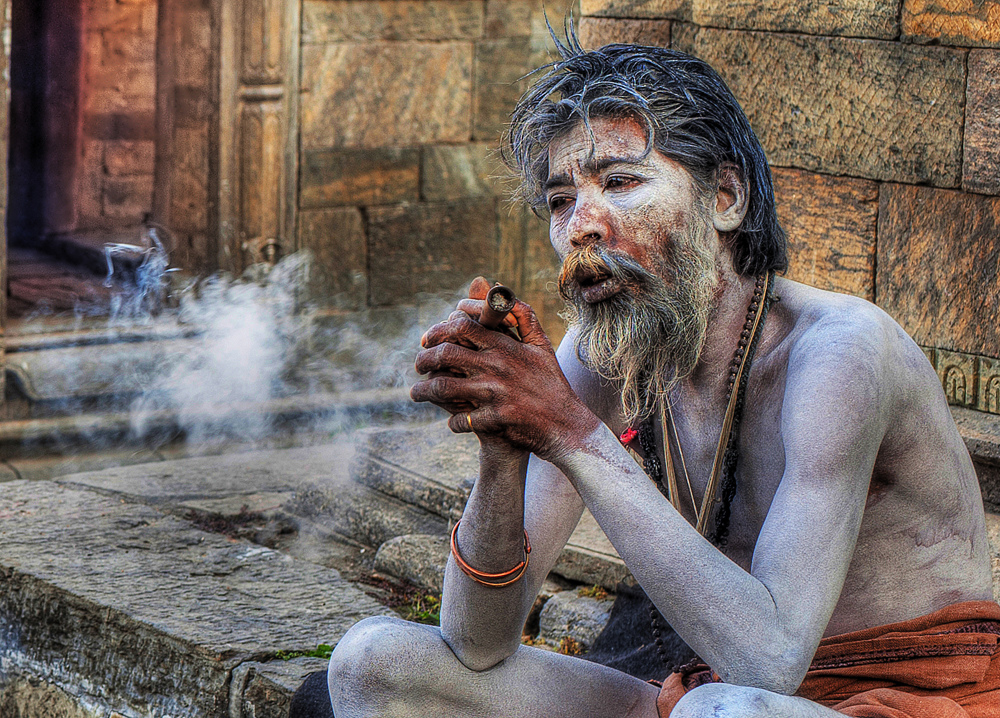
According to Doniger’s theory (described later), this is a “friar” similar to the one who is under critique in the above poem. He is an Aghori, a sect which split off from the Kapalika. The Kapalika would have been contemporaneous to Sudraka. Image source: Flickr

Continue reading

Freudian Psychoanalysis vs. Intellectual Rigor in Hinduism Studies.

image9

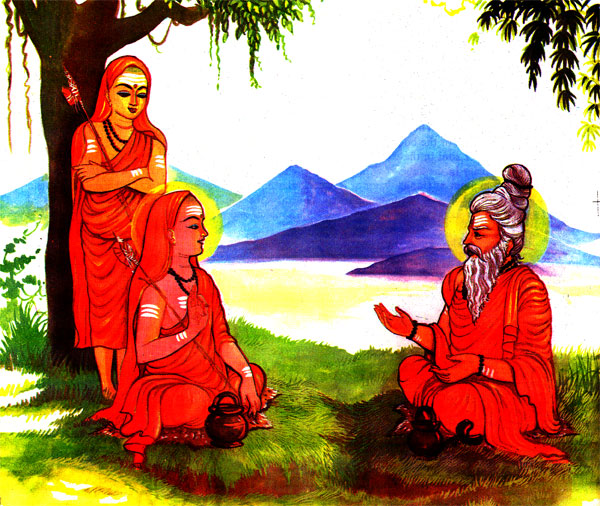
Disagreement and debate have long been central to the Hindu tradition. Here is a mythological debate between Adi Shankara and Vyasa. Image source: Ramakrishna Mission

“The cure for pride is knowledge. Who can cure

A man who’s proud of knowledge?

If the patient should be allergic to amrita,

The prognosis

Is hopeless.”

-Shudraka[1]

Those who have read this website since its inception know that it forwards a heterodox perspective on Hinduism. I empathize with Duryodhana and Karna in the Mahabharata, and find Arjuna’s despondency to be justified. I’m deeply interested in naastik sects, and I’m critical of the conception of female morality, which has been derived from characters like Sita or Draupadi. This is the critique of a highly skeptical student of the Hindu philosophical tradition, not the kneejerk response of a blindly reverent follower.

Furthermore, I don’t wholly dismiss the work of the scholars I’m about to criticize. I’ve enjoyed her books immensely, and strongly respect the her work, including her work on eroticism, gender, and sexuality. I’ve cited some of their work in the past, and will continue to do so. Western scholars viewing Hinduism from the outside provide a useful perspective. To quote Wendy Doniger’s introduction to her and Brian Smith’s translation of The Laws of Manu:

“Of course, both native commentators and Orientalists have axes to grind, but they are different sorts of axes. The axe of the native commentator is honed on a more intense and immediate personal involvement in the text, which may give him good reasons to want to misread the text, to fudge or misinterpret the verse in order to make it mean what he thinks it ought to mean. The axe of the Orientalist, on the other hand is sharpened by cultural ignorance and lack of empathy, or a distancing from the culture, which may lead to misinterpretations of a very different sort.”[2]

Doniger isn’t a fool. She understands that she and her colleagues are coming from outside the tradition they study, and that this will necessarily introduce certain biases into their scholarship.

Knowing that she acknowledges her bias, at least in theory, lets proceed to the criticism:

The Short Version:

The main problem, which many Hindus have with her work, and the work of her students, lies in their Freudian approach. Critics from within and outside of Hinduism posit that this methodology is not intellectually rigorous, and often is used to formulate bizarre and (to a believer) denigrating portrayals of the religion based on untested psychological speculation. Defenders of the Freudian approach are quick to point out that though Freudian theories have gone out of style in clinical and research psychology, it is still very much in vogue in philosophy, literary criticism, and religious studies. This is a fair point, but simply being widespread doesn’t make the Freudian lens more tenable in this author’s opinion.

More damningly, the scholars under critique have committed a number of factual inaccuracies and translation errors throughout their work. Worst of all, since these scholars predominate in the field (critics sometimes use the word “cartel”) the peer review process is relatively ineffective in ensuring that their errors don’t make it into journals and published books. This isn’t necessarily a criticism of the scholars in question, but is a natural product of in-group bias. As a result, such works are praised, awarded, and often become bestsellers. These portrayals, which are of a decidedly outsider’s perspective form the basis of Hinduism as portrayed in encyclopedias, textbooks, and museums.

However, the response of Doniger and her Freudian colleagues to their critics is what truly raises the moralistic ire of the diasporic Hindu community. When critics such as Rajiv Malhotra (who normally poses unnecessarily aggressive critiques, but in this particular instance his polemic pointed to specific arguments and facts), Swami Tyagananda, S.N. Balagangadhara, or those at the Hindu American Foundation or the number of other Hindu groups point out their denigrating portrayals and inaccuracies, these critics are not treated as “insiders” giving a critique which might be biased in the opposite direction, but which nevertheless deserves consideration and response. They are instead accused of religious radicalism, bigotry, and a proclivity towards violence. It is true that there are Hindu groups and individuals which are guilty of these things, and much of the loudest and most rhetorically effective criticism of Doniger and the Freudians have been from this camp (The funny thing is that while Doniger is normally the centerpiece of this controversy, her writing is mild compared to that of her colleagues.) It is a disaster for free speech that her recent book was pulled from the Indian market at their behest, and their participation in the 2009 California textbook case pushed moderate Hindu voices into the background. But this does not justify conflating criticisms of erroneous content, with criticisms of a more emotional character, nor does it justify tarring their opponents as quasi-terroristic or Hindutva radicals. By this conflation, substantive Hindu critiques aren’t even recognized as legitimate much less addressed.

Let me substantiate this narrative:

Continue reading

Book Review: Uniqueness of Carvaka Philosophy in Traditional Indian Thought

cover

I’m working on a much longer article (or series of articles?) on the Charvaka/Lokayata school of philosophy, so I’m going through a whole bunch of texts on the school of thought. As this one was the shortest, I finished it first. And as I’ve got a lazy saturday afternoon on my hands, I’ll supply a short review:

Uniqueness of Carvaka Philosophy in Traditional Indian Thought (or a version thereof) served as Dr. Bupender Heera’s doctoral thesis, so my expectations were high in terms of the scholarly quality of this text. However, in total I was disappointed. Heera doesn’t offer a new perspective on Charvaka, nor does he synthesize some of the existing viewpoints on Charvaka into one coherent conception, nor does he give a clearly worded survey of the range of theories about Charvaka. I also found that many of the book’s claims were either sourced in a frustratingly obscure way (i.e. a claim would appear [for example] five times throughout the book, but would cited only the third time.) To a degree this is unavoidable, but it made the text problematic as a research material.

Heera has clearly read the work of Debiprasad Chattopadhyaya, but he neither utilizes his theories on Charvaka effectively, nor addresses/refutes them. Chattopadhyaya for example, points out that most of the academic viewpoints on Charvaka rely on the description of the philosophy which is contained in Madhvacharya’s  Sarva-shastrartha-sangraha as a basis point, without properly accounting for Madhvacharya’s Vedantic bias, and his argumentative style. Madhvacharya tried to “put himself in the shoes” of his opponent, which often led to him presenting a position derived from a blending of his own Vedantic beliefs, and the beliefs of the opposing system, as purely the beliefs of the opposing system. Thus, the uncritical reliance on Madhvacharya’s account renders most accounts of Charvaka distorted. Heera’s work largely falls prey to Chattopadhyaya’s criticism, without attempting to justify why Madhvacharya’s account should be accepted as basically consistent with actual Charvaka practice. For instance, on page 42, where Heera claims that Charvakas quote scripture in defense of their position, a claim which derives completely from Madhvacharya’s account, and without which would seem bizarre.

The book also contains numerous internal contradictions. Heera cannot seem to decide whether or not the Charvakas had any actual texts, or not. On page 17 he says:

“Many of the above mentioned works, by way of quoting with acknowledgements the sutras, karikas and slokas pertaining to materialistic school of thought, hold out a clear and unmistakable evidence to the effect that there once existed, at least, two works of the Indian materialists, namely the Barhaspatya-Sutra and the Lokayata Sastra. Patanjali’s Mahabhasya on Panini’s Vyakarana refers to another work of the Lokayata School — One by Bhaguri, a commentary on Lokayata Sastra.” (Emphasis added, and my apologies for omitting diacritical marks)

Then on page 87 he says:

They did not have any literature of their own like other philosophical systems of traditional Indian thought. The Carvakas did not have any sutra… In the case of Carvaka we hear only Barhaspatya Sutra which is very small in size besides being a sutra of questionable authenticity.” (Emphasis added, and my apologies for omitting diacritical marks)

Another notable inconsistency is the notion that Charvaka was simultaneously the first Indian philosophical system, and a reactionary movement against asceticism and brahmanism. In an attempt to simply describe Charvaka without getting entangled in any of the historical controversies, he presents a wide range of mutually exclusive scholarly opinions (without prefacing them as such) and thus creates an incoherent view of the Charvaka philosophy.

There are also certain confusions which occur towards the end of the book, such as the idea that the Charvakas were not condemning the Vedas, but were rather condemning their distortion and misinterpretation by brahmanas. This claim is not sourced*, leading me to believe that this is Heera’s opinion or personal interpretation. Thus, I theorize that Heera in an attempt to be charitable, has formed a conception of Charvaka which is strongly influenced by his own spiritual outlook. In this sense, he is himself a modern Madhvacharya.

Nevertheless, the book was useful to me. It has pointed out many source texts to explore further, and summarized some of the beliefs of prior scholars. There are also useful analogies made to Western philosophers like Hume, Locke, Lucretius, and Strato of Lampsacus. For this, I humbly thank Dr. Heera, though I have trouble recommending his volume. Nevertheless, it is the briefest (and cheapest) exposition of Charvaka philosophy on the market, so if you can tolerate some inconsistencies and are aware that this perspective may be distorted, why not check it out? Even with all the problems, it still provides a more nuanced and complete perspective on Charvaka than any online resource I’ve discovered so far.

*Interestingly, this claim is only remotely plausible if Madhvacharya’s account is discarded. The Sarva-shastrartha-sangraha (page 10) contains an alleged quotation from Brihaspati in which the authors of the Vedas are explicitly condemned as “fools, knaves, and demons.”

Hariti: Saraswati’s Persian Cousin

Image

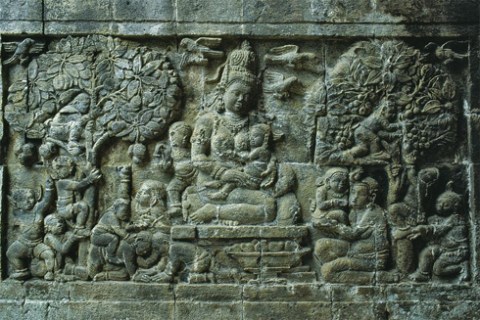
Hariti Relief Panel at Candi Mendut, Java. What is an Iranian deity doing in Java?

Hariti’s history goes way back. I’m taking pre-Vedic. Something like 2500 BC or maybe even earlier. At that time the Iranians and Indo-Aryans were still one people– the Indo-Iranians. They worshipped two classes of deities: Devas and Asuras in Sanskrit, or Daevas and Ahuras in Avestan. After the Indo-Iranians split into two distinct civilizations, Vedic civilization (eventually) adopted the Devas as Gods. The Devas were engaged in a perpetual war with the Asuras, which evolved into evil-ish demigods. Ancient East Iranian civilization did the reverse, deifying the Ahuras and demonizing the Daevas (hence words like demon and devil.) The reasons for this reversal is not entirely clear. I’d like to imagine there was a fascinating, but long lost clerical-political drama involved, but who knows. The mystery of this era is half the appeal.

To reiterate and simplify:

Vedic civilization: Devas- Good guys, Asuras- Bad guys

East Iranian civilization: Ahuras- Good guys, Daevas- Bad guys

Vedic civilization had a Devi, a fertility/mother goddess by the name of Saraswati. She was the personification of a main river of Indo-Iranian culture. Therefore, her Iranian equivalent, Harauhuti, or Hariti was a Daevi, and a fertility/mother demon as odd as that sounds.* Hariti was believed to be a highly prolific mother with hundreds of children. The problem is that she would also steal other peoples children in order to cannibalize them and feed them to her young. In practical worship, she was treated as a demon of pestilence who needed to be appeased, probably because disease was a big killer of children.

That was the story, at least until Buddhists came out of the core Indian subcontinent and into modern Afghanistan. The Buddhists modified the original tale to fit better into the Indian cosmology. For instance, they transformed Hariti from a “Daeva” into a Yaksha (nature spirit), and gave her a backstory involving reincarnation. More importantly, they also extended the original tale to include a fateful interaction with the Buddha.**

Image

Hariti with children.”House of Naradakha,” Found in Shaikhan Dheri, Charsada, Khyber Pakhtunkhwa, Pakistan. This is a Gandharan piece.

According to the Buddhist legends, the childless victims of Hariti beg the Buddha to save them from her cruelty.*** To help, Buddha waits until Hariti leaves the house and traps her smallest child, Priyankara under his alms bowl. When she returns and cannot find her son she weeps and panics. She scours every city, village, mountain, lake, and forest on Earth. She franticly soars into the hells and into the divine realms in search of her son, even going so far as to demand entrance into the abode of Indra. After exhausting all other options, she too appeals to the Buddha for help. He points out that her suffering is minor compared to the combined suffering of all the mothers whose children she has killed. She agrees, and (although seemingly under duress) agrees to protect those who she formerly devoured if only Buddha renders his assistance. At that, Buddha lifts up his alms bowl and Priyankara hops out safe and sound. Thereafter Hariti converts to Buddhism, quits cannibalism, and becomes a spirit of fertility, childbirth, motherhood, and the protection of children (and also of healing in some areas, such as Southeast Asia where the top image is from.)

One might imagine that this was part of a marketing strategy by the Buddhists. Brand localization. Thats speculation. Anyway, from Afghanistan, Hariti was exported back to India, and the rest of the Buddhist world as a mother goddess and defender of children.

But isn’t this an odd progression? First there was an Indo-Iranian fertility deity which split into Saraswati and Harauhuti/Hariti. Two figures which are basically the same, only one is deified and the other is demonized. From the Indian point of view, Harauhuti is a reversal of Saraswati. Fast forward a few thousand years, the Indian Buddhists come back and adopt the reversed Saraswati, and reverse her once again into Hariti, a fertility spirit (Yaksha.) How many times can this character switch sides? Furthermore, now the Hindu and Buddhist pantheons have a duplication problem. They’ve got two deities with the same origin and function. Saraswati and Hariti both fertility deities based on the same river. I know I know, over time their backstories changed enough to be perceptibly different figures, but its still an interesting mythological duplication.

Image

Saraswati with her veena. Over time she lost a lot of her more blatant “motherly” traits and became more associated with knowledge and the arts.

Image

Hariti: Saraswati’s long lost cousin? You can see she’s crawling with children. Clearly the more blatant fertility/mother deity out of the two.


Continue reading

The Modern Renunciate in Guru Dutt’s “Pyaasa” (Thirsty)

“Birth is misery, old age is misery, and so are disease and death, and indeed, nothing but misery is Samsâra, in which men suffer distress.” -Mahavira, Uttarâdhyayana Sûtra, Lecture 19, Verse 15.

***SPOILER ALERT***

pyaasa-poster2

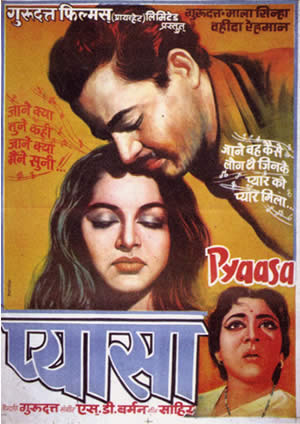
Pyaasa movie poster depicting Vijay (Guru Dutt), and Gulabo (Waheeda Rahman) in the center, with Meena (Mala Sinha) looking on unhappily from the corner. This poster kind of gives away the resolution of the love triangle.
Image source: A Tangle of Wires

The full movie is available on Youtube. Click the “CC” button to access english subtitles.

This is probably the most beautiful, poetic Bollywood film I’ve seen to date. For what it’s worth, Time Magazine agrees that its one of the best in cinema history. You really should watch it for yourself, but not everyone has a 2 hour commitment. So just read the post instead. You’ll feel like you saw it. A small amount of summarization will be necessary here, but go to Wikipedia for an actual summary.

If you are just interested in the songs, they’ll be collected at the bottom of the article with the relevant Youtube links. (you might have to hit “Continue reading” if coming from the main page.)

something stirred 0 14 20

Waheeda Rahman being seductive in the song “Jaane Kya Tune Kahi.” 0:14:20

The Saraswati River Runs Dry: The film starts out in a metaphorical Garden of Eden, (or should I say the Saraswati valley?) Vijay is peacefully lying down next to a river in a garden, and celebrating the beauty of nature in song. Within the first minute, the dreamy mood is broken by an anonymous leather shoe, which crushes a bumblebee before Vijay’s eyes and shatters the serenity of the moment. As he exits the park, Vijay ends the song by rhetorically asking: “What little have I to add to this splendor, save a few tears, a few sighs?”

The Eden analogy is apt because never again (on the story’s timeline) does Vijay sing a happy word of poetry. From here on, the story inhabits the corrupt material realm of fallen man.

Socialist Pipe Dreams:

“We have to build the noble mansion of free India where all her children may dwell. The appointed day has come – the day appointed by destiny – and India stands forth again, after long slumber and struggle, awake, vital, free and independent.”  –Jawaharlal Nehru in the speech “A Tryst with Destiny,” August 14 1947

Impressive words right? Nehru didn’t invent this ideology. He just voiced the common sentiment that independence would harken a glorious new era for India, in which political and social structures would be overhauled for the better. Here is another such quote by a prominent independence leader you might have heard of:

“In the democracy which I have envisaged, a democracy established by non-violence, there will be equal freedom for all. Everybody will be his own master. It is to join a struggle for such democracy that I invite you today. Once you realize this you will forget the differences between the Hindus and Muslims, and think of yourselves as Indians only, engaged in the common struggle for independence.” -Mahatma Gandhi from “Quit India speech”, August 8, 1942

The fantasy of being on the cusp of a socialist golden age was integral to Congress’ nationalist ideology. When the heralded changes never materialized, disenchantment, despair, and even disgust at the state of Indian society percolated through the national zeitgeist.

Instead of this idealized future, Vijay finds a society in which one’s humanity is only worth what it can fetch on the market. A society permeated by hypocrisy and cruelty,  These characteristics are not unique to India, but given the high hopes engendered by the independence movement it is easy to see why some Indians reacted with such despair in the 1950s. Nehruvian socialism failed in its promises, and left India to bear the unmitigated social and economic realities of developing world capitalism. I would argue to the contrary that it intensified the harshness of those realities, but that is a topic fit for another post.

guru-dutt-actor

Actor and Director of the film, Guru Dutt looking angsty.
Despite the watermark, Image source: Bollywood Updates

Vijay the Marxist: More than anything else, the film’s social critique centers around the dehumanizing conditions of Indian “capitalism.” I refer to “capitalism” in quotations here, because India by no means had capitalism, as defenders of the free market would define it. Nehruvian socialism was quite distant from laissez-faire. The definition used here is the Marxist one: an economic system in which the means of production is owned privately rather than collectively, In the Marxist paradigm, capitalism leads to things like commodification, commodity fetishism, and the alienation of workers from their labor (and therefore from their humanity.)

(If on the main page, hit “Continue reading” to read more)

Continue reading

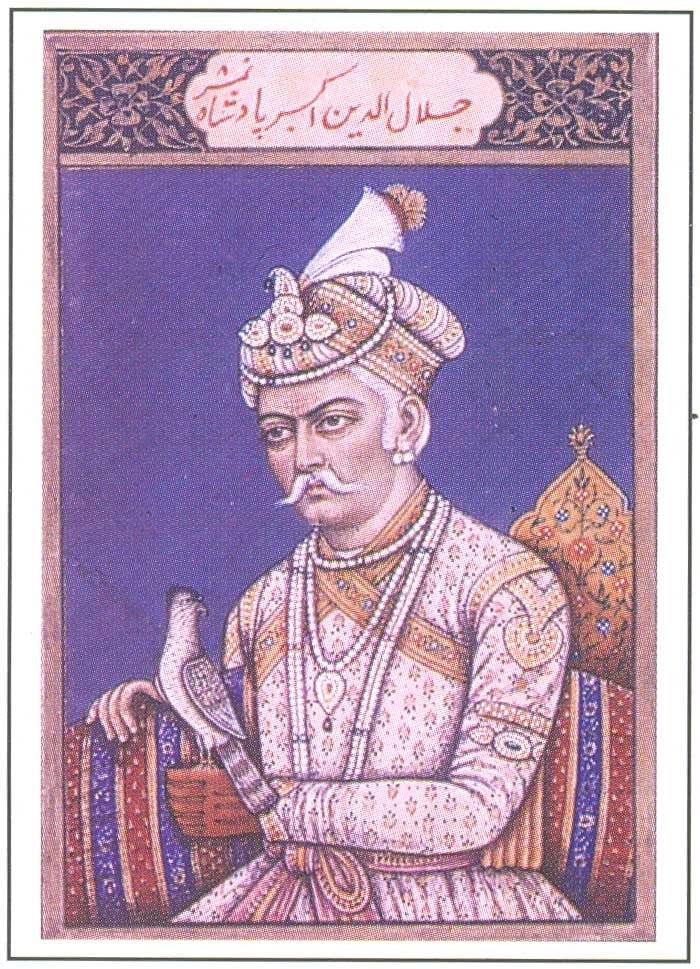
Akbar Commits Gestapo-style Medical Crimes in an Attempt at Rationalism

Mughal_Akbar

Mughal Emperor Akbar, (1556-1605). Religious reformer and commissioner of freaky experiments. From the National Museum, New Delhi
Image source Indiapicks.com

When I was reading Abd al-Qadir Bada’uni’s history, Tarikh-i-Badauni in preparation for the last post I made on the Razmnamat, I came across an interesting passage. According to Bada’uni, Akbar carried out an early psychological experiment in infant seclusion. The history reads:

“In this year (989 H. [1581 AD]), in order to verify the circumstances of the case (of the man who heard without ears), an order was issued that several suckling infants should he kept in a secluded place far from habitations, where they should not hear a word spoken. Well-disciplined nurses were to be placed over them, who were to refrain from giving them any instruction in speaking, so as to test the accuracy of the tradition which says, “Every one that is born is born with an inclination to religion,” by ascertaining what religion and sect these infants would incline to, and above all what creed they would repeat. To carry out this order, about twenty sucklings were taken from their mothers for a consideration in money, and were placed in an empty house, which got the name of Dumb-house. After three or four years the children all came out dumb, excepting some who died there – thus justifying the name which had been given to the house.”[1]

Italics added

I had thought that for sure that Akbar must have been the first one to carry this experiment out. But I was wrong. It turns out that Psamtik I, Pharoh of Egypt from 664 – 610 BC, Frederick II, Emperor of the Holy Roman Empire from 1212–122, and James IV, King of Scotland from 1488–1513, all had beat Akbar to the punch. However, they all did it to discover which language the infants would end up speaking.[2] Akbar seems to be the first to try this with religion in mind.

I truly admire the impetus for this experiment. He was trying to obtain some scientific data on the question of religion by removing the variables of societal and parental conditioning from the equation. How modern! Of course, if he was trying to find the “true” religion via this method, the whole premise of the experiment is flawed. Even if people are inclined towards a particular religion without any conditioning, it doesn’t necessarily mean that religion is true. However, Bada’uni never hints at such a bold hypothesis, so I must conclude that it was a very admirable attempt at rational discovery of truths normally reserved for “revelation.”

Less admirable is the fact that he was willing to sacrifice the lives of several children to get the answer. This is the kind of thing I’d expect to read in a Nazi or Japanese war crimes tribunal. Were the deleterious effects of social and maternal deprivation not known at the time? Or did the concept of child abuse simply not exist in the 14-1500s, as Psychohistorians like Lloyd deMause would argue?

I’ve looked for other references to this experiment for more information, but have only been able to find this one reference from Bada’uni’s history. I’m also unclear on what he means by “the man who heard without ears.” I’m assuming it means a man who believed a religion without ever having heard it due to deafness. If anyone has more information put it in the comments please.

Hit “Continue reading” for citations.


(Edit: It has become evident that I need to substantiate the title of this piece. Sure, the Gestapo didn’t actually conduct the experiments, but neither did Akbar. The Gestapo was just Himmler’s tool for pressuring the medical establishment and doing logistical tasks like picking out the subjects. Regardless, a better title would have replaced “Gestapo” with “SS” or “Himmler.” I’ll probably change that at a later point in time)

[1] Elliot, Sir Henry Miers. The history of India, as Told by its own Historians: The Muhammadan period, Hertford, 1873, Page 533

[2] Sułek, Antoni. The Experiment of Psammetichus: Fact, Fiction, and Model to Follow, Journal of the History of Ideas, No. 4 (Oct. – Dec., 1989), pp. 645-651

King Akbar’s Mahabharata, or the Razmnama (Book of Wars)

Image

The battle of Duryodhana and Bhima (among others.) From the 1616-1617 edition of the Razmnama. By Kamal.
Image source: Simon Ray


When I was little I used to come across prints (much less elaborate than the above) in my house of scenes from the Mahabharata—with (what I assumed to be) Urdu writing on them! It confused me. I looked it up. Turns out, the Mughal king Akbar had a copy of the Mahabharata translated into Persian. Mystery solved. I put it to the back of my mind until recently when, while trying to plug gaps in my knowledge base I found out that there is actually a pretty interesting cast of characters behind this translation. An impassioned, suicidal artist, and his apollonian counterpart! An Islamic fundamentalist tasked with translating infidel texts! A king motivated by both religious toleration, and the maintenance of his regime’s legitimacy! Plus, it’s a good focal point around which to examine Indian art history which gives me the opportunity to post pretty pictures. Swiftly onwards–

Akbar’s Translation movement:

Akbar has a well-earned reputation as the most tolerant and humane of the Mughal kings. His formal policies towards non-muslims displayed liberality, and the composition of his court bespeaks of inclusivity. The range of art and music he chose to patronize also knew no religious bounds.[1] He even founded “Din-e-Ilahi,” a new syncretistic religion that earned the scorn of the orthodox Muslim intelligentsia.

Given these tolerant and syncretistic tendencies, it is no surprise that Akbar was interested in gaining access to the literature of the non-Persian speaking world. During his reign Akbar’s scholars translated works from Sanskrit, Hindi, Arabic, Greek, and Latin into Persian, and also did substantial translation work from Persian into Hindi. Though the Mahabharata was the center of his project, Akbar also had the Ramayana, the Artha Veda, the Lilavati (a treatise on mathematics), and other Sanskrit texts translated into Persian.[2] [3]

Court historian Mulla Daud writes that Akbar “ordered, that the rational contents of different religions and faiths should be translated in the language of each, and that the rose garden of the traditional aspects of each religion should, as far as possible, be cleared of the thorns of bigotry.” Akbar’s reputation for tolerance has helped this explanation for the translation movement stick.[4] However, one should treat anything explanation given by court historians as suspicious. The Razmnama’s text has an array of strangely translated passages, additions, or omissions which justify this suspicion. While I’m sure that Akbar was genuinely interested in reading Hindu texts and spreading knowledge of them amongst his nobility, I also think that the translation project had distinctly fetishistic and propagandistic elements to it.

But First—

The Translation Process:

Ok, here’s the basic process. First, Sanskrit literate Brahmans (many of whom were converts to Islam) translated a common North Indian variant of the Mahabharata from Sanskrit into Hindi both in text, and verbally. Then the Hindi text was translated into Persian by a staff of Muslim, Persian speaking scholars. [5] Then that raw translation was converted into poetic verse by the project’s head, a scholar named Abu al-Fazl. [6] So obviously “translation” is a very loose term. It’s really more of a retelling.

script

A folio from a 1616 copy of the Razmnama in which: “Asvatthama Fires the Narayana Weapon (Cosmic Fire) at the Pandavas.” You’ll notice I have so far posted no images from the 1587 manuscript which is under discussion here. That is because it sits in the City Palace Museum in Jaipur off limits to all historians. So thanks for nothing City Palace Museum in Jaipur.
Image source: Metropolitan Museum of Art

(If on the main page, hit “Continue Reading” for more [theres pretty pictures ahead {do it}])

Continue reading

Bengali Feminist Sci-Fi: “Sultana’s Dream” by Roquia Hussain

Read the story here! If you find the writing style basic, keep in mind, English was her fifth language. Its an early work of both feminist literature, and science fiction. I think you’ll dig it.

sul·tan·a [suhl-tan-uh, –tah-nuh] (noun)

1: : a woman who is a member of a sultan’s family; especially: a sultan’s wife

2: a mistress or concubine of a sultan

3: A female sultan *
OLYMPUS DIGITAL CAMERA

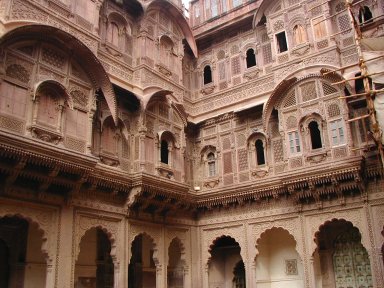
The Zenana Deodi in the middle of Mehrangarh Fort in Jodhpur, Rajastan. This is from a royal palace, probably a tad fancier than the one Hussein grew up in.

A note on Purdah: This is a customary practice wherein the sexes are segregated, and the movement of females is restricted to the zenana (women’s quarters) with varying levels of severity. It also usually entails the requirement that females wear a veil, burka, or some sort of covering. This was much more common in the middle and upper class than amongst the poor populations. While it exists in both Hindu and Muslim communities, Muslim implementations are generally more severe, hence Roquia Hussain’s consciousness raising efforts.

Some Context: Muslim Reformers in the Bengal Renaissance: Calcutta 1900! A bustling early-capitalist metropolis with a sizable bourgeois and upper class– A set of intellectuals economically capable and philosophically inspired to paint, write, make scientific discoveries, and root out social evils. What a time it must have been to be alive!

Like many intellectual renaissances, the Bengal Renaissance (broadly defined: 1775-1941) entailed a simultaneous harkening back to ancient traditions for inspiration, and a striving for modernity and progress.** Hindu writers and thinkers revived and reinterpreted Vedic/Upanishadic philosophy to combat social ills like sati and the caste system. Likewise, The Muslim intelligentsia entered a period of self-criticism wherein writers looked back to their Islamic traditions for sources of inspiration, and reinterpreted their texts to liberalize Islam from the inside.

Muslim scholars like Maulana Abul Kalam Azad, advocated a “continuous, unending process of ijtihad, interpretation according to the needs of the time” and wanted to overhaul the Madrassa system of education much like Hussain. The author Kazi Abdul Wadud honored the prophet Muhammed as “a great man,” and referred to him as “just like a light-house to the sea-voyagers” but denied that he was “omniscient” or an “all-pervading master.” Wazed Ali, another writer, observed “the arrival of a religious reformer is essential for the removal of filth from life. In Muslim society too, high-souled men appeared from time to time to remove filth and to make religion time-befitting.”[1] Do you see a pattern emerging?

Now examine some quotations from our author, Roquia Hussain:

“where there is much rigidity in religion, there is greater oppression of women”[2]

“[religious books are] nothing but man made code.” [3]

“Allah has made no distinction in the general life of male and female — both are equally bound to seek food, drink, sleep and pray five times a day.” [4]

“The opponents of female education say that women will become wanton and unruly. Fie! They call themselves Muslims and yet go against the basic tenet of Islam, which gives women an equal right to education. If men are not led astray once educated, why should women?”[5]   ***

A similar pattern emerges, no?
persp2

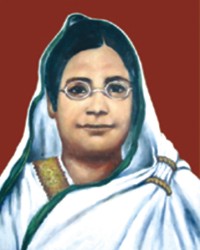
Rokheya Shekhawat Hossein

Well-intentioned scholars sometimes try to contextualize Roquia Hussain within the global or even western feminist movement.[6] I’ve seen her described as a “contemporary” of Mary Shelley, Charlotte Perkins Gilman, and Virginia Woolf. But in what sense are they really contemporaries? Hussain’s consciousness raising mission was extremely focused on her own social group. She wrote almost entirely in Bengali, and about issues, like purdah and zenana, which impacted the Bengali Muslim upper and middle classes. [7]  Her writing was not intended for, nor read by western audiences.

Hussain may have been more radical than most of her Bengali cohorts, but she was still firmly within their social and literary milieu. The pattern evident in her nonfiction writing is the same pattern we see in other Bengal Renaissance socio-religious reformers: Liberal reforms are advocated through appeals to religious tradition, while simultaneously jettisoning negative or outdated aspects of that same tradition. Hussein’s religion played a major role in her approach to feminism. Her opposition to purdah coexisted with her encouragement of wearing the veil.[8] She believed in universal education– so long as it was segregated by sex and included Arabic in the curriculum.[9] She believed in the earthly origins of scripture, and also in the God of the Qur’an. This is the tension, or confluence (depending on your perspective) at the heart the Bengal Renaissance.

———————————————————————————

Other cool Bengal Renaissance stuff:

Complete works of Rabindranath Tagore (Bengali) (English)

Paintings by Abanindranath Tagore 

“The Renaissance in India” a collection of essays by Sri Aurobindo (PDF direct download link)

The Torch Bearers of Indian Renissance,” a PDF detailing the scientific and mathematical minds of the Bengal Renissance

———————————————————————————

* This is an amalgam definition from Webster.com, dictionary.com, and wiktionary. I include it because I think the name “Sultana” was intentionally chosen for it’s mixed connotations in regards to female power.

** Call me a colonial apologist but… I think its obvious that the British colonial presence in Calcutta (the capital of British India until 1911) had something to do with the Bengal renaissance, particularly in the contribution of what we conceive of as “modern” ideas. Calcutta received contact with the west earlier, and more strongly than the rest of India. British critiques of Indian culture, classical liberalism, the English language, British artistic and literary techniques, the presence of a colonial hegemon to inspire nationalist reactions– These are all indispensable parts of the Bengal Renaissance. This is not to credit the Bengal Renaissance to the British, but merely to observe that cultural diffusion and the importation of new ideas from abroad has a destabilizing, influence on existing cultural patterns.

*** In Sultana’s Dream when Sultana asks Sister Sara about religion, this is what occurs “What is your religion, may I ask?’

‘Our religion is based on Love and Truth. It is our religious duty to love one another and to be absolutely truthful.”

Hit “Continue Reading” for citations.

Continue reading

Hindu Devas take a (silk) road trip to Japan!

(Note: If you are only interested in pictures, skip past this and hit “Continue Reading”)

This is a historical phenomenon, which entertains and fascinates me to no end. Buddhism had a huge impact on all East Asian cultures, especially on their pantheons of deities. On first glance it might seem odd that a reform movement, which rejected many of the core tenants of Vedic religion would transmit a belief in Vedic deities. This apparent oddity is a misunderstanding of Buddhism’s “atheism,” and a misunderstanding of what a “Deva” actually is. Most forms of Buddhism, while rejecting the concept of all-powerful gods or creator deities, openly accept the existence of powerful supernatural beings. This includes yakshas (nature spirits) rakshasas (demons) gandharvas (celestial musicians) nagas (supernatural snakes) and many other beings, including Devas (deities.) In Hindu and Buddhist cosmology, Devas are created beings that roam around the universe seeking the divine, albeit very powerful ones with much greater spiritual capabilities than humans. Hindu traditions tend to accord Devas much more power and divinity than Buddhism, and worship them as manifestations of The Supreme. In the Buddhist pantheon, the Devas have generally converted to Buddhism and now serve as his protectors, the protectors of his teachings, or as helpers to mortals who are trying to achieve enlightenment.

The reader should be aware that in Japanese mythology and theology the below deities freely interact with native Shinto deities, and deities imported from China. I am isolating the Indian derived deities for the purpose of this bog post, but do not be deluded into thinking that they are unintegrated with the rest of Japanese mythology.

The more popular of these deities are used in non-esoteric Mahayana Buddhism (the bulk of Buddhist sects in Japan.) However, most of these are relatively obscure deities because they are only used in the Shingon school, an esoteric (tantric) school of Buddhism. As such, the bulk of these Devas achieved full development in Japan around the late 700s or early 800s, as a result of the rise in popularity (especially amongst the political elite) of esoteric and Shingon Buddhism.

Last note: There are a lot of different names involved here, because (among other reasons) Sanskrit and Japanese don’t transliterate very well. For deities in which two names are listed, the first is Sanskrit, and the second is Japanese. In cases where, for some reason, I’ve listed many names, I will specify with an (S) or a (J) which language it is from.

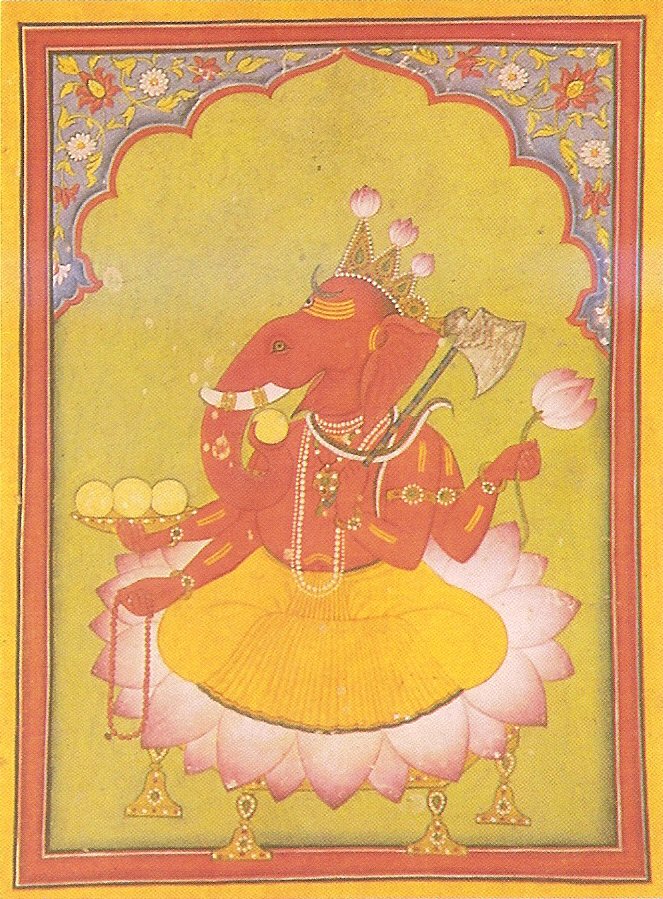
(S) Ganesha/ (S) Vinayaka / (J) Binayaka / (J) Shoten/ (J) Kangiten: Ganesha was one of the first Indian deities to transit to Japan, and as in India, is one of the most popular in both esoteric and non-esoteric sects. Perhaps this is because his association with worldly prosperity has been retained, or perhaps amplified into a general association with pleasure. Thus, actors, geishas, gamblers, restaurant proprietors, etc offer him worship. Shoten has retained the association for removing obstacles, although his ancient association with creating obstacles which has long since been expunged from the Hindu tradition is still mildly active in Japan for reasons which will become clear later.

Ganesh (musée d'art indien de Berlin)

Dancing Ganesha from North Bengal, 11th Century. Image From Vikram Kharvi’s blog “My Lord Ganesha”


Kangiten

Contemporary Kankiten Statue from Fukuoka Japan. Image from this Japanese Website

He is often depicted in (implicitly erotic) embrace with another elephant headed figure. In that iconography, his name is “Kangiten” or “Binayaka.” This is an allusion to a Japanese myth about Kangiten’s “evil” origins, wherein his mother, Uma births 1,500 evil children onto her left (collectively called Binayakas), the first of which was Binayaka. On her right side she births 1,500 good children the first of which was Avalokiteśvara/Kannon (the Bodhisatva of compassion) incarnated as Idaten (Skanda or Murugan in India.) In order to win Binayaka over to goodness, Idaten reincarnates as a female binayaka and becomes Kangiten’s wife. The bliss generated by their union turns Kangiten good. According to this myth therefore, the embracing Kangiten figures actually represent Kangiten in sexual union with his brother reincarnated as his wife/sister. There are other myths, which seek to explain this iconography, but all of them involve some sort of gender reversal, usually by means of reincarnation.[1]  There is a huge corpus of Japanese Ganesha myths, which do not exist at all in India, but the initial one just mentioned seems to almost reference Ganesha’s actual historical development in India. Ganesha probably evolved from the set of demons called Vinayakas/Binayakas who were known for erecting obstacles and creating divisions between allies. However, they were easily appeased. So easily appeased in fact that over time they evolved into positive forces, and merged into one deity—Ganesha.[2]

embrace 2

Embracing Kangiten. Image from onmarkproductions.com

However, the aforementioned Japanese myths all seem to be trying to explain the dual figured Kangiten iconography by posing, as it’s mythological basis. The real basis lies elsewhere, probably in the translations of Amoghavajra, a half Indian half Sogdian monk living in China in the early 700s. He was a founder of the “Chen-Yen” school of esoteric Buddhism (a precursor to the Shingon school,) and his translations of various tantric texts entail repeated references to the “dual-bodied Vinayaka” which is an obstacle removing and prosperity inducing deity described as looking exactly like modern embracing Kangiten figures, including the erotic embrace. There was also a pre-Buddhist Japanese deity named N-io, which took the form of a male and female in embrace, which could have contributed, or facilitated the popularity of the embracing Kangiten figures.[3]

Continue reading