Review of Nonviolence Consumption and Community Among Ancient Indian Ascetics

I recently read this book, which I would like to share my impressions of. Or at least my impressions of the first essay, entitled “The Politics of Alms gathering: Asceticism, Exchange, and the Alimentary Ethics of Ancient Buddhist and Jain Mendicants”. It is a fairly short book consisting of just two essays, so it is the type of thing which is easy to read and review. The first essay was quite interesting. I feel as though a Jain reading it would be irritated and maybe have some counterarguments. Nevertheless, I’ll just present it relatively uncritically, as this is more of a summary or a book review than a full analysis which would require further follow up research. 

Gandhara depiction of the emaciated Buddha, in the midst of his harsh ascetic practice prior to receiving enlightenment. (Also the profile pic of Videshi Sutra!)

Sutherland frames ancient Indian monastic communities in a way I haven’t heard before, though which in retrospect is rather intuitive. The idea is that Jain, Ajivika, Buddhist, and even Hindu renunciates all at one point in time late in classical antiquity followed a relatively similar pattern of monastic life (and continued to do so into the middle ages, and to some minor extent still do) centered around relatively extreme renunciation and ascetic practices, including wandering throughout cities and villages, isolation in the forest for extended periods of time, and a pretty extreme impulse towards maintaining some iteration of “purity”. Namely, purity of the sort which would be required to attain moksha, or nirvana, which sometimes could be termed “ritual purity” though that concept is not really inclusive enough to describe this.

Lets pause on this for a moment. This is unique and interesting to me because while we sometimes think of sramanas as sort of consisting of one distinct class of monks. We often think of them as being united by some implicit non-vedic doctrines, or perhaps a shared prehistory which is no longer accessible to us. Thinking of them as instead united by a shared practice is a different idea, an interesting one to me, and one which might offer a more obvious explanation of how it is that Brahminical ascetics were effectively part of the same system, social milieu, and world of ideas.

Continuing on, This whole ascetic programme created a problem, because now you have renunciates who basically don’t engage in the normal social world at all except in one particular respect, which is how they get their food. This link with normal society, though very thin, is a potential vessel for contamination. What if the food you take entails violence in some way? Now you’ve got that karma, that papam. What if the person giving it to you is ritually impure? Now you’ve got that on you as well. (Side note on that: Actually, just as this is a problem for the ascetic, it is also a social function of an ascetic. The ascetic, assuming he is powerful enough, has the spiritual power to “burn through” or “digest” the karma of the laity, which they themselves do not possess. In this sense giving the ascetic food relieves the laity of their papam via the symbolic act of donation, and allows the ascetic to dispense with the karmic debt in a sort of specialized form of spiritual labor. Though obviously this entails risk on behalf of the ascetic). What if you start storing up the food? Now you’ve got acquisitions and property which opens the door to materialistic living and an abandonment of ascetic practice. What if the food tastes really good? Now you’ve become mired in attachments as well. So these monks are in a situation where they have to be really really concerned about what types of food they take, who they take it from, and under what circumstances. This puts them in an odd situation where they are nominally independent and free of social strictures and conventions, while also being totally at the mercy of the productive classes of society for their food, while also being subject to risks imposed by the “sinful” acts of that same society.

Continue reading
A Scrap of Maldivian Buddhism

The Maldives are not a country we typically associate with Buddhism. Currently, it is primarily known to the West as a culturally denuded vacation dystopia/utopia catering to the cosmopolitan elite, though in reality, it also exists alongside a somewhat extremist Islamic state. A double whammy to ensure the cultural irrelevance of anything preceding even early modernity.

The paucity of the noticeable historical impact of Buddhism vis a vis Islam in the Maldives is actually one of the most severe I’ve ever studied, of any formerly Buddhist society. Typically those who mourn over the loss of such cultural zones reference Afghanistan, perhaps northern India, Bactria, Indonesia or elsewhere in Central Asia, or Southest Asia. But the elimination of Buddhism (and Hinduism for that matter) in the Maldives is shockingly total, not only in terms of population but also in terms of archeological evidence and even historical memory. This really is not something I’m making up. In the words of Hassan Ahmed Maniku (from CONVERSION OF MALDIVES TO ISLAM, Journal of the Royal Asiatic Society Sri Lanka Branch , 1986/87, New Series, Vol. 31 (1986/87), pp. 72-81):

Unlike any other country, when Maldives accepted Islam it was a complete acceptance. No trace of any other religion was left. Vestiges of whatever form of worship that existed prior to such acceptance was completely erased from view.

Whatever scraps escaped this storm are still under threat up until modernity. In 1959 the below pictured Buddhist statue was discovered in an excavation. It had clearly been intentionally buried to escape the wave of destruction that swept over the Maldives in the immediate aftermath of its conversion to Islam.

thoddu_statue_1959

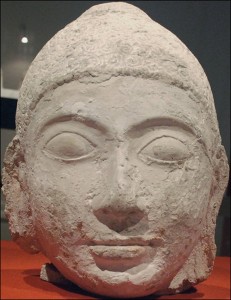
Almost immediately upon discovery, the statue’s head was smashed off, and most of the brittle torso was reduced to fragments. Below is the remaining head in the National Museum, after undergoing some restoration. Though given what happened in 2012 (see below) I am unsure of its current fate.

Maldives-231x300

Continue reading

Octagonal grinding disk cuts through the universe

Though an ominous, violent phrase, I think this I think represents two ends of a similar means of attaining wisdom within the broader Dharmic tradition. Two which are at opposite ends of a particular horseshoe. 1) The intoxicated Caitanya-esque ecstatic dancing, music, or trance (embodied in most epitomized form by the heterodox, antinomian and anti-textualist Baul tradition) on the one hand, and 2) The almost inhuman, absurdist form of samadhi of Chan/Zen Buddhism on the other, which produced the brutal, piercing line from which this post derives its title. Theoretically, the two share a genealogical origin in conjoined tantric traditions of Sahaja/Sahajiya Buddhism/Vaishnivism respectively. See the below diagram, with Bauls occupying the far left and Zen occupying the far right of the diagram. See the following quotation for a Chan/Zen mode of describing this condition.

DSCN1536

An eight-sided grinding disk is the large millstone which is turned by an ox or donkey. The idea that such an object was flying and cutting through the universe was something beyond common sense during the latter portion of the Kamakura period (1185–1333). There were intense debates on which form of Buddhism was superior: the established forms of Mahayana Buddhism or the newly imported Zen Buddhism. Scholars of the established Buddhist doctrine, with the intent to “crush” the newly arrived Zen Buddhism, debated Myocho Shuho who represented the Zen Buddhism side. (Later the Imperial Court honored Shuho by awarding him the highest title of Daito, Kokushi.) The scholars, after many debates, questioned Shuho: “Zen discourses intimate kyo gai betsu den [kyo=teaching; gai=outside; betsu=separate; den=communication]. What is the meaning of that phrase?” Shuho’s instant answer was “Octagonal grinding disk cuts through the universe.” The meaning of this phrase is that regardless of how well one intellectually understands the doctrine or dogma, without actual experience the understanding remains only on the surface. Deep attachments, delusions, intellectual understanding of good or evil; stubborn self-centered ideas and teaching through sutras: they who assume they are erudite scholars can be smashed into pieces but spiritual activity is totally free. Thus this statement ended the discourse and debates between the established Buddhist sects, and Zen Buddhism consequently gained a foothold in Kyoto.

The sagacity of this ichigyo mono made Zen Buddhism acceptable to other Buddhist scholars, and Daito, Kokushi since then has become greatly respected. The goal in Zen is to search for the truth with complete disregard for scholarly dialogue or one’s station in life.

In the work at left by Gengo Akiba Roshi, the subtitle is “Furyu Monji.” This means “not depending upon literature,” and is one of the phrases in traditional Chinese ideograms that explain the characteristic nature of Zen Buddhism. Other such phrases are Kyo gai betsu den meaning “extra- curricular or outside the teaching of sutras”; Jiki shi jin shin meaning “directly reaching to the heart and soul of that person”; and Ken sho sei butsu, meaning “rediscover the existing Buddha nature within oneself.” One must surpass or go beyond doctrine and the language from the teacher, and di- rectly connect with the spirit within. The student must take the mentor’s teaching and then internalize and digest it. Then it becomes an intrinsic part of heart and soul and allows each individual to grasp the core of Buddhist teaching in order to open the passage to satori. A simple way of saying this is to point your finger to your heart and it is the Buddha.

156-157, SHODO The Quiet Art of Japanese Zen Calligraphy

Buddhist Meditation on the Foul, and the Body in Horror Manga

contemplationofimpurities.png

From “The True Shape of Human Bones — On the Dawn of Anatomical Dissections in Early Modern Japan” By Michel Wolfgang. p 42

Warning! Very graphic imagery ahead if you choose to click through to this article.

I had the hypothesis that the type of “body horror” imagery which we see in modern Japanese horror Manga had some kind of historical relationship with Japanese Buddhism, probably via Buddhist meditative practices focused on repulsion. After some study, I am convinced of this hypothesis.

The imagery I saw in these manga reminded me of certain anatomical sketches and grotesque Japanese paintings from the Buddhist tradition. But what really put the idea in my head that there might be a connection between the contemplative practices of Buddhism and these manga was the disturbing experience of actually reading them. Although I’m not a Buddhist or well versed in how these particular meditative practices are supposed to be carried out formally, the straightforward descriptions of these meditations seems at least superficially similar to the experience of viewing grotesque images on paper.

Lets me show you what I mean:

Quotations from the Sutras:

The following is from Ekottarikāgama 12.1, which seems to be a Chinese recension of earlier texts:

““In this case, the practitioner meditates on the body as a body and according to its functions. When he examines it from head to toes or from toes to head, he sees that it is composed of impure constituents, and he is unable to be attached to it. He observes that this body has hair of the head and hair of the body, nails, teeth, skin, flesh, sinews, bones, marrow, sweat, pus, stomach, small intestine, large intestine, heart, liver, spleen, kidneys. He observes and recognizes urine, excrement, tears, saliva, blood vessels, grease, and observing and knowing them all, he is unattached and regrets nothing. This is the way the practitioner observes the body in order to realize peace and joy and be able to end unwholesome thoughts and remove anxiety and sorrow.”

It even explicitly uses a butcher analogy:

“Just like a skillful butcher or his apprentice might lay out the different parts of a slaughtered cow and distinguish the leg, heart, torso, and head, the practitioner observing his own body distinguishes the Four Elements just as clearly, seeing that this is earth, this is fire, and this is air. Thus the practitioner meditates on the body in the body in order to end attachment.”

Continue reading

Hindu Iconography from Far Central Asia

I already made a post about Hindu iconography in Japan, as expressed primarily in Shingon Buddhism. Now I’ll look to the west. As in the east, Hindu iconography appears in an ancient and intermixed state alongside other forms of iconography. In this case the context is Manichean, Zoroastrian, Greek, indigenous, and Buddhist. In many spots it gets hard to distinguish the border between iconographical forms as they tend to blend together into syncretic representations. It really is a historically unique scenario which produced such a melting pot of aesthetic trends. In any case the locations of these images, in a loose sense, define the high water mark of Hindu cultural expansion into Western Asia (Irredentists eat your heart out).

For the purposes of this exercise, I’ll ignore the art of Gandhara (inner Afghanistan/Peshawar region) which is already well known and should really be considered Indian art rather than an export. I’ll only be looking at art from north and west of Gandhara I’ll also be ignoring images of the deity Mitra/Mithra, because there are simply too many of them as this deity became very popular in the west and evolved its own well developed cult in Europe which is really a very different phenomenon than the diffusion of Shiva, Ganesha, or Parvati imagery in Western Asia. Due to the nature of the subject, some of the sourcing on these images or information is sketchy, but I’ll flag that when it is relevant.

Kushan Culture

Bactria

Bactria-320BCE

Bactria, 320 BC. Source: Wikimedia Commons

The following pieces are from the Metropolitan Museum of Art in New York City. They are all from the same archeological find, so I’ll only list that information in the first caption.

DT917

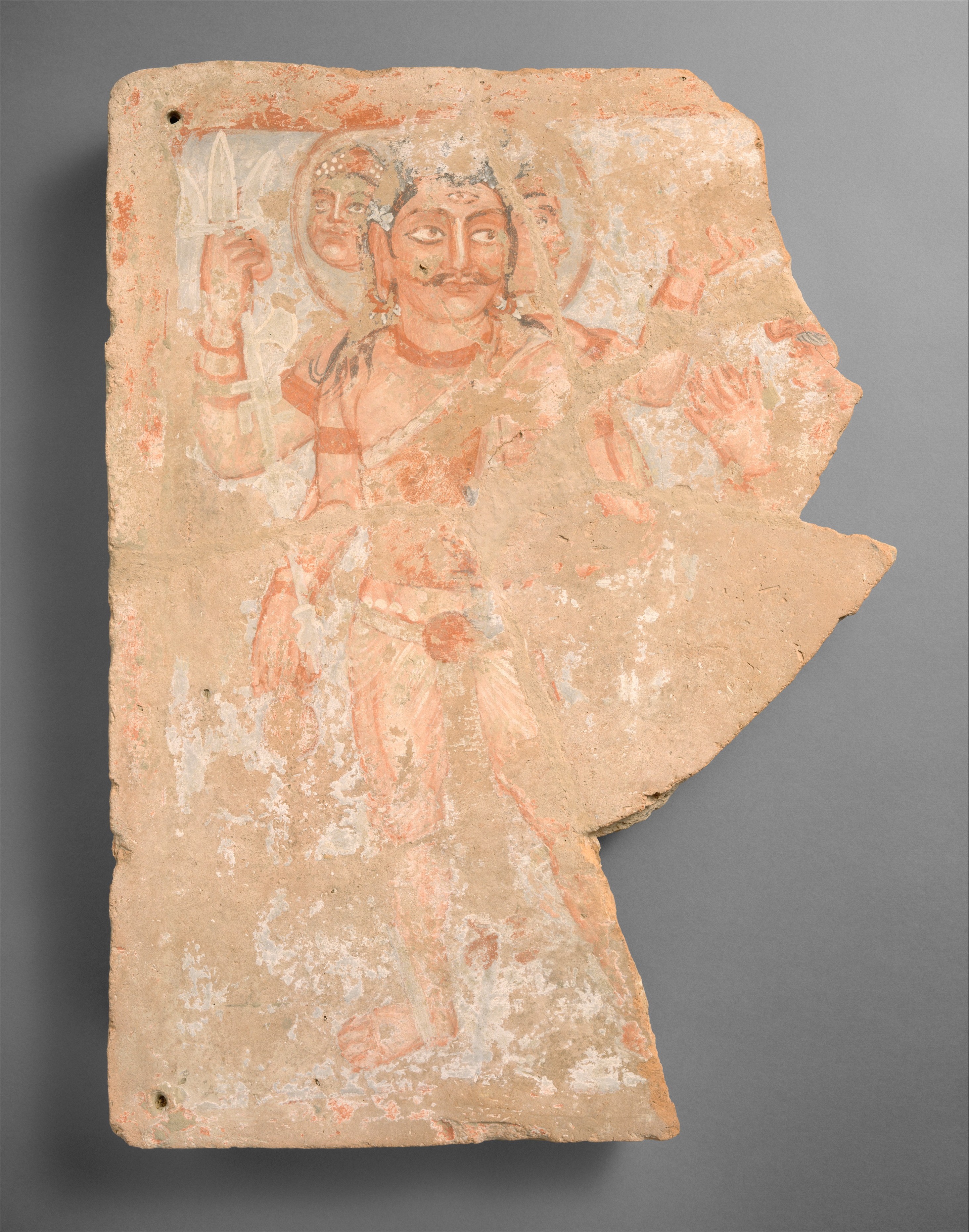
Panel fragment with the god Shiva/Oesho. Period:Kushan Date:ca. 3rd century A.D. Geography:Bactria, Culture:Kushan Medium:Terracotta, gouache Dimensions:H. 57.2 cm, W. 41.6 cm, D. 5.7 cm Classification:Ceramics-Paintings. Source: The Met

Hegel on India and Hinduism

I was reading Hegel a while back and I thought my dear readers might want to see some of his content. At the end of this introductory bit I have just excerpted in total “Section II: India” and “Section II: (Continued) India Buddhism”  from “Part 1: The Oriental World” of G.W.F Hegel’s The Philosophy of History. So if you’d like to skip my blather, go down to the section “On India” right below the winged Zoroastrian symbol.

Introduction and preliminary analysis: 

Everyone seems to dislike that Hegel is overly obtuse and abstract, but when he discusses history he is actually taking in very concrete terms most of the time. This is not exactly a reliable source for specific information about Indian history or philosophy. In some ways it is a better study of how Europeans see India than it is a study of India. It suffers from a caricatured view of India as a land of contradiction, chaos, and conflict. For the most part his characterizations of India aren’t totally baseless though, as stereotypes often have a basis in reality. They are just stereotypical exaggerations or generalizations which lack any sort of nuance or qualification. He also seems to uncritically accept very early orientalist insights in Sanskritic culture as fact, and as reflective of the Indian society of the 1800s. To some degree this is excusable because Sanskrit translations and real detailed historical knowledge of India were still undergoing development in Europe. He had to have been over reliant on early translations of the Vedas, the Dharmashastras (particularly Manu), the Pali canon perhaps, and the writings of some few high-philosophers. Given his time period, his knowledge of Indian philosophy is actually impressive. He writes some rather detailed information here about the Samkhya, Nyaya, and Vaisheshika schools, so he at least knew that much. Yet perhaps I am being too generous to Hegel here. It is somewhat baffling to me how he derives an extreme idealist worldview from these three schools, Vaisheshika in particular. It was reading those philosophical schools which persuaded me that India has a sublimated tradition of naturalism. I feel that if he was also familiar with them it should have occurred to him that Hindu idealism is at least alloyed with a rationalistic form of naturalism.

Continue reading

Covert Lokayata I: Doctrines

lokayatachartfiddled_PT1

This chart doesn’t represent every possible influence between the subject categories, just those relating to Lokayata’s influence. Each post will start with this chart, darkened to signify which relationships will be explored in that post.

This will be the first in a series of posts exploring the hidden role of Lokayata, and closely related forms of materialism, in Indian history and philosophy.

Reconstructing the influence of a dead school of philosophy is a difficult task, made all the more difficult in the case of Lokayata, where none of the original source material has survived. We are left to rely on the few fragmentary quotations, which pass on to us exclusively from critics of the school. The following posts rely heavily on the work of Debiprasad Chattopadhyaya, Dale Riepe, and Rasik Vihari Joshi, both in their analytical capacities, and in the collections of primary source fragments they’ve published.

In future posts I will examine the proto-materialist origins of Lokayata, Tantra, and Vedic religion, the impact of Lokayata on the orthodox darsanas, the impact on social and physical sciences,  the impact on culture and art, and the 20th century revival of interest in Lokayata. But this first post will simply be an overview of the remarkable characteristics of Lokayata.

Core Features of Lokayata

Though Lokayata (also known as Carvaka, or Brihaspati Darsana) changed over time the main features were as follows:

Continue reading

If you Meet Krishna on the Road, Kill Him.

(Disclaimer: The title is a reference to the Buddhist saying: “If you meet Buddha on the road, kill him.” meaning something like: To fetishize your interpretation of Buddha is to disregard his teachings. If you think that you’ve discovered the truth, shatter your illusion.)

This will be a response to some of the criticism I’ve received on and offline for the post The Yoga of Arjun’s Despondency.

The most common criticism I receive is that I didn’t “get” it. I interpreted the text literally, whereas it is a metaphorical or spiritual treatise. Its really about an “inner battle” whereas I focus entirely on the external battle.

The second criticism I get is that since I disagree with Krishna’s conclusions, I must not understand, or disagree with his reasoning.

I find these criticisms unsatisfactory, but they comes up a lot so I might as well address them:

Image Source: ISKON/Corbis

Image Source: ISKON/Corbis

Levels of Analysis: First of all, Hindu exegesis has (at least) three levels. First, adhyatmika (analysis on a philosophical, spiritual, transcendental level) second adhidaivika (analysis of cosmological, ritualistic, psychological factors) and third adhibhautika (analysis of physical events, the sphere of matter and nature.) Check out Page 76 of this paper for a better set of definitions.

Continue reading

Book Review (sort of): Poems from the Sanskrit

John_Brough_Poems_Sanskrit_400x615

Cover art from the Ellora Caves Image source: Buddhism for Vampires

“If learned critics publicly deride

My verse, well, let them. Not for them I wrought.

One day a man shall live to share my thought:

For time is endless and the world is wide”

Bhavabhuti (p.53)

I try not to saturate this blog with book reviews, but I have a justification in this case. This review contains a slew of poems excerpted from the book, which are worth far more than my review, and my numerous tangents. Hit “Continue Reading” and scroll down if you just want to check those out.

John Brough’s Poems from the Sanskrit[1], despite its confusing title, (what is the Sanskrit?) is actually a very charming anthology of translated Sanskrit poems, ranging from roughly the 4th through 10th centuries.

The translator’s stated purpose for compiling this volume is as follows: Normally Sanskrit translators, focus on conveying meaning at the expense of poetic or prosaic style. But since Sanskrit and English grammars differ considerably, meaning focused translations often come across as stilted or sometimes even unreadable. Sanskrit Poetry compounds this problem, because so much literary value is vested in the poetic structure itself (for example: The number, repetition, and weight of syllables.) This is a translation, which attempts to give equal weight to content and form.

Translating a Sanskrit poem into rhyming verse while keeping the original meaning intact is an impossible task. Perhaps a more accurate description of the book is: an anthology of English poems by John Brough, based closely on Sanskrit classics. The purist in me recoils at this prospect, but if you read the poems without wringing your hands over the potential “butchery” of the originals which preceded them, they are actually quite lovely  on their own merits. And based on the samples and explanation of his technique as delineated in the introduction, I have faith that he has amply conveyed at least the basic sense of each work.

I’ll jump right into the verses and save my criticisms for the end:

I noticed some recurring patterns:

Anti-Clericalism: There are a surprising amount of poems in here, which are highly critical of priests, focusing on their hypocrisy foolishness, or exploitation. These are mostly secular poems, but it still surprises me. One has to wonder: Were they talking about priests generally or about “the bad ones” i.e. the heterodox ones?

“‘So, friar, I see you have a taste for meat.’

‘Not that it’s any good without some wine.’

‘You like wine too, then?’ ‘Better when I dine

With pretty harlots.’ ‘Surely such girls eat

No end of money?’ ‘Well, I steal, you see,

Or win at dice.’ ‘A thief and gambler too?’

‘Why, certainly. What else is there to do?

Aren’t you aware I’m vowed to poverty?'”

Sudraka (p.79)

5427541032_9391f01560_b

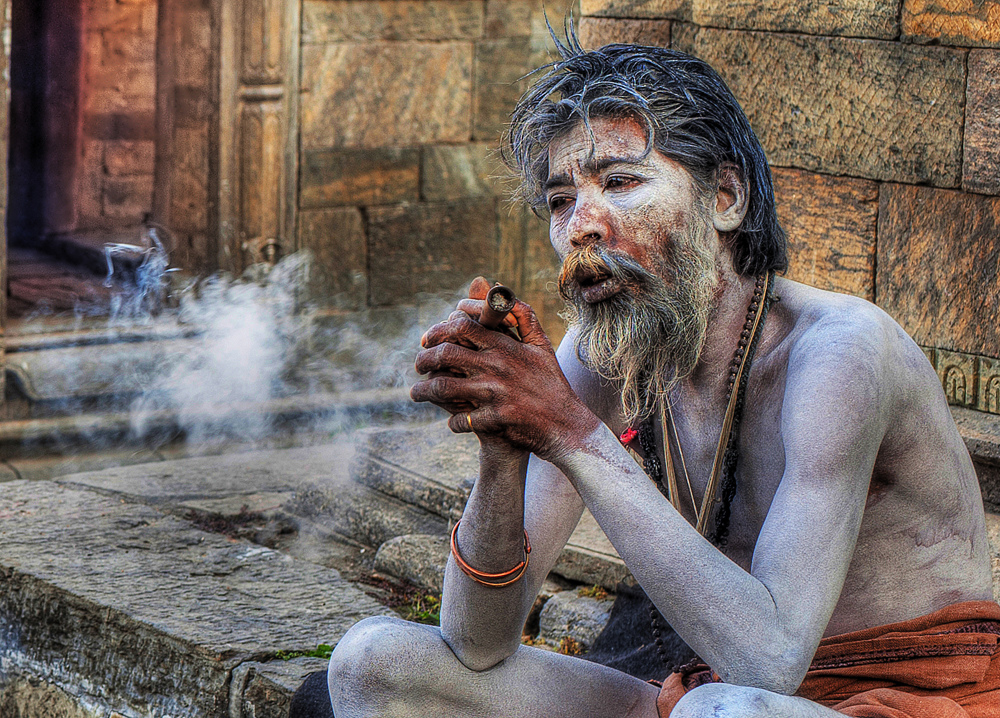
According to Doniger’s theory (described later), this is a “friar” similar to the one who is under critique in the above poem. He is an Aghori, a sect which split off from the Kapalika. The Kapalika would have been contemporaneous to Sudraka. Image source: Flickr

Continue reading

Hariti: Saraswati’s Persian Cousin

Image

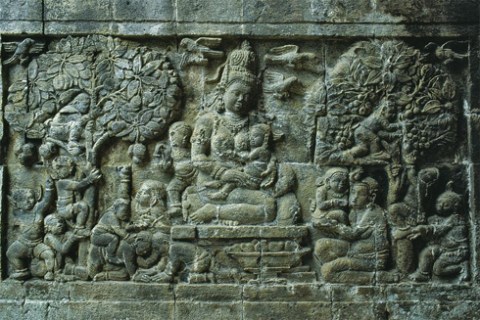
Hariti Relief Panel at Candi Mendut, Java. What is an Iranian deity doing in Java?

Hariti’s history goes way back. I’m taking pre-Vedic. Something like 2500 BC or maybe even earlier. At that time the Iranians and Indo-Aryans were still one people– the Indo-Iranians. They worshipped two classes of deities: Devas and Asuras in Sanskrit, or Daevas and Ahuras in Avestan. After the Indo-Iranians split into two distinct civilizations, Vedic civilization (eventually) adopted the Devas as Gods. The Devas were engaged in a perpetual war with the Asuras, which evolved into evil-ish demigods. Ancient East Iranian civilization did the reverse, deifying the Ahuras and demonizing the Daevas (hence words like demon and devil.) The reasons for this reversal is not entirely clear. I’d like to imagine there was a fascinating, but long lost clerical-political drama involved, but who knows. The mystery of this era is half the appeal.

To reiterate and simplify:

Vedic civilization: Devas- Good guys, Asuras- Bad guys

East Iranian civilization: Ahuras- Good guys, Daevas- Bad guys

Vedic civilization had a Devi, a fertility/mother goddess by the name of Saraswati. She was the personification of a main river of Indo-Iranian culture. Therefore, her Iranian equivalent, Harauhuti, or Hariti was a Daevi, and a fertility/mother demon as odd as that sounds.* Hariti was believed to be a highly prolific mother with hundreds of children. The problem is that she would also steal other peoples children in order to cannibalize them and feed them to her young. In practical worship, she was treated as a demon of pestilence who needed to be appeased, probably because disease was a big killer of children.

That was the story, at least until Buddhists came out of the core Indian subcontinent and into modern Afghanistan. The Buddhists modified the original tale to fit better into the Indian cosmology. For instance, they transformed Hariti from a “Daeva” into a Yaksha (nature spirit), and gave her a backstory involving reincarnation. More importantly, they also extended the original tale to include a fateful interaction with the Buddha.**

Image

Hariti with children.”House of Naradakha,” Found in Shaikhan Dheri, Charsada, Khyber Pakhtunkhwa, Pakistan. This is a Gandharan piece.

According to the Buddhist legends, the childless victims of Hariti beg the Buddha to save them from her cruelty.*** To help, Buddha waits until Hariti leaves the house and traps her smallest child, Priyankara under his alms bowl. When she returns and cannot find her son she weeps and panics. She scours every city, village, mountain, lake, and forest on Earth. She franticly soars into the hells and into the divine realms in search of her son, even going so far as to demand entrance into the abode of Indra. After exhausting all other options, she too appeals to the Buddha for help. He points out that her suffering is minor compared to the combined suffering of all the mothers whose children she has killed. She agrees, and (although seemingly under duress) agrees to protect those who she formerly devoured if only Buddha renders his assistance. At that, Buddha lifts up his alms bowl and Priyankara hops out safe and sound. Thereafter Hariti converts to Buddhism, quits cannibalism, and becomes a spirit of fertility, childbirth, motherhood, and the protection of children (and also of healing in some areas, such as Southeast Asia where the top image is from.)

One might imagine that this was part of a marketing strategy by the Buddhists. Brand localization. Thats speculation. Anyway, from Afghanistan, Hariti was exported back to India, and the rest of the Buddhist world as a mother goddess and defender of children.

But isn’t this an odd progression? First there was an Indo-Iranian fertility deity which split into Saraswati and Harauhuti/Hariti. Two figures which are basically the same, only one is deified and the other is demonized. From the Indian point of view, Harauhuti is a reversal of Saraswati. Fast forward a few thousand years, the Indian Buddhists come back and adopt the reversed Saraswati, and reverse her once again into Hariti, a fertility spirit (Yaksha.) How many times can this character switch sides? Furthermore, now the Hindu and Buddhist pantheons have a duplication problem. They’ve got two deities with the same origin and function. Saraswati and Hariti both fertility deities based on the same river. I know I know, over time their backstories changed enough to be perceptibly different figures, but its still an interesting mythological duplication.

Image

Saraswati with her veena. Over time she lost a lot of her more blatant “motherly” traits and became more associated with knowledge and the arts.

Image

Hariti: Saraswati’s long lost cousin? You can see she’s crawling with children. Clearly the more blatant fertility/mother deity out of the two.


Continue reading