King Akbar’s Mahabharata, or the Razmnama (Book of Wars)

Image

The battle of Duryodhana and Bhima (among others.) From the 1616-1617 edition of the Razmnama. By Kamal.
Image source: Simon Ray


When I was little I used to come across prints (much less elaborate than the above) in my house of scenes from the Mahabharata—with (what I assumed to be) Urdu writing on them! It confused me. I looked it up. Turns out, the Mughal king Akbar had a copy of the Mahabharata translated into Persian. Mystery solved. I put it to the back of my mind until recently when, while trying to plug gaps in my knowledge base I found out that there is actually a pretty interesting cast of characters behind this translation. An impassioned, suicidal artist, and his apollonian counterpart! An Islamic fundamentalist tasked with translating infidel texts! A king motivated by both religious toleration, and the maintenance of his regime’s legitimacy! Plus, it’s a good focal point around which to examine Indian art history which gives me the opportunity to post pretty pictures. Swiftly onwards–

Akbar’s Translation movement:

Akbar has a well-earned reputation as the most tolerant and humane of the Mughal kings. His formal policies towards non-muslims displayed liberality, and the composition of his court bespeaks of inclusivity. The range of art and music he chose to patronize also knew no religious bounds.[1] He even founded “Din-e-Ilahi,” a new syncretistic religion that earned the scorn of the orthodox Muslim intelligentsia.

Given these tolerant and syncretistic tendencies, it is no surprise that Akbar was interested in gaining access to the literature of the non-Persian speaking world. During his reign Akbar’s scholars translated works from Sanskrit, Hindi, Arabic, Greek, and Latin into Persian, and also did substantial translation work from Persian into Hindi. Though the Mahabharata was the center of his project, Akbar also had the Ramayana, the Artha Veda, the Lilavati (a treatise on mathematics), and other Sanskrit texts translated into Persian.[2] [3]

Court historian Mulla Daud writes that Akbar “ordered, that the rational contents of different religions and faiths should be translated in the language of each, and that the rose garden of the traditional aspects of each religion should, as far as possible, be cleared of the thorns of bigotry.” Akbar’s reputation for tolerance has helped this explanation for the translation movement stick.[4] However, one should treat anything explanation given by court historians as suspicious. The Razmnama’s text has an array of strangely translated passages, additions, or omissions which justify this suspicion. While I’m sure that Akbar was genuinely interested in reading Hindu texts and spreading knowledge of them amongst his nobility, I also think that the translation project had distinctly fetishistic and propagandistic elements to it.

But First—

The Translation Process:

Ok, here’s the basic process. First, Sanskrit literate Brahmans (many of whom were converts to Islam) translated a common North Indian variant of the Mahabharata from Sanskrit into Hindi both in text, and verbally. Then the Hindi text was translated into Persian by a staff of Muslim, Persian speaking scholars. [5] Then that raw translation was converted into poetic verse by the project’s head, a scholar named Abu al-Fazl. [6] So obviously “translation” is a very loose term. It’s really more of a retelling.

script

A folio from a 1616 copy of the Razmnama in which: “Asvatthama Fires the Narayana Weapon (Cosmic Fire) at the Pandavas.” You’ll notice I have so far posted no images from the 1587 manuscript which is under discussion here. That is because it sits in the City Palace Museum in Jaipur off limits to all historians. So thanks for nothing City Palace Museum in Jaipur.
Image source: Metropolitan Museum of Art

(If on the main page, hit “Continue Reading” for more [theres pretty pictures ahead {do it}])

Continue reading

Bengali Feminist Sci-Fi: “Sultana’s Dream” by Roquia Hussain

Read the story here! If you find the writing style basic, keep in mind, English was her fifth language. Its an early work of both feminist literature, and science fiction. I think you’ll dig it.

sul·tan·a [suhl-tan-uh, –tah-nuh] (noun)

1: : a woman who is a member of a sultan’s family; especially: a sultan’s wife

2: a mistress or concubine of a sultan

3: A female sultan *

OLYMPUS DIGITAL CAMERA

The Zenana Deodi in the middle of Mehrangarh Fort in Jodhpur, Rajastan. This is from a royal palace, probably a tad fancier than the one Hussein grew up in.

A note on Purdah: This is a customary practice wherein the sexes are segregated, and the movement of females is restricted to the zenana (women’s quarters) with varying levels of severity. It also usually entails the requirement that females wear a veil, burka, or some sort of covering. This was much more common in the middle and upper class than amongst the poor populations. While it exists in both Hindu and Muslim communities, Muslim implementations are generally more severe, hence Roquia Hussain’s consciousness raising efforts.

Some Context: Muslim Reformers in the Bengal Renaissance: Calcutta 1900! A bustling early-capitalist metropolis with a sizable bourgeois and upper class– A set of intellectuals economically capable and philosophically inspired to paint, write, make scientific discoveries, and root out social evils. What a time it must have been to be alive!

Like many intellectual renaissances, the Bengal Renaissance (broadly defined: 1775-1941) entailed a simultaneous harkening back to ancient traditions for inspiration, and a striving for modernity and progress.** Hindu writers and thinkers revived and reinterpreted Vedic/Upanishadic philosophy to combat social ills like sati and the caste system. Likewise, The Muslim intelligentsia entered a period of self-criticism wherein writers looked back to their Islamic traditions for sources of inspiration, and reinterpreted their texts to liberalize Islam from the inside.

Muslim scholars like Maulana Abul Kalam Azad, advocated a “continuous, unending process of ijtihad, interpretation according to the needs of the time” and wanted to overhaul the Madrassa system of education much like Hussain. The author Kazi Abdul Wadud honored the prophet Muhammed as “a great man,” and referred to him as “just like a light-house to the sea-voyagers” but denied that he was “omniscient” or an “all-pervading master.” Wazed Ali, another writer, observed “the arrival of a religious reformer is essential for the removal of filth from life. In Muslim society too, high-souled men appeared from time to time to remove filth and to make religion time-befitting.”[1] Do you see a pattern emerging?

Now examine some quotations from our author, Roquia Hussain:

“where there is much rigidity in religion, there is greater oppression of women”[2]

“[religious books are] nothing but man made code.” [3]

“Allah has made no distinction in the general life of male and female — both are equally bound to seek food, drink, sleep and pray five times a day.” [4]

“The opponents of female education say that women will become wanton and unruly. Fie! They call themselves Muslims and yet go against the basic tenet of Islam, which gives women an equal right to education. If men are not led astray once educated, why should women?”[5]   ***

A similar pattern emerges, no?

persp2

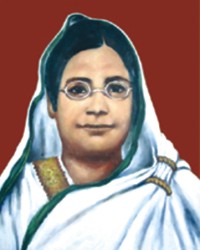
Rokheya Shekhawat Hossein

Well-intentioned scholars sometimes try to contextualize Roquia Hussain within the global or even western feminist movement.[6] I’ve seen her described as a “contemporary” of Mary Shelley, Charlotte Perkins Gilman, and Virginia Woolf. But in what sense are they really contemporaries? Hussain’s consciousness raising mission was extremely focused on her own social group. She wrote almost entirely in Bengali, and about issues, like purdah and zenana, which impacted the Bengali Muslim upper and middle classes. [7]  Her writing was not intended for, nor read by western audiences.

Hussain may have been more radical than most of her Bengali cohorts, but she was still firmly within their social and literary milieu. The pattern evident in her nonfiction writing is the same pattern we see in other Bengal Renaissance socio-religious reformers: Liberal reforms are advocated through appeals to religious tradition, while simultaneously jettisoning negative or outdated aspects of that same tradition. Hussein’s religion played a major role in her approach to feminism. Her opposition to purdah coexisted with her encouragement of wearing the veil.[8] She believed in universal education– so long as it was segregated by sex and included Arabic in the curriculum.[9] She believed in the earthly origins of scripture, and also in the God of the Qur’an. This is the tension, or confluence (depending on your perspective) at the heart the Bengal Renaissance.

———————————————————————————

Other cool Bengal Renaissance stuff:

Complete works of Rabindranath Tagore (Bengali) (English)

Paintings by Abanindranath Tagore 

“The Renaissance in India” a collection of essays by Sri Aurobindo (PDF direct download link)

The Torch Bearers of Indian Renissance,” a PDF detailing the scientific and mathematical minds of the Bengal Renissance

———————————————————————————

* This is an amalgam definition from Webster.com, dictionary.com, and wiktionary. I include it because I think the name “Sultana” was intentionally chosen for it’s mixed connotations in regards to female power.

** Call me a colonial apologist but… I think its obvious that the British colonial presence in Calcutta (the capital of British India until 1911) had something to do with the Bengal renaissance, particularly in the contribution of what we conceive of as “modern” ideas. Calcutta received contact with the west earlier, and more strongly than the rest of India. British critiques of Indian culture, classical liberalism, the English language, British artistic and literary techniques, the presence of a colonial hegemon to inspire nationalist reactions– These are all indispensable parts of the Bengal Renaissance. This is not to credit the Bengal Renaissance to the British, but merely to observe that cultural diffusion and the importation of new ideas from abroad has a destabilizing, influence on existing cultural patterns.

*** In Sultana’s Dream when Sultana asks Sister Sara about religion, this is what occurs “What is your religion, may I ask?’

‘Our religion is based on Love and Truth. It is our religious duty to love one another and to be absolutely truthful.”

Hit “Continue Reading” for citations.

Continue reading

Hindu Devas take a (silk) road trip to Japan!

(Note: If you are only interested in pictures, skip past this and hit “Continue Reading”)

This is a historical phenomenon, which entertains and fascinates me to no end. Buddhism had a huge impact on all East Asian cultures, especially on their pantheons of deities. On first glance it might seem odd that a reform movement, which rejected many of the core tenants of Vedic religion would transmit a belief in Vedic deities. This apparent oddity is a misunderstanding of Buddhism’s “atheism,” and a misunderstanding of what a “Deva” actually is. Most forms of Buddhism, while rejecting the concept of all-powerful gods or creator deities, openly accept the existence of powerful supernatural beings. This includes yakshas (nature spirits) rakshasas (demons) gandharvas (celestial musicians) nagas (supernatural snakes) and many other beings, including Devas (deities.) In Hindu and Buddhist cosmology, Devas are created beings that roam around the universe seeking the divine, albeit very powerful ones with much greater spiritual capabilities than humans. Hindu traditions tend to accord Devas much more power and divinity than Buddhism, and worship them as manifestations of The Supreme. In the Buddhist pantheon, the Devas have generally converted to Buddhism and now serve as his protectors, the protectors of his teachings, or as helpers to mortals who are trying to achieve enlightenment.

The reader should be aware that in Japanese mythology and theology the below deities freely interact with native Shinto deities, and deities imported from China. I am isolating the Indian derived deities for the purpose of this bog post, but do not be deluded into thinking that they are unintegrated with the rest of Japanese mythology.

The more popular of these deities are used in non-esoteric Mahayana Buddhism (the bulk of Buddhist sects in Japan.) However, most of these are relatively obscure deities because they are only used in the Shingon school, an esoteric (tantric) school of Buddhism. As such, the bulk of these Devas achieved full development in Japan around the late 700s or early 800s, as a result of the rise in popularity (especially amongst the political elite) of esoteric and Shingon Buddhism.

Last note: There are a lot of different names involved here, because (among other reasons) Sanskrit and Japanese don’t transliterate very well. For deities in which two names are listed, the first is Sanskrit, and the second is Japanese. In cases where, for some reason, I’ve listed many names, I will specify with an (S) or a (J) which language it is from.

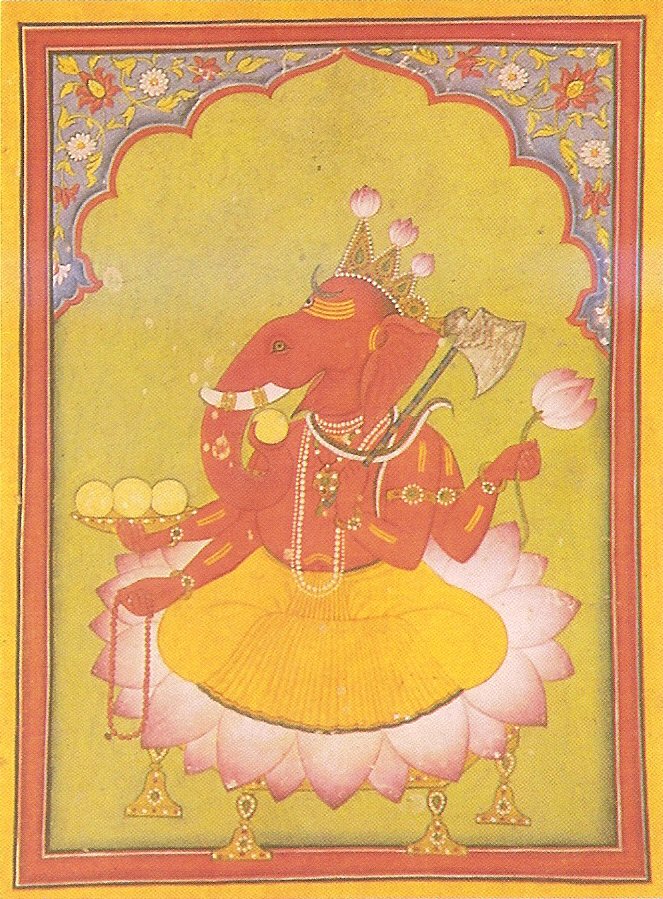
(S) Ganesha/ (S) Vinayaka / (J) Binayaka / (J) Shoten/ (J) Kangiten: Ganesha was one of the first Indian deities to transit to Japan, and as in India, is one of the most popular in both esoteric and non-esoteric sects. Perhaps this is because his association with worldly prosperity has been retained, or perhaps amplified into a general association with pleasure. Thus, actors, geishas, gamblers, restaurant proprietors, etc offer him worship. Shoten has retained the association for removing obstacles, although his ancient association with creating obstacles which has long since been expunged from the Hindu tradition is still mildly active in Japan for reasons which will become clear later.

Ganesh (musée d'art indien de Berlin)

Dancing Ganesha from North Bengal, 11th Century. Image From Vikram Kharvi’s blog “My Lord Ganesha”


Kangiten

Contemporary Kankiten Statue from Fukuoka Japan. Image from this Japanese Website

He is often depicted in (implicitly erotic) embrace with another elephant headed figure. In that iconography, his name is “Kangiten” or “Binayaka.” This is an allusion to a Japanese myth about Kangiten’s “evil” origins, wherein his mother, Uma births 1,500 evil children onto her left (collectively called Binayakas), the first of which was Binayaka. On her right side she births 1,500 good children the first of which was Avalokiteśvara/Kannon (the Bodhisatva of compassion) incarnated as Idaten (Skanda or Murugan in India.) In order to win Binayaka over to goodness, Idaten reincarnates as a female binayaka and becomes Kangiten’s wife. The bliss generated by their union turns Kangiten good. According to this myth therefore, the embracing Kangiten figures actually represent Kangiten in sexual union with his brother reincarnated as his wife/sister. There are other myths, which seek to explain this iconography, but all of them involve some sort of gender reversal, usually by means of reincarnation.[1]  There is a huge corpus of Japanese Ganesha myths, which do not exist at all in India, but the initial one just mentioned seems to almost reference Ganesha’s actual historical development in India. Ganesha probably evolved from the set of demons called Vinayakas/Binayakas who were known for erecting obstacles and creating divisions between allies. However, they were easily appeased. So easily appeased in fact that over time they evolved into positive forces, and merged into one deity—Ganesha.[2]

embrace 2

Embracing Kangiten. Image from onmarkproductions.com

However, the aforementioned Japanese myths all seem to be trying to explain the dual figured Kangiten iconography by posing, as it’s mythological basis. The real basis lies elsewhere, probably in the translations of Amoghavajra, a half Indian half Sogdian monk living in China in the early 700s. He was a founder of the “Chen-Yen” school of esoteric Buddhism (a precursor to the Shingon school,) and his translations of various tantric texts entail repeated references to the “dual-bodied Vinayaka” which is an obstacle removing and prosperity inducing deity described as looking exactly like modern embracing Kangiten figures, including the erotic embrace. There was also a pre-Buddhist Japanese deity named N-io, which took the form of a male and female in embrace, which could have contributed, or facilitated the popularity of the embracing Kangiten figures.[3]

Continue reading

Book Review: Chalo Delhi: Writings and Speeches 1943-1945 By Subhash Chandra Bose

Image

You have to be a huge Indian history nerd to enjoy this book. It is a waterfall of primary documents, mainly speeches by or about Subhash Chandra Bose. Its not light reading, and its probably not interesting to you if you aren’t fascinated by it’s highly focused subject matter. Even I had to remember that it is a collection of primary sources so it will get repetitive and boring at times. The pacing goes at life speed, not at the speed of a well-written novel.

Now for some interesting themes I picked up: Bose’s mission required the mobilization of Indians who lived outside of India, namely those living in East Asia. Those living abroad seemed more amenable to Bose’s brand of militant nationalism than those at home. His mission reminded me strongly of the Ghadar movement, and various modern Hindu, Sikh, and Tamil Nationalist organizations which had/have their bases of support located outside of India. Why is it that non-resident South Asians seem consistently more nationalist and militant than those living in India? (Note: I think that Bose and the Ghadars show that the linked article provides an unsatisfactory answer to this question  since this is evidently a very old phenomenon, and therefore is not attributable to the post 1960s growing NRI middle class)

However, unlike the aforementioned communalist or regionalist movements, the Azad Hind government was strongly Pan-South-Asian (Pan-Bharatvarashi? Pan-Gurkani?) and emphatically inclusory. Bose was firmly in favor of a united India (including Lanka) and opposed to regionalism, classism, and caste. I seriously doubt he would have appreciated modern India’s federal structure which leaves states a degree of autonomy.

This inclusory spirit is evident in the composition of his organization. The majority of the soldiers in his army were Muslims, and the variant of Hindustani used by the organization was heavily slanted towards Urdu for their benefit  Tamils played a huge role in his organization as well due to their large numbers in Southeast Asia. Females were also included in combat roles (As a side note, the U.S. just got on board with this 4 days ago.) Sometimes Bose goes a bit overboard in the pursuit of unity. For example: at the time there was a conflict over the Hindustani language. Should the new government use Devanagari script, or Persian script? Or retain both and have the resultant communication problems and social fragmentation? Bose proposed solving this by ditching both Devanagari and Persian script in favor of Latin script, in a conscious imitation of Ataturk. This is why all Indian National Army documents were written using Latin characters.

His passion for a united India informed his stance on Jinnah and the Muslim League. Needless to say, he was virulently and morally opposed to the notion of Pakistan and seems to have disliked Jinnah as a person. This is exacerbated by what Bose identifies as Jinnah’s traitorous behavior at the Simla conference, wherein the Muslim League allegedly promised to support the British war effort in exchange for Pakistan.

Image

There were a few select essays, such as “Gandhiji’s Part in India’s Fight” which are great examples of Bose’s rhetorical abilities and skill in propagandizing. In that essay he repeatedly praises Gandhi’s character and dedication, referring to his many prior interactions with the man while never commenting on his diametrically opposed tactics. He thus associates himself with Gandhi’s personality cult while obfuscating Gandhi’s opposition to the Indian National Army’s violent strategy. Then in the last paragraph he throws in a direct Gandhi quote “If India has the sword today, she will draw the sword”, and asserts that Gandhi was only opposed to revolution in the past because the time wasn’t right. Now the time is right, so Gandhi supporters should listen to their hero and join the Indian National Army. Clever, no?

Another clever rhetorical tool, which I noticed, was his persistent use of vague religious language. He often refers to his revolution as a “holy war”, a vague enough term to fit into the paradigm of Islamic Jihad, Hindu Dharmayudha, or Sikh divine command to defend the innocent.

It is difficult to say how accurate his impressions of World War 2 were, given that these speeches were intended for a general audience and are thus necessarily propagandistic. Morale, to Bose was a more important military factor than technology or supplies. This is probably his most important misapprehension since it governed his military strategy. He continued to claim that Germany’s victory was obvious until the Red Army was almost in Berlin. The same claim was bade about the Japanese until late in the British-American re-conquest of Burma. However, his predictions about the post-war situation were pretty good. Bose understood that it would be an “American Century” and that the Soviets and the west would not remain allies for long. A notable error was his mistaken assumption that Britain would never “voluntarily” India after the war. Perhaps it is unfair to call that a “mistake” though, because Bose’s own actions led to the British losing faith in their Indian troops, a contributing factor to their peaceful withdrawl from the subcontinent.

One can imagine that if Hitler died prior to World War 2, or if Stalin had died while fighting the Nazis their modern reputations would have been greatly improved. In that sense, it is wonderful for Bose that he died before ever achieving a position of power. Those who admire Bose (and I am one of them) might want to acknowledge is that he was basically a Fascist. He repeatedly speaks glowingly National Socialism, Italian Fascism, Communism and the Japanese imperial state. He clearly indicates that he has no problem with dictatorship, and that India’s government should not be a democracy, but would rather be a state blending the positives of Nazi Germany and Stalinist Russia. If Japan had won the war and Bose’s army had actually made it to Delhi, India would probably have been a Fascist dictatorship with Neetaji as the head autocrat. Judging by his harsh actions when his army faced the stressors of defeat and retreat, political freedom would not exist and political purges would have been the norm. Based on his economic theories, starvation would have been widespread as the result of central agricultural planning. For the sake of his legacy, Bose is lucky he died early.

I picked this up in Calcutta for 500 rupees  but its a lot more expensive to buy in the west. Anyway, if this review interested you then you are probably this book’s target audience.

The Yoga of Arjuna’s Despondency

Continuing in my trend of alternative takes on Hindu texts…
“Arjuna, having thus spoken on the battlefield, cast aside his bow and arrows and sat down on the chariot, his mind overwhelmed with grief.” -(Chap 1 Verse 46)

“Arjuna that chastiser of enemies said: I shall not fight O Krishna, and became silent.” (Chap 2 verse 9)

"Arjuna, having thus spoken on the battlefield, cast aside his bow and arrows and sat down on the chariot, his mind overwhelmed with grief."

“Arjuna, having thus spoken on the battlefield, cast aside his bow and arrows and sat down on the chariot, his mind overwhelmed with grief.”

But unfortunately, the story doesn’t end there.

At the start of the Bhagvad Gita Arjuna is faced with a dilemma. On the one hand he is reluctant to enter into a war which is likely to cost the lives of most of his family, friends, respected elders, along with at least 4 million of his own citizens. On the other hand he also has moral duties as a warrior, and as a righteous person. According to the traditional interpretation the dilemma is resolved when Arjunas objections are defeated by the Divine Krishna’s appeals to selfless dedication to duty, (and the revelation of his Universal Form and the mystic wisdom that comes with it).

Seen in another light, this is the story of a rational, nonviolent man who gets persuaded, and frightened into obeying the whims of a mystical and powerful supernatural entity— Krishna. As a result of listening to Krishna’s advice he goes to war resulting in millions of deaths including almost his entire family. Most tragically, Arjuna loses his beloved 15 year old son Abhimanyu, who he loved deeply. Arjuna’s eventual victory is pyrrhic. He gains a kingdom he didn’t want all that badly, and loses many human relationships which he valued highly. He gives up a higher value in favor of a lower value– a fruitless sacrifice. As such, in the later chapters of the Mahabharata there is very little celebration of the victory at Kurukshetra. Instead sorrow and despair dominate the psyches of Arjuna and all the Pandava brothers.

This interpretation makes chapter 1 of the Gita the most noteworthy (Chapters 2 and 3 also contain some gems, but Arjuna’s defiance tends to fizzle out as the text goes on). Most readers go into this chapter under the preconception that Arjuna is wrong. It is read mostly as a preface to Krishna’s later statements. I implore readers to take this chapter seriously, because in fact the objections which Arjuna raises here are never adequately addressed by Krishna.

Arjuna, while he still retains his nonviolent instincts presents his argument against going to war. Despite being overwhelmed by grief and distress he repeatedly states that the kingdom, divine reward, or happiness which would result from winning the battle are simply not worth the resulting deaths:

“O Krishna, of what value are kingdoms? What value is living for happiness if they for whom our kingdom, material pleasure, and happiness is desired: preceptors, fatherly elders, sons; and grandfatherly elders, maternal uncles, fathers in law, grandsons, brothers in law, and relatives are all present on this battle field ready to give up their kingdoms and very lives? O Krishna even if they want to take my life I do not wish to take their lives. O Krishna what to speak for the sake of the earth, even for the rulership of the three worlds; in exchange for slaying the sons of Dhrtarastra what happiness will be derived by us?” (Chap 1 verses 32-35)

“How by slaying our own kinsmen will we be happy?” (Chap 1 verse 36)

“Alas how strange it is that we have resolved to commit great sin. Just because of greed for royal luxuries we are prepared to slay our own kinsmen.” (Chap 1 verse 44)

“It is better to live in this world by begging, without slaying our great and elevated superiors; otherwise by slaying our superiors the wealth and pleasurable things we are bound to enjoy will be tainted by blood.” (Chap 2 verse 5)

“Even if the sons of Dhrtarastra armed with weapons in hand slay me unarmed and unresisting on the battlefield that would be considered better for me.” (Chap 1 verse 45)

Arjuna seems relatively rational here. He engages in cost benefit analysis. He shows his preference for nonviolence over power, and family over material greed.

Krishna counters this with a blind appeal to duty but why should Arjuna adhere to his martial duty if there will be no perceptible gains to any party? According to Krishna doing one’s duty is inherently moral irrespective of the consequences so long as it is done with dedication to God. The idea that detachment from consequences is ideal becomes a persistent theme in the Gita. To be sure, selfless or detached action is useful in many avenues of life. But should we really ignore consequences when millions of lives are at stake?

Eventually Krishna reveals his Universal Form to Arjuna. In Chapter 11 verse 23 Arjuna says “O mighty armed one, seeing Your magnificent form of manifold faces and eyes, manifold arms, legs and feet, manifold stomachs and manifold terrifying teeth; all the planets tremble in fear and so do I”. After this frightening episode, Krishna’s suggestions become more forceful and sometimes take on the form of commands.

“O mighty armed one, seeing Your magnificent form of manifold faces and eyes, manifold arms, legs and feet, manifold stomachs and manifold terrifying teeth; all the planets tremble in fear and so do I”

“O mighty armed one, seeing Your magnificent form of manifold faces and eyes, manifold arms, legs and feet, manifold stomachs and manifold terrifying teeth; all the planets tremble in fear and so do I”

In the end, Arjuna succumbs to Krishna’s advice and fights. His teacher Drona, his son Abhimanyu, his grandfather Bhishma, his brother Karna, and innumerable others all die. After the battle, Arjuna repeatedly expresses remorse about his actions, and why wouldn’t he? Prior to the battle he made his preference for familial bonds over winning a kingdom perfectly clear. Yet, he followed Krishna’s advice to the letter for which he paid a heavy price.

How have so many thousands of years passed with nobody noticing that in this instance, Krishna gave profoundly poor advice? From a rights theorist perspective, Arjuna made the wrong choice because although he killed plenty of guilty people, innocents (i.e. draftees) also died. From a utilitarian perspective he made the wrong choice because he caused an enormous amount of unnecessary suffering and pain. From a rational egoist perspective he made the wrong choice because the decision did not serve his interests or advance his goals. Indeed, the only perspective from which Arjuna made the right choice is that of Bhagavad Gita devotionalist-duty ethics, whereby doing one’s duty as a devotional practice without thought for one’s own desires or the consequences of one’s actions overrides all other concerns.

The Gita can be read as the story of a peaceful rational man, reluctant to send 4 million men many of whom he loved to their deaths. However, this man lets his mind slip and allows himself to be persuaded and intimidated by a powerful and non-rational superhuman being. We should follow the path of Arjuna’s despondency and reject those who try to persuade us into committing acts of violence with irrational appeals to “duty” or “God”. When faced with evil consequences, we should take our reluctance seriously lest we end up like Arjuna, largely alone due to our own foolishness and in possession of a kingdom we never truly desired.

Follow up for those who think I’ve “missed the point.”

For those of you who say “but wait! The war was necessary and justified because Duryodhana was evil!”, please read the following in which I defend Duryodhana.

Book Review: Yajnaseni- The Story of Draupadi

Image

Yajnaseni by Pratibha Ray and translated by Pradip Bhattacharya is a retelling of the Mahabharata from the viewpoint of Draupadi. In the original epic she is the wife of the five Pandava brothers, the protagonists. This book makes Draupadi into the protagonist, similar to “The Palace of Illusions”. Readers who are unfamiliar with the original tale will probably find this book confusing. The Mahabharata has a huge cast of characters and this book doesn’t thoroughly them all. It was written by an Indian for Indians, so it presupposes a base level of knowledge about the original story (remember, this was originally written in Oriya). The sentence construction is also obviously Indian, seeming imitative of the protracted, overly dramatic dialogue style of ancient texts. Before I rant against the core message of the book, I should note that I enjoyed reading it for its unique perspective on gender issues, which is rarely heard in the West. Also, while the dialogue may have been a bit stilted or odd at times, the descriptions of war, death, sorrow as well as of natural beauty, urban beauty, courage, and strength were quite lovely. I’m a sucker for descriptive prose.

Despite being a tale told from a female perspective, this is basically an anti-feminist work in my evaluation. Draupadi constantly endures hardship because of her gender, and the frankly unreasonable expectations, which the Pandava brothers have of her. Even accepting arranged marriages as a given social norm, she is forced into a polygamous marriage, which she is initially quite hostile to. Throughout the story she is forced to live in the forest, forced into a scheduled mating pattern with her five husbands, has her children killed in a war due to the actions of her husbands, is humiliated in court due to her oldest husband gambling her away as an article of property, etc. etc. etc. She bears all of this willingly, and even lovingly. She is the epitome of the “good Hindu wife”. She worships her husbands (particularly Arjuna) literally as Gods. Jai Patidev.

Now, it would be one thing if the story were written for us to read this and say “What a tragic character! She had to endure all of this abuse because of the faulty moral beliefs of her day. If only she could have broken out of that paradigm and seen her own enslavement.” But it isn’t written that way at all. It is written for us to admire her for her submission, and willingness to live entirely for her husbands’ sake and for Krishna. Her obedience and submission, i.e. her adherence to her wifely Dharma regardless of any consequences is supposed to be admired. This is precisely why the morality of the Bhagavad Gita if followed diligently (and God forbid, in conjunction with the moral goals of Manu Smriti) is pathologically self abusive. Thankfully, there is a much better moral model in the story: Karna. But before I get to that, here are some quotes relating to Draupadi to illustrate what I’m talking about:

Draupadi: “I have made an offering of my life to keep the five Pandavas bound together”

“Removing pride from within me, I pour out my femininity like an offering of flowers before my husbands, made fragrant by the water of desireless action. I try not to be envious under any circumstances…. I never eat or lie down before my husbands eat or lie down. I am up before they get up. I am never lazy in their work. If they return from a long journey, I keep seat, water, food, resting place ready for them. Despite servants being available, I keep watch on household chores. I cook their favorite food myself and serve it with my own hands. I do not burden them with my own worried and anxieties. Rather, participating in their concerns, I offer my views. I do not spend too much time on toilet, bath and dressing. If my husbands are far away, I refrain from decorating myself. I do not make interest in matters which they dislike. Without their having to tell me I am able to sense their likes and dislikes. I am never interested in arguing fruitlessly or in rolling about in meaningless mirth. The most important thing is that I never doubt them, nor do I ever shower them with unnecessary compliments. Similarly I never keep anything secret from them… I anticipate their wishes, even their commands to servants. I never describe the wealth, prosperity, luxury of my father’s house before my husbands… I do not mention any woman as more fortunate than myself. I do not feel it necessary to display my innumerable desires before my husbands. I do not spend time in private with another man. I avoid women who are of a cunning nature. In front of my husbands I try to appear fresh, beautiful, ever youthful.”

Raja Ravi Varma

The next quote requires some context. All of the Pandavas have barely escaped death, and Draupadi is clasping Arjuna’s feet in joyful relief that he has survived. Arjuna is the husband who she is most truly in love with, and she has just poured her heart out onto him:

“Arjun quickly removed his feet, ‘As a wife, all [the Pandava brothers] are your husbands. You ought to behave in the same manner with all… If we countenance injustice then the defeat of the Pandavas is inevitable. Draupadi, remove this mountainous burden of unjust love from me. That is all’ I thought my grief would provide Arjun with some encouragement. But lecturing me regarding justice, law, rules, he again turned me into an untouchable. My tears keep flowing, washing away the guilt and sin of loving my husband.”

Ok. After I read this book I checked to see what people on Goodreads were saying. Some were critical of Draupadi’s depiction, but some were not. Examine this user’s review of the book:

“I must admit that I have always had a sneaking fondness for the proud princess of Panchal. I have found in her a strength that is lacking in most other mythological heroines. Sita, I have always visualised as a doormat, but masculine culture will portray her as the womans softer side, while Draupadi is unabashedly and prominently a queen, with a womans pride, a sharp intellect and a strong will. Very few women in Indian mythology were strong enough to speak their own minds. Imagine then, my delight in coming across a novel in which Draupadi finally comes into her own.”

Even considering all of the above passages, this (presumably female and presumably Hindu) reviewer still considers Draupadi a strong and proud character. Clearly, the system of morality represented by Draupadi is alive and well.

Thank God Karna is in the tale.

karna

In my eyes, this retelling makes Karna into the greatest hero of the story. He is kind to those who treat him well, and spiteful to those who denigrate or abuse him for no reason. He is also supremely generous, courageous, and honest. The reader is supposed to think that he is deeply flawed because of his pride, egoism, and “arrogance”. However I see these as virtues, especially when compared to the slavish nature of Draupadi and the servile obedience exhibited by the Pandavas towards Krishna. Karna’s boldness in combination with his more traditionally “moral” traits (honesty, generosity, loyalty etc.) makes him a well-rounded character, and (almost) an ideal Man. He is the greatest warrior who has ever lived. He has reason to be proud. His greatest flaw is supposed to be that he relies on himself to achieve greatness rather than relying on Krishna. This is to me, his greatest virtue.

Perhaps Draupadi should take some lessons from Karna.

“Mocking, Karna said, ‘Lady! I acknowledge that your husband [Arjuna] is brave. But I fail to understand what sort of man he is. If I were in Arjun’s place and Ma [Queen Kunti] had ordered that the woman I had won in the svayamvar [contest to win a bride] was to be shared by other brothers, I would have left that kingdom…I do not consider blindly obeying improper directives as the sign of manhood. This is the only difference between Arjun and myself.

Karna is the best.

Again, while it might look like I’m highly critical of this book I actually really enjoyed it. Characters like Draupadi almost never exist in American books (outside of 50 Shades of Grey). Besides, if you have a more dignified, achievement oriented moral outlook there is always Karna to root for.

Playing Duryodhana’s Advocate

Duryodhana

“The humble sages, by virtue of true knowledge, see with equal vision a learned and gentle brahmaṇa, a cow, an elephant, a dog and a dog-eater.” (Bhagavad Gita 5.18)[1]

When I discuss the Mahabharata with my Hindu friends and relatives I am often struck by their insistence on Duryodhana’s unambiguous wickedness. This is a common sentiment online as well as in published commentaries, but I find it odd. It is uncontroversial to point out that the character depth of the entire cast of the Mahabharata comes largely from their moral ambiguity. Why is Duryodhana the lone exception to this?

Here I offer an alternative view of Duryodhana and his role, which I believe to be more properly supported by the Mahabharata’s text, and historical context.

I posit that Duryodhana while certainly the antagonist of the Mahabharata was written as a morally nuanced, or even sympathetic character. His role is to embody a philosophy of ritualism and Kshatriya Dharma (warrior morality), which inevitably and irreconcilably conflicts with the Bhakti (devotional) Dharma represented by Krishna. However, as I will show, Duryodhana conforms too well to the image of a “good Kshatriya”, and is treated far too well by divine figures to be a pure villain.

His admirable traits such as loyalty, efficient governance, honorable and skilled warfare, power, and boldness represent Kshatriya Dharma at its best, uncontextualized by devotional religion. His negative traits such as wrathfulness and treachery, as well as his defeat at the battle of Kurukshetra serve to illustrate the perils of pursuing one’s earthly duties without devotion to Krishna and the self-control, which it brings.

Duryodhana’s Crimes: Since are commonly repeated and well known, I will make this section short.

Continue reading

Hello World!

Hello! This blog will be dedicated to exploring South Asian culture, history, religion, politics, etc. Hopefully I’ll do some long essay type posts, and some short cute ones.