Ahl-i-Hadis, Deobandis, and Barelvis: Responses to Colonialism in Early Modern Subcontinental Islam

The Ahl-i-Hadiths, Deobandis, and Barelvis engaged in a series of debates with one another over the course of the late 19th century which illustrated three sets of varying doctrinal positions. This is based on a series of thoughts I’ve taken notes on over the course of a few years reading the books and journal articles in the bottom of this section. I will try to touch upon the social background of each sect in turn, and then briefly summarize what some of their more important doctrinal differences were. I am forced to discuss doctrine for the simple reason that it is what these sects’ writers wrote most about, and it is what the scholars who study them continue write most about. However, I think that this focus on doctrinal minutia can easily mislead us from observing the more practically relevant characteristics which distinguished them from one another, namely their strategies for dealing with the colonial encounter.

Some Background:

Before delving into the differences it is necessary to make a few remarks on the common context of defeat which all three sects shared. One piece of context is the failure of the Wahabee jihads in the earlier part of the 19th century, a piece of background which almost nobody talks about for some reason. Syed Ahmad Barelvi (not to be confused with the later Barelvi movement) led a jihad against British rule, Sikh rule, and local Muslim rulers whom he considered un-Islamic. His movement gained traction in the 1820s and 1830s, particularly in northwestern India (modern-day Pakistan and Afghanistan). The goal was to establish an Islamic state based on strict adherence to the Quran and Hadith. He fought against the Sikh Empire under Ranjit Singh but was ultimately killed in 1831 at the Battle of Balakot. So that failed.

Depiction of the Battle of Balakot, part of Syed Ahmad Barelvi’s Jihadi campaign against the Sikhs, in which he was killed in battle against Maharaja Ranjit Singh

A second failure is the failure of the 1856 mutiny the Muslim ulema was starkly confronted with the weakness of their position in the post-Mughal political environment. As a whole they attributed the decline of Muslim power not to a political failure or to technological factors, but rather to a failure to live as proper Muslims. It was the desire to revive and reform true Islam amongst the Indian Muslims which constituted the overall driving motivation behind this spate of sectarian proliferation. Though all three groups were all philosophically anti-western and religiously conservative in the doctrinal sense, they were modern and “westernized” insofar as they made use of western cultural forms (education) and technologies (printing).

And then a third, which doesn’t require much elaboration, is just the overall failure of Muslim regimes to retain control over the Indian subcontinent in the first place, and their loss of sovereignty (including the end of their domination over Hindus and Sikhs) and subjugation by the British.

Shah Waliullah’s (1703–1762) school of thought is the ultimate progenitor of all three schools which I’ll be considering, though his ideas are advanced along different lines in each sect. On the one hand, it is true that Waliullah promoted the use of independent reasoning to analyze the Quran and Hadith, and wanted to make these texts more available without any commentary, at least to the Persian reading public. This is the part of his teaching which would be emphasized by the Deobandis and the Ahl-i-Hadis. On the other hand, he also valued the teachings of Islam’s historical intellectual and jurisprudential schools, and utilized them in his own Quranic interpretation. In addition, while he challenged some traditional Sufi practices, he was an overall supporter of Sufism and intended to reform rather than oppose Sufism. These are the aspects which would be emphasized by the Barelvi sect. He additionally enjoined his followers to adhere to Hanafi law in particular. On this point the Deobandis and Barelvis agreed (a rare occasion), while the Ahl-i-Hadis dissented. From this alone we can already see the general pattern forming: Barelvis adopt a more permissive traditionalist position, Ahl-i-Hadis adopt a conservative textualist position, and Deobandis adopt a conservative traditionalist position.
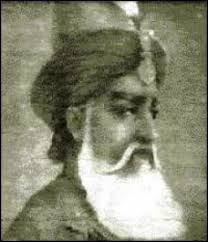
Modern portrait of Shah Waliullah Dehlawi

Now let us examine each school in turn.

Continue reading

Earliest Glimpses of Colorado Hinduism

The early 20th century in Denver marks a fragmented period for the presence of Hinduism, a time when authentic Hindu philosophy and spirituality began to emerge alongside a flurry of sensationalist and dubious claims. The Vedanta Society made a brief but notable appearance, attempting to establish a foothold for genuine Hindu teachings, though its influence appears to have been transient. More dominant in this period, however, were hucksters and lecturers who used Hindu concepts and imagery in ways that blended Western spiritualism, occultism, and commercial opportunism. Even among these figures, it is difficult to discern where genuine spiritual intent ended and snake-oil salesmanship began. These fragments highlight a historical moment where the public’s fascination with the exotic and mysterious often overshadowed earnest efforts to introduce Hindu traditions, creating an ambiguous and complicated legacy that warrants further exploration.

The absolute earliest fragments are some scattered references (2) in very early (1894) newspaper about Hindu beliefs or publications, but they are very sparse, and view the subject hazily and at a distance.

Some other very early articles contextualizing the extremely early Vedantic and Theosophical period in the context of the concern, anxiety, or even panic surrounding New Thought, occult, and other novel turn of the century religious movements are as follows:

Older Christian Science (1899)

Age of Spiritual Hunger (1903)

Mixture of Odd Beliefs (1910)

Wrongly Blamed (1906)

But for where there is more meat to the story, I will start with something a little more concrete:

The earliest reference I’ve been able to find of a Hindu actually visiting Colorado is actually a Brahmo Sajami, B. B. Nagarkar, who visited in 1894, having previously represented that tradition at the Chicago Congress of Religions the previous year. Despite the Brahmo Samaj being one of the first to bring Hindu thought to Denver and perhaps the US in general, its influence would eventually be eclipsed by the Ramakrishna movement, which gained prominence in the early 20th century, particularly through the work of Swami Vivekananda. Nevertheless, Nagarkar’s visit marks an important early moment of direct engagement between Hinduism and Colorado, predating the later widespread interest in Vedanta and other aspects of Hinduism that would follow with the Ramakrishna Mission and other movements.

Continue reading

Review of Nonviolence Consumption and Community Among Ancient Indian Ascetics

I recently read this book, which I would like to share my impressions of. Or at least my impressions of the first essay, entitled “The Politics of Alms gathering: Asceticism, Exchange, and the Alimentary Ethics of Ancient Buddhist and Jain Mendicants”. It is a fairly short book consisting of just two essays, so it is the type of thing which is easy to read and review. The first essay was quite interesting. I feel as though a Jain reading it would be irritated and maybe have some counterarguments. Nevertheless, I’ll just present it relatively uncritically, as this is more of a summary or a book review than a full analysis which would require further follow up research. 

Gandhara depiction of the emaciated Buddha, in the midst of his harsh ascetic practice prior to receiving enlightenment. (Also the profile pic of Videshi Sutra!)

Sutherland frames ancient Indian monastic communities in a way I haven’t heard before, though which in retrospect is rather intuitive. The idea is that Jain, Ajivika, Buddhist, and even Hindu renunciates all at one point in time late in classical antiquity followed a relatively similar pattern of monastic life (and continued to do so into the middle ages, and to some minor extent still do) centered around relatively extreme renunciation and ascetic practices, including wandering throughout cities and villages, isolation in the forest for extended periods of time, and a pretty extreme impulse towards maintaining some iteration of “purity”. Namely, purity of the sort which would be required to attain moksha, or nirvana, which sometimes could be termed “ritual purity” though that concept is not really inclusive enough to describe this.

Lets pause on this for a moment. This is unique and interesting to me because while we sometimes think of sramanas as sort of consisting of one distinct class of monks. We often think of them as being united by some implicit non-vedic doctrines, or perhaps a shared prehistory which is no longer accessible to us. Thinking of them as instead united by a shared practice is a different idea, an interesting one to me, and one which might offer a more obvious explanation of how it is that Brahminical ascetics were effectively part of the same system, social milieu, and world of ideas.

Continuing on, This whole ascetic programme created a problem, because now you have renunciates who basically don’t engage in the normal social world at all except in one particular respect, which is how they get their food. This link with normal society, though very thin, is a potential vessel for contamination. What if the food you take entails violence in some way? Now you’ve got that karma, that papam. What if the person giving it to you is ritually impure? Now you’ve got that on you as well. (Side note on that: Actually, just as this is a problem for the ascetic, it is also a social function of an ascetic. The ascetic, assuming he is powerful enough, has the spiritual power to “burn through” or “digest” the karma of the laity, which they themselves do not possess. In this sense giving the ascetic food relieves the laity of their papam via the symbolic act of donation, and allows the ascetic to dispense with the karmic debt in a sort of specialized form of spiritual labor. Though obviously this entails risk on behalf of the ascetic). What if you start storing up the food? Now you’ve got acquisitions and property which opens the door to materialistic living and an abandonment of ascetic practice. What if the food tastes really good? Now you’ve become mired in attachments as well. So these monks are in a situation where they have to be really really concerned about what types of food they take, who they take it from, and under what circumstances. This puts them in an odd situation where they are nominally independent and free of social strictures and conventions, while also being totally at the mercy of the productive classes of society for their food, while also being subject to risks imposed by the “sinful” acts of that same society.

Continue reading

A Scrap of Maldivian Buddhism

The Maldives are not a country we typically associate with Buddhism. Currently, it is primarily known to the West as a culturally denuded vacation dystopia/utopia catering to the cosmopolitan elite, though in reality, it also exists alongside a somewhat extremist Islamic state. A double whammy to ensure the cultural irrelevance of anything preceding even early modernity.

The paucity of the noticeable historical impact of Buddhism vis a vis Islam in the Maldives is actually one of the most severe I’ve ever studied, of any formerly Buddhist society. Typically those who mourn over the loss of such cultural zones reference Afghanistan, perhaps northern India, Bactria, Indonesia or elsewhere in Central Asia, or Southest Asia. But the elimination of Buddhism (and Hinduism for that matter) in the Maldives is shockingly total, not only in terms of population but also in terms of archeological evidence and even historical memory. This really is not something I’m making up. In the words of Hassan Ahmed Maniku (from CONVERSION OF MALDIVES TO ISLAM, Journal of the Royal Asiatic Society Sri Lanka Branch , 1986/87, New Series, Vol. 31 (1986/87), pp. 72-81):

Unlike any other country, when Maldives accepted Islam it was a complete acceptance. No trace of any other religion was left. Vestiges of whatever form of worship that existed prior to such acceptance was completely erased from view.

Whatever scraps escaped this storm are still under threat up until modernity. In 1959 the below pictured Buddhist statue was discovered in an excavation. It had clearly been intentionally buried to escape the wave of destruction that swept over the Maldives in the immediate aftermath of its conversion to Islam.

thoddu_statue_1959

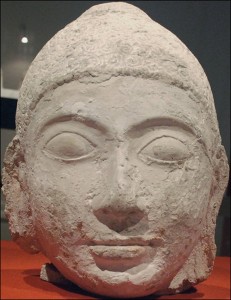
Almost immediately upon discovery, the statue’s head was smashed off, and most of the brittle torso was reduced to fragments. Below is the remaining head in the National Museum, after undergoing some restoration. Though given what happened in 2012 (see below) I am unsure of its current fate.

Maldives-231x300

Continue reading

Octagonal grinding disk cuts through the universe

Though an ominous, violent phrase, I think this I think represents two ends of a similar means of attaining wisdom within the broader Dharmic tradition. Two which are at opposite ends of a particular horseshoe. 1) The intoxicated Caitanya-esque ecstatic dancing, music, or trance (embodied in most epitomized form by the heterodox, antinomian and anti-textualist Baul tradition) on the one hand, and 2) The almost inhuman, absurdist form of samadhi of Chan/Zen Buddhism on the other, which produced the brutal, piercing line from which this post derives its title. Theoretically, the two share a genealogical origin in conjoined tantric traditions of Sahaja/Sahajiya Buddhism/Vaishnivism respectively. See the below diagram, with Bauls occupying the far left and Zen occupying the far right of the diagram. See the following quotation for a Chan/Zen mode of describing this condition.

DSCN1536

An eight-sided grinding disk is the large millstone which is turned by an ox or donkey. The idea that such an object was flying and cutting through the universe was something beyond common sense during the latter portion of the Kamakura period (1185–1333). There were intense debates on which form of Buddhism was superior: the established forms of Mahayana Buddhism or the newly imported Zen Buddhism. Scholars of the established Buddhist doctrine, with the intent to “crush” the newly arrived Zen Buddhism, debated Myocho Shuho who represented the Zen Buddhism side. (Later the Imperial Court honored Shuho by awarding him the highest title of Daito, Kokushi.) The scholars, after many debates, questioned Shuho: “Zen discourses intimate kyo gai betsu den [kyo=teaching; gai=outside; betsu=separate; den=communication]. What is the meaning of that phrase?” Shuho’s instant answer was “Octagonal grinding disk cuts through the universe.” The meaning of this phrase is that regardless of how well one intellectually understands the doctrine or dogma, without actual experience the understanding remains only on the surface. Deep attachments, delusions, intellectual understanding of good or evil; stubborn self-centered ideas and teaching through sutras: they who assume they are erudite scholars can be smashed into pieces but spiritual activity is totally free. Thus this statement ended the discourse and debates between the established Buddhist sects, and Zen Buddhism consequently gained a foothold in Kyoto.

The sagacity of this ichigyo mono made Zen Buddhism acceptable to other Buddhist scholars, and Daito, Kokushi since then has become greatly respected. The goal in Zen is to search for the truth with complete disregard for scholarly dialogue or one’s station in life.

In the work at left by Gengo Akiba Roshi, the subtitle is “Furyu Monji.” This means “not depending upon literature,” and is one of the phrases in traditional Chinese ideograms that explain the characteristic nature of Zen Buddhism. Other such phrases are Kyo gai betsu den meaning “extra- curricular or outside the teaching of sutras”; Jiki shi jin shin meaning “directly reaching to the heart and soul of that person”; and Ken sho sei butsu, meaning “rediscover the existing Buddha nature within oneself.” One must surpass or go beyond doctrine and the language from the teacher, and di- rectly connect with the spirit within. The student must take the mentor’s teaching and then internalize and digest it. Then it becomes an intrinsic part of heart and soul and allows each individual to grasp the core of Buddhist teaching in order to open the passage to satori. A simple way of saying this is to point your finger to your heart and it is the Buddha.

156-157, SHODO The Quiet Art of Japanese Zen Calligraphy

Ab Ki Bar Trump Sarkar

ap_16132301815691-1.jpg

Image Source: Quartz India

This recent spate of “right wing” victories which includes Brexit, Trump, and the European nationalists is part of the same global phenomenon which produced Modi.

It almost seems too obvious to point out how similar Trump and Modi are but I haven’t seen many people in my circles saying it. Probably because I hang out mostly with Americanized NRI liberals in the Brahmin class (as per Moldbug’s schema, not Chaturvarna). These people love Modi and hate Trump and want to avoid finding the obvious similarities and connections. There are some articles tracing out the connections. Mostly in condemnatory tones. But some sources are saying the exact opposite as well, which is totally ridiculous. So lets go over some of the basics.

Victory of the Edgelords: The first major similarity is their negative public branding, and the material causes for why that sort of branding was possible in the first place. Trump and Modi both are both considered bigots by their liberal opponents (particularly in English language media which has been totally captured by leftist establishment forces), and have garnered support from right wing radicals. In Trump’s case this mostly centers around his rhetoric, though he is also favored by far right groups like (numerically and politically insignificant) KKK or the (much more numerous and significant) Alt-Right. In Modi’s case it derives from his institutional connection with the RSS and Hindutvadis in general, and his role in the Gujarat riots. In both cases this seemed to have damaged their reputations and election chances at the time. They were considered outsiders with hickish attitudes by their own liberal countrymen, and scary nationalists by neoliberals in other countries. Remember how under Obama the US denied Modi’s visa? Well Trump narrowly escaped the same fate at the hands of the UK parliament. Ultimately in both cases this politically correct negative branding failed to stop the candidate, as what the media establishment portrayed as a negative and bigoted campaign was interpreted very differently by the voting public.

Continue reading

Covert Lokayata III: Orthodox Darshanas

(Click to go back to Part I: Doctrines)

(Click to go back to Part II: Proto-Materialism in Vedic and Tantric Traditions)

lokayatachartfiddled_PT3.jpg

Orthodox Hindu Schools

As anyone familiar with the orthodox Hindu darshanas knows, a belief in God is not a central feature of all orthodox schools of thought. Two of the orthodox Darshanas in particular seem distinctly rooted in materialism: Samkhya and Vaisheshika. Those are discussed below.

Early Samkhya:

Chattopadhyaya goes so far as to claim that:

“If the Sankhya philosophy were in the earlier times an explicit philosophical re-statement of the fundamental theoretical position implicit in Tantrism, and, if further, as we have aready tried to argue, the term Lokayata originally stood for the beliefs and practices broadly referred to as Tantrism, then original Sankhya may be viewed as the most important developmet of the Lokayata tradition in Indian philosophy. Silamka, the Jaina commentator, was justified in denying any basic difference between Sankhya and Lokayata. Sankara, too, made the Sankhya philosophers quote the authority of the Lokayatikas”[1]

Continue reading

The Islamization of Bengal

bengali final8 1

The cover of Richard Eaton’s book, upon which this post is premised.

I just reread Richard Eaton’s book The Rise of Islam and the Bengal Frontier, 1204-1760, and thought I’d make some observations on the theory it purports, and some of the implications. The entire book is available for free: Here.

The Theory

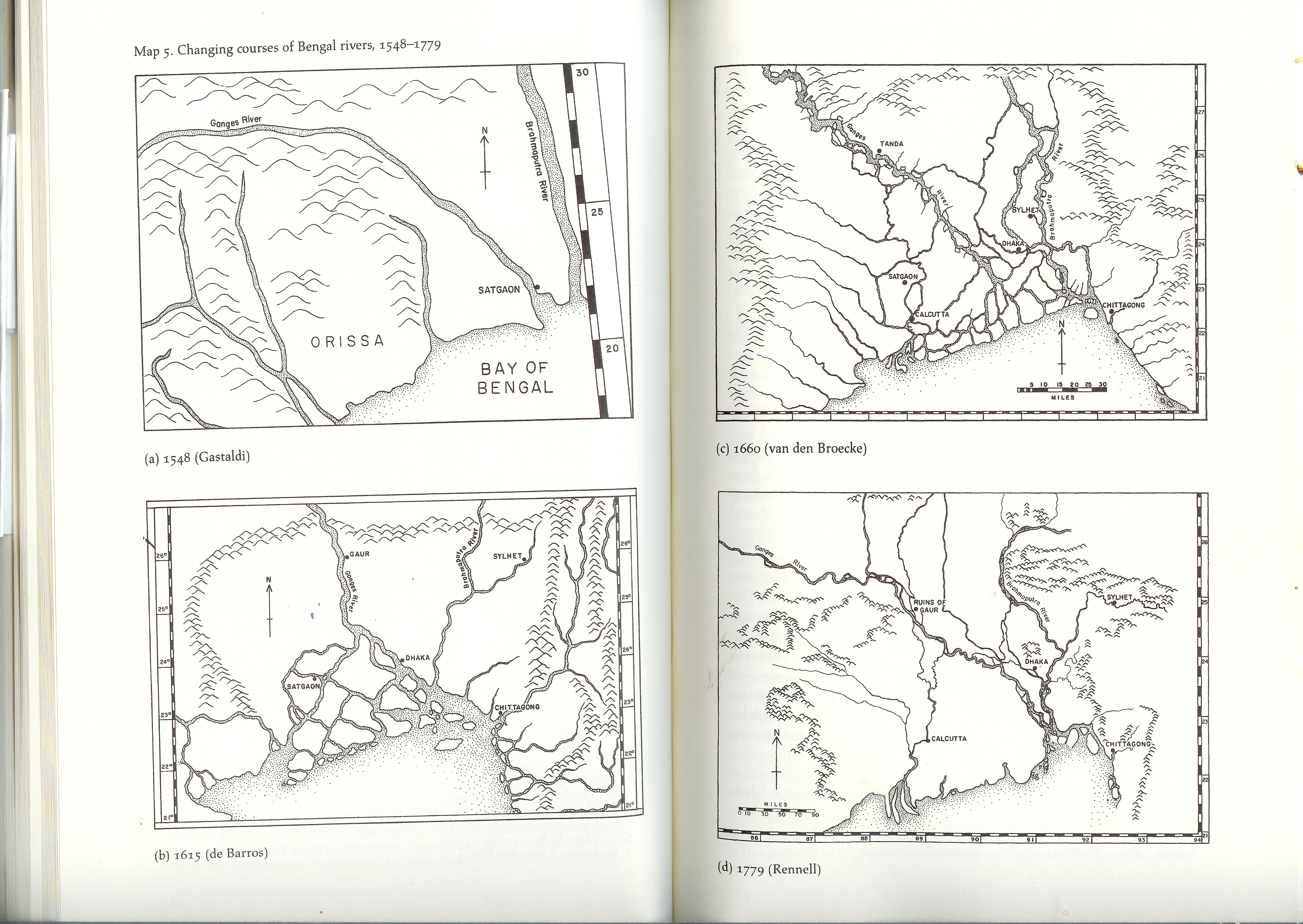
Eaton’s theory of Islamization rests on a much broader theory of how Bengali religion; both Hindu and Muslim was transmitted. It goes more or less as follows: New agricultural technologies, systems of land tenure, and legal/governing institutions were the main drivers behind the spread of both religions. Initially Brahmins, but later Sufis would head into a new region of the delta and establish themselves as local elites responsible for agricultural management (a similar pattern can be seen in the Deccan). Often the Sufi leader and his institution, or a temple institution would get a land grant from the state for this purpose, but this was not always the case. These religiously affiliated colonists brought with them new agricultural technologies from the west, which they would then implement locally. By some arrangement, religious elites became aligned with political elites. This was either because a preexisting regime sent out the Brahmins/Sufis in the first place, or because the regime sought to co-opt them once they had gained a following, and increased local agricultural productivity. Along with religion, the Brahmins and Sufis would bring in with them notions of law, languages, trading customs, etc. which brought eastern regions into the orbit of Indic civilization. In western Bengal this happened in the Epic period. In north Bengal, this happened in the historical period just preceding the Mughals. Due to its lateness, the land tenure system in the north was more primitive, relying on corvée labor rather than taxation in the form of crops or currency which existed in the west of Bengal. In the east and south of the delta however, no organized system of agriculture, government, or religion existed prior to the Mughal period. It was what we would call “aboriginal.” The main driver of this entire pattern was the eastward shift of the Gangetic delta between ~1400 and 1800, which rendered old land less productive, and forced people to confront the task of clearing and farming the forest. This moving river system thus constitutes a frontier in multiple dimensions; ecological, political, technological, and religious. All of these frontiers long predate the presence of Islam in the subcontinent, and can be easily discerned in earlier Sanskrit depictions of the region. Most of Bengal is described as mleccha territory outside the domain of “Aryavarta” in Sanskrit texts like the Baudhayana Dharmasutra (5th c BCE). Thus, Islamization is just the most recent episode in a phenomenon, which has roots in the Bronze or Iron Age.

bengali final8

From the book. Maps illustrating the eastward migration of the Bengal delta.

Other Theories

This general pattern explains the population drift, and the transmission of new religion and technology eastward over time. But here it might be necessary to back up a step. The broadest problem, which Eaton is trying to solve, is the uncanny distribution of Muslim populations in the subcontinent. It is striking on a demographic map that Muslims are concentrated on the eastern and western flanks of north India, but are thinly spread out in the middle. Eaton lays out the prior 4 theories to explain Islamization before presenting his own. They are as follows: Continue reading

How Rammohan Roy Broke Into Liberal Discourse

A bust which Roy actually had the patients to sit for (unlike many portraits of him). Image Source

A bust which Roy actually had the patients to sit for (unlike many portraits of him). Image Source

The Problem

When entering the realm of European liberal discourse, Rammohan Roy was faced with a double sided problem. Firstly, liberal thought at the time considered India to be in a state of backwardness, and therefore inherently unfit for political autonomy. Secondly, it was thought that a culture lacking a tradition of liberty couldn’t produce individuals worthy of entering the public discourse. Thus, Roy had to simultaneously challenge liberalism’s notions of civilizational advancement and backwardness, and also convince his opponents to stop seeing him as a primitive who lacked the right to participate in the intellectual arena.

Roy’s solution to this (consciously formulated or not) was to create a new paradigm within liberalism based on some concept of “class” instead of race or culture. In this paradigm elites across cultures have more in common with one another, than they do with their respective sets of commoners. This is why elites everywhere practice forms of religion closer to monotheism, and also why idolatry and trinitarianism are practiced by the masses of ignorant commoners. Based on this logic, the British elites in India should support and cooperate with their Indian counterparts, as they constitute the same in-group. Educated and mercantile elements of both societies should engage in commerce and cultural interchange, and work for the upliftment of the ignorant underclass of both British and Indian populations. In this new model, the relationship of liberal upliftment is shifted from something akin to the “white man’s burden,” to something more akin to the “bourgeois monotheist’s burden.”

Liberalism was indeed universal in regards to the equal capacities of all human beings. However, liberals saw those who came from “despotic” societies as inherently primitive in social development, and therefore unworthy of political representation. Furthermore, liberals looked for certain social indicators, which would identify people as worthy of political inclusion, and deserving a voice in the public sphere. These indicators included language, dress, education, and religion which were easily recognizable as civilized by Europeans.1

Continue reading

Subversive Hindu Thought

“In childhood a female must be subject to her father, in youth to her husband, when her lord is dead to her sons; a woman must never be independent….If a wife obeys her husband, she will for that (reason alone) be exalted in heaven.” –Manu Smriti[1] ***

“I have nothing to do with the husbands of this world”- Akka Mahadevi

Akka Mahadevi. Image source.

Akka Mahadevi in samadhi, nude but draped in her flowing hair.  Image source.

I’ll try to reserve most of my comments for the end of this post. The following is a collection of verses by female, often low caste Bhakti (devotional) poets which I’ve collected from various books and journal articles. They challenge the way we normally think about women in Hinduism. Caste rules to gender norms, and even the Vedas and Brahmins all are opened up for fiery criticism. This is a part of the Hindu tradition, which often doesn’t get much press. You normally read about how caste is inherent to Hinduism, and how if one Brahminical texts says it, then it is the official, textually certified Hindu position on the matter. Not so. Hinduism is a much more anarchic tradition than that.

The Role of Women:

By Akka Mahadevi (12th century AD):

“The preceptor became the giver;

The Lord Linga became the bridegroom;

And I became the bride.

All this the world knows

The innumerable devotees are my parents

Hence Chenna Mallikarjuna is my husband,O Prabhu,

I have nothing to do with the husbands of this world” [2]

 This is an inversion of Manu’s claim that a woman should treat the husband as God. She treats God as her husband.

“On a frame of water, raising a roof of fire,

Spreading the hailstones for the bridal floor-bed,

A husband without a head, married a wife without legs,

My parents gave me to an inseparable life,

They married me to Lord Chenna Mallikarjuna” [3]

Verses such as these can be read as conservative, but remember that this poet, like many others Bhakti sants, did refuse to get married to any man. This wasn’t just talk. Given the stigma attached to unmarried women in Indian society, this was a radical statement. In Akka Mahadevi’s case, she rejected a Jain king named Kausika rendering it an even more powerful act of defiance.

Continue reading