The Modern Renunciate in Guru Dutt’s “Pyaasa” (Thirsty)

“Birth is misery, old age is misery, and so are disease and death, and indeed, nothing but misery is Samsâra, in which men suffer distress.” -Mahavira, Uttarâdhyayana Sûtra, Lecture 19, Verse 15.

***SPOILER ALERT***

pyaasa-poster2

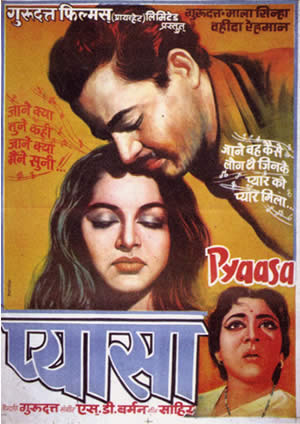
Pyaasa movie poster depicting Vijay (Guru Dutt), and Gulabo (Waheeda Rahman) in the center, with Meena (Mala Sinha) looking on unhappily from the corner. This poster kind of gives away the resolution of the love triangle.
Image source: A Tangle of Wires

The full movie is available on Youtube. Click the “CC” button to access english subtitles.
This is probably the most beautiful, poetic Bollywood film I’ve seen to date. For what it’s worth, Time Magazine agrees that its one of the best in cinema history. You really should watch it for yourself, but not everyone has a 2 hour commitment. So just read the post instead. You’ll feel like you saw it. A small amount of summarization will be necessary here, but go to Wikipedia for an actual summary.

If you are just interested in the songs, they’ll be collected at the bottom of the article with the relevant Youtube links. (you might have to hit “Continue reading” if coming from the main page.)

something stirred 0 14 20

Waheeda Rahman being seductive in the song “Jaane Kya Tune Kahi.” 0:14:20

The Saraswati River Runs Dry: The film starts out in a metaphorical Garden of Eden, (or should I say the Saraswati valley?) Vijay is peacefully lying down next to a river in a garden, and celebrating the beauty of nature in song. Within the first minute, the dreamy mood is broken by an anonymous leather shoe, which crushes a bumblebee before Vijay’s eyes and shatters the serenity of the moment. As he exits the park, Vijay ends the song by rhetorically asking: “What little have I to add to this splendor, save a few tears, a few sighs?”

The Eden analogy is apt because never again (on the story’s timeline) does Vijay sing a happy word of poetry. From here on, the story inhabits the corrupt material realm of fallen man.

Socialist Pipe Dreams:

“We have to build the noble mansion of free India where all her children may dwell. The appointed day has come – the day appointed by destiny – and India stands forth again, after long slumber and struggle, awake, vital, free and independent.”  –Jawaharlal Nehru in the speech “A Tryst with Destiny,” August 14 1947

Impressive words right? Nehru didn’t invent this ideology. He just voiced the common sentiment that independence would harken a glorious new era for India, in which political and social structures would be overhauled for the better. Here is another such quote by a prominent independence leader you might have heard of:

“In the democracy which I have envisaged, a democracy established by non-violence, there will be equal freedom for all. Everybody will be his own master. It is to join a struggle for such democracy that I invite you today. Once you realize this you will forget the differences between the Hindus and Muslims, and think of yourselves as Indians only, engaged in the common struggle for independence.” -Mahatma Gandhi from “Quit India speech”, August 8, 1942

The fantasy of being on the cusp of a socialist golden age was integral to Congress’ nationalist ideology. When the heralded changes never materialized, disenchantment, despair, and even disgust at the state of Indian society percolated through the national zeitgeist.

Instead of this idealized future, Vijay finds a society in which one’s humanity is only worth what it can fetch on the market. A society permeated by hypocrisy and cruelty,  These characteristics are not unique to India, but given the high hopes engendered by the independence movement it is easy to see why some Indians reacted with such despair in the 1950s. Nehruvian socialism failed in its promises, and left India to bear the unmitigated social and economic realities of developing world capitalism. I would argue to the contrary that it intensified the harshness of those realities, but that is a topic fit for another post.

guru-dutt-actor

Actor and Director of the film, Guru Dutt looking angsty.
Despite the watermark, Image source: Bollywood Updates

Vijay the Marxist: More than anything else, the film’s social critique centers around the dehumanizing conditions of Indian “capitalism.” I refer to “capitalism” in quotations here, because India by no means had capitalism, as defenders of the free market would define it. Nehruvian socialism was quite distant from laissez-faire. The definition used here is the Marxist one: an economic system in which the means of production is owned privately rather than collectively, In the Marxist paradigm, capitalism leads to things like commodification, commodity fetishism, and the alienation of workers from their labor (and therefore from their humanity.)

(If on the main page, hit “Continue reading” to read more)

Continue reading

King Akbar’s Mahabharata, or the Razmnama (Book of Wars)

Image

The battle of Duryodhana and Bhima (among others.) From the 1616-1617 edition of the Razmnama. By Kamal.
Image source: Simon Ray


When I was little I used to come across prints (much less elaborate than the above) in my house of scenes from the Mahabharata—with (what I assumed to be) Urdu writing on them! It confused me. I looked it up. Turns out, the Mughal king Akbar had a copy of the Mahabharata translated into Persian. Mystery solved. I put it to the back of my mind until recently when, while trying to plug gaps in my knowledge base I found out that there is actually a pretty interesting cast of characters behind this translation. An impassioned, suicidal artist, and his apollonian counterpart! An Islamic fundamentalist tasked with translating infidel texts! A king motivated by both religious toleration, and the maintenance of his regime’s legitimacy! Plus, it’s a good focal point around which to examine Indian art history which gives me the opportunity to post pretty pictures. Swiftly onwards–

Akbar’s Translation movement:

Akbar has a well-earned reputation as the most tolerant and humane of the Mughal kings. His formal policies towards non-muslims displayed liberality, and the composition of his court bespeaks of inclusivity. The range of art and music he chose to patronize also knew no religious bounds.[1] He even founded “Din-e-Ilahi,” a new syncretistic religion that earned the scorn of the orthodox Muslim intelligentsia.

Given these tolerant and syncretistic tendencies, it is no surprise that Akbar was interested in gaining access to the literature of the non-Persian speaking world. During his reign Akbar’s scholars translated works from Sanskrit, Hindi, Arabic, Greek, and Latin into Persian, and also did substantial translation work from Persian into Hindi. Though the Mahabharata was the center of his project, Akbar also had the Ramayana, the Artha Veda, the Lilavati (a treatise on mathematics), and other Sanskrit texts translated into Persian.[2] [3]

Court historian Mulla Daud writes that Akbar “ordered, that the rational contents of different religions and faiths should be translated in the language of each, and that the rose garden of the traditional aspects of each religion should, as far as possible, be cleared of the thorns of bigotry.” Akbar’s reputation for tolerance has helped this explanation for the translation movement stick.[4] However, one should treat anything explanation given by court historians as suspicious. The Razmnama’s text has an array of strangely translated passages, additions, or omissions which justify this suspicion. While I’m sure that Akbar was genuinely interested in reading Hindu texts and spreading knowledge of them amongst his nobility, I also think that the translation project had distinctly fetishistic and propagandistic elements to it.

But First—

The Translation Process:

Ok, here’s the basic process. First, Sanskrit literate Brahmans (many of whom were converts to Islam) translated a common North Indian variant of the Mahabharata from Sanskrit into Hindi both in text, and verbally. Then the Hindi text was translated into Persian by a staff of Muslim, Persian speaking scholars. [5] Then that raw translation was converted into poetic verse by the project’s head, a scholar named Abu al-Fazl. [6] So obviously “translation” is a very loose term. It’s really more of a retelling.

script

A folio from a 1616 copy of the Razmnama in which: “Asvatthama Fires the Narayana Weapon (Cosmic Fire) at the Pandavas.” You’ll notice I have so far posted no images from the 1587 manuscript which is under discussion here. That is because it sits in the City Palace Museum in Jaipur off limits to all historians. So thanks for nothing City Palace Museum in Jaipur.
Image source: Metropolitan Museum of Art

(If on the main page, hit “Continue Reading” for more [theres pretty pictures ahead {do it}])

Continue reading

Hindu Devas take a (silk) road trip to Japan!

(Note: If you are only interested in pictures, skip past this and hit “Continue Reading”)

This is a historical phenomenon, which entertains and fascinates me to no end. Buddhism had a huge impact on all East Asian cultures, especially on their pantheons of deities. On first glance it might seem odd that a reform movement, which rejected many of the core tenants of Vedic religion would transmit a belief in Vedic deities. This apparent oddity is a misunderstanding of Buddhism’s “atheism,” and a misunderstanding of what a “Deva” actually is. Most forms of Buddhism, while rejecting the concept of all-powerful gods or creator deities, openly accept the existence of powerful supernatural beings. This includes yakshas (nature spirits) rakshasas (demons) gandharvas (celestial musicians) nagas (supernatural snakes) and many other beings, including Devas (deities.) In Hindu and Buddhist cosmology, Devas are created beings that roam around the universe seeking the divine, albeit very powerful ones with much greater spiritual capabilities than humans. Hindu traditions tend to accord Devas much more power and divinity than Buddhism, and worship them as manifestations of The Supreme. In the Buddhist pantheon, the Devas have generally converted to Buddhism and now serve as his protectors, the protectors of his teachings, or as helpers to mortals who are trying to achieve enlightenment.

The reader should be aware that in Japanese mythology and theology the below deities freely interact with native Shinto deities, and deities imported from China. I am isolating the Indian derived deities for the purpose of this bog post, but do not be deluded into thinking that they are unintegrated with the rest of Japanese mythology.

The more popular of these deities are used in non-esoteric Mahayana Buddhism (the bulk of Buddhist sects in Japan.) However, most of these are relatively obscure deities because they are only used in the Shingon school, an esoteric (tantric) school of Buddhism. As such, the bulk of these Devas achieved full development in Japan around the late 700s or early 800s, as a result of the rise in popularity (especially amongst the political elite) of esoteric and Shingon Buddhism.

Last note: There are a lot of different names involved here, because (among other reasons) Sanskrit and Japanese don’t transliterate very well. For deities in which two names are listed, the first is Sanskrit, and the second is Japanese. In cases where, for some reason, I’ve listed many names, I will specify with an (S) or a (J) which language it is from.

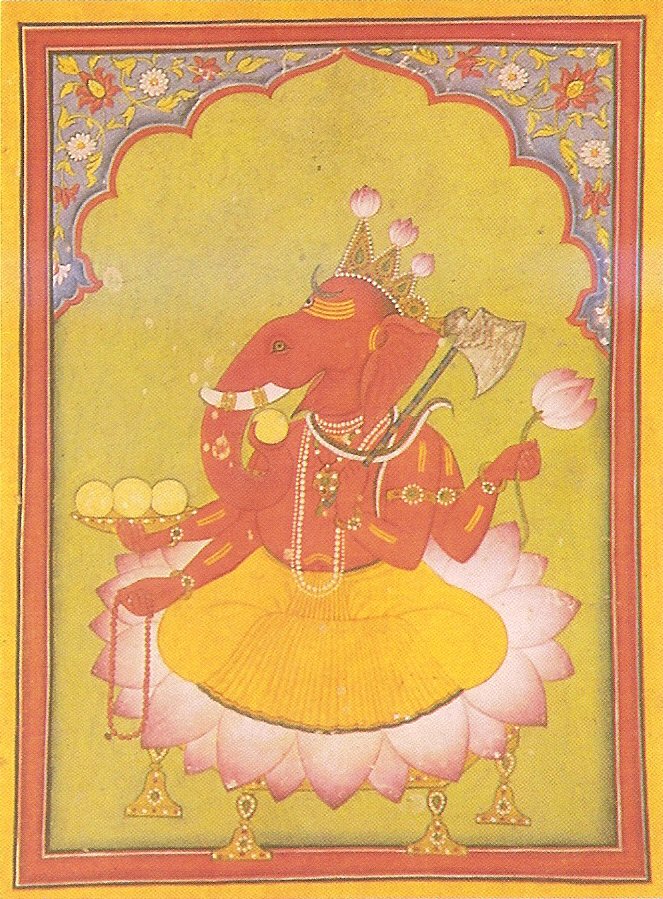
(S) Ganesha/ (S) Vinayaka / (J) Binayaka / (J) Shoten/ (J) Kangiten: Ganesha was one of the first Indian deities to transit to Japan, and as in India, is one of the most popular in both esoteric and non-esoteric sects. Perhaps this is because his association with worldly prosperity has been retained, or perhaps amplified into a general association with pleasure. Thus, actors, geishas, gamblers, restaurant proprietors, etc offer him worship. Shoten has retained the association for removing obstacles, although his ancient association with creating obstacles which has long since been expunged from the Hindu tradition is still mildly active in Japan for reasons which will become clear later.

Ganesh (musée d'art indien de Berlin)

Dancing Ganesha from North Bengal, 11th Century. Image From Vikram Kharvi’s blog “My Lord Ganesha”


Kangiten

Contemporary Kankiten Statue from Fukuoka Japan. Image from this Japanese Website

He is often depicted in (implicitly erotic) embrace with another elephant headed figure. In that iconography, his name is “Kangiten” or “Binayaka.” This is an allusion to a Japanese myth about Kangiten’s “evil” origins, wherein his mother, Uma births 1,500 evil children onto her left (collectively called Binayakas), the first of which was Binayaka. On her right side she births 1,500 good children the first of which was Avalokiteśvara/Kannon (the Bodhisatva of compassion) incarnated as Idaten (Skanda or Murugan in India.) In order to win Binayaka over to goodness, Idaten reincarnates as a female binayaka and becomes Kangiten’s wife. The bliss generated by their union turns Kangiten good. According to this myth therefore, the embracing Kangiten figures actually represent Kangiten in sexual union with his brother reincarnated as his wife/sister. There are other myths, which seek to explain this iconography, but all of them involve some sort of gender reversal, usually by means of reincarnation.[1]  There is a huge corpus of Japanese Ganesha myths, which do not exist at all in India, but the initial one just mentioned seems to almost reference Ganesha’s actual historical development in India. Ganesha probably evolved from the set of demons called Vinayakas/Binayakas who were known for erecting obstacles and creating divisions between allies. However, they were easily appeased. So easily appeased in fact that over time they evolved into positive forces, and merged into one deity—Ganesha.[2]

embrace 2

Embracing Kangiten. Image from onmarkproductions.com

However, the aforementioned Japanese myths all seem to be trying to explain the dual figured Kangiten iconography by posing, as it’s mythological basis. The real basis lies elsewhere, probably in the translations of Amoghavajra, a half Indian half Sogdian monk living in China in the early 700s. He was a founder of the “Chen-Yen” school of esoteric Buddhism (a precursor to the Shingon school,) and his translations of various tantric texts entail repeated references to the “dual-bodied Vinayaka” which is an obstacle removing and prosperity inducing deity described as looking exactly like modern embracing Kangiten figures, including the erotic embrace. There was also a pre-Buddhist Japanese deity named N-io, which took the form of a male and female in embrace, which could have contributed, or facilitated the popularity of the embracing Kangiten figures.[3]

Continue reading