Buddhist Meditation on the Foul, and the Body in Horror Manga

contemplationofimpurities.png

From “The True Shape of Human Bones — On the Dawn of Anatomical Dissections in Early Modern Japan” By Michel Wolfgang. p 42

Warning! Very graphic imagery ahead if you choose to click through to this article.

I had the hypothesis that the type of “body horror” imagery which we see in modern Japanese horror Manga had some kind of historical relationship with Japanese Buddhism, probably via Buddhist meditative practices focused on repulsion. After some study, I am convinced of this hypothesis.

The imagery I saw in these manga reminded me of certain anatomical sketches and grotesque Japanese paintings from the Buddhist tradition. But what really put the idea in my head that there might be a connection between the contemplative practices of Buddhism and these manga was the disturbing experience of actually reading them. Although I’m not a Buddhist or well versed in how these particular meditative practices are supposed to be carried out formally, the straightforward descriptions of these meditations seems at least superficially similar to the experience of viewing grotesque images on paper.

Lets me show you what I mean:

Quotations from the Sutras:

The following is from Ekottarikāgama 12.1, which seems to be a Chinese recension of earlier texts:

““In this case, the practitioner meditates on the body as a body and according to its functions. When he examines it from head to toes or from toes to head, he sees that it is composed of impure constituents, and he is unable to be attached to it. He observes that this body has hair of the head and hair of the body, nails, teeth, skin, flesh, sinews, bones, marrow, sweat, pus, stomach, small intestine, large intestine, heart, liver, spleen, kidneys. He observes and recognizes urine, excrement, tears, saliva, blood vessels, grease, and observing and knowing them all, he is unattached and regrets nothing. This is the way the practitioner observes the body in order to realize peace and joy and be able to end unwholesome thoughts and remove anxiety and sorrow.”

It even explicitly uses a butcher analogy:

“Just like a skillful butcher or his apprentice might lay out the different parts of a slaughtered cow and distinguish the leg, heart, torso, and head, the practitioner observing his own body distinguishes the Four Elements just as clearly, seeing that this is earth, this is fire, and this is air. Thus the practitioner meditates on the body in the body in order to end attachment.”

Continue reading

Ab Ki Bar Trump Sarkar

ap_16132301815691-1.jpg

Image Source: Quartz India

This recent spate of “right wing” victories which includes Brexit, Trump, and the European nationalists is part of the same global phenomenon which produced Modi.

It almost seems too obvious to point out how similar Trump and Modi are but I haven’t seen many people in my circles saying it. Probably because I hang out mostly with Americanized NRI liberals in the Brahmin class (as per Moldbug’s schema, not Chaturvarna). These people love Modi and hate Trump and want to avoid finding the obvious similarities and connections. There are some articles tracing out the connections. Mostly in condemnatory tones. But some sources are saying the exact opposite as well, which is totally ridiculous. So lets go over some of the basics.

Victory of the Edgelords: The first major similarity is their negative public branding, and the material causes for why that sort of branding was possible in the first place. Trump and Modi both are both considered bigots by their liberal opponents (particularly in English language media which has been totally captured by leftist establishment forces), and have garnered support from right wing radicals. In Trump’s case this mostly centers around his rhetoric, though he is also favored by far right groups like (numerically and politically insignificant) KKK or the (much more numerous and significant) Alt-Right. In Modi’s case it derives from his institutional connection with the RSS and Hindutvadis in general, and his role in the Gujarat riots. In both cases this seemed to have damaged their reputations and election chances at the time. They were considered outsiders with hickish attitudes by their own liberal countrymen, and scary nationalists by neoliberals in other countries. Remember how under Obama the US denied Modi’s visa? Well Trump narrowly escaped the same fate at the hands of the UK parliament. Ultimately in both cases this politically correct negative branding failed to stop the candidate, as what the media establishment portrayed as a negative and bigoted campaign was interpreted very differently by the voting public.

Continue reading

India’s Ancient Constitution, Part 1

Did India have an Ancient Constitution worth respecting, or not? Did the British uphold it, or destroy it? For a Libertarian or Burkean Conservative Hindu, these are important questions to consider dispassionately. The answer actually matters. If India had an Ancient Constitution which was destroyed when the British came, then much of India’s existing constitution, a combination of British laws and the arbitrarily imposed theories of Ambedkar, is an usurpation of the ancient rights and privileges primordial to the land and the race. The very basis of the Indian state is in question in this case. On the other hand, if India had no such Ancient Constitution, or if it was destroyed by the Mughals and restored by the British, then the period of British rule was a period of liberation from Oriental Despotism wherein India was Brought Into History as Hegel might have said. This is a somewhat false binary, but I present it anyway to show some of the dramatic potential conclusions we can come to.

Its also important to consider what such a concept as an Ancient Constitution really even means. Is it a principle of abstract justice which is universal? Or do different societies create internally valid social compacts which might differ from one another in legitimate ways? Or is this an incorrect way of framing the question?

I’m not really going to try to definitively settle the historical question in this post. I’m still doing research on the topic and will put out my full view on it later if I think I gain enough information to make such a judgement. I’ll instead just briefly discuss what the idea of an Ancient Constitution meant to a few thinkers in the context of India. I’ll look at Bose, Burke, Roy, and Naoroji.

Subhas Chandra Bose .jpg

Portrait of Subhash Chandra Bose. Image source: quotesgram.com

Bose:

Continue reading

Covert Lokayata IV: Social and Physical Sciences

(Click to go back to Part I: Doctrines)

(Click to go back to Part II: Proto-Materialism in Vedic and Tantric Traditions)

(Click to go back to Part III: Orthodox Darshanas)

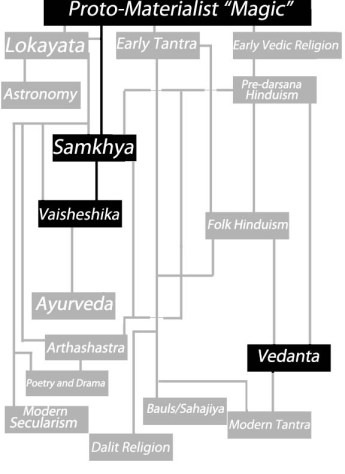
lokayatachartfiddled_science.png

Political theory

The word Lokayata occurs only once in the Arthashastra (PDF here), but it is a very significant mention. The treatise opens with the line “Om, salutations to Sukra and Brihaspati” the two progenitors of materialism and deha-vada (doctrine of the body as soul) in Vedic mythology. There are also numerous mentions of the “school of Brihaspati” later on in the text; though it is ambiguous which school Kautilya is referring to. Kautilya’s mention of Lokayata is as follows:

Anvikshaki comprises the Philosophy of Sankhya, Yoga, and Lokayata… Righteous and unrighteous acts (Dharmadharmau) are learnt from the triple Vedas; wealth and non-wealth from Varta; the expedient and the inexpedient (Nayanayau), as well as potency and impotency (Balabale) from the science of government.

When seen in the light of these sciences, the science of Anvikshaki is most beneficial to the world, keeps the mind steady and firm in weal and woe alike, and bestows excellence of foresight, speech and action.” (1)

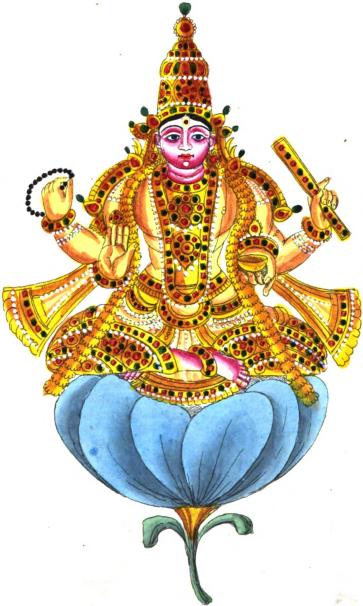
Shukra_graha.JPG

Shukra. One of the teachers of the Asura in Vedic mythology, along with Brihaspati. Source: Wikimedia Commons

Continue reading

Ancient Indian Aristocratic Republics

Mahajanapadas_(c._500_BCE).png

Map of the 16 Janapadas. Source: Wikimedia Commons

I was reading about non-monarchical forms of government in ancient India. Really I was interested in what they call the “Republics” of ancient India. But that concept is a bit misleading. It has all sorts of Eurocentric connotations, and implicit associations with democracy, egalitarianism, populism, etc. It has those implicit connections even though many European republics were essentially similar to the Indian ones insofar as they had restricted franchise and were basically aristocratic or oligarchic in nature, or merchant guild-based. In Sanskrit they were called Janapadas, Gana Sanghas, or a few other more esoteric words. 

I suppose one major difference between Indian and European republics is that there is  European republics frequently had agents which were said to “represent” the people, implying that “the people” were the sovereign ruler of the society. “The People” generally had an aristocratic definition, but also had the capacity to get quite plebian. It is difficult to tell who was regarded as sovereign in some of the following Indian examples, but if I had to guess I would say that as a general rule the ruling Kshatriya clan, or confederation of clans, was regarded as sovereigs. That said, in other literature I also saw evidence to suggest that sovereignty was also sometimes vested in individual villages, districts, or constituent guilds or corporations which themselves sent representatives to the council. Without copies of their constitutions we don’t know for sure, but I don’t evidence of directly democratic institutions. And why would we? Political egalitarianism is an alien concept to the subcontinent.

Given the existence of these republics really amazing that we still think of India as a static land of “Oriental Despotism.” For instance, we think of Buddha as a “Prince” when really he was a prince only insofar as he was the son of the elected leader of the Shakya Republic (to be fair, Buddhist literature inflates Sudhodana’s reputation which confuses this issue as much as the Hegelian/Marxist historiography). Republics are also central to the history of Jainism. Anyway the point is, India had ancient aristocratic republics and that is cool.

Below is a large chunk of Chapter 1: Forms and Types of States from the book Aspects of the ancient Indian polity, by Narendra Nath Law,  (Oxford, The Clarendon press, 1921.) Apologies for the typographical errors, I tried to clean up the ones which inhibited meaning:

Continue reading

The Anglo-Saxons Were Robbers and Pirates in Their Own Country

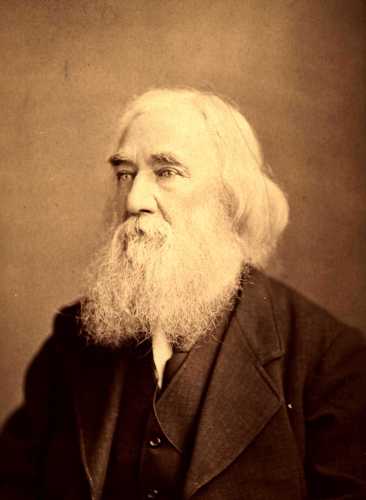
randy-Other_Spooner_Hi_Res.jpg

Lysander Spooner. Image Source: Volokh

Wipe out, then, these feudal robbers – the whole race of kings, and queens, and nobles, and all their accomplices in every grade of life, and take possession of all the spoils which they and their predecessors have wrung from you and your ancestors. Put an end to their Parliaments and Courts. Blot out forever their statute books. They contain little or nothing else than the records of their villanies. Free England and Ireland, and thus all the rest of the empire, of the tyrants and robbers that are plundering, enslaving, and crushing, and starving you.

Sorry Anglo-Saxons, this post is not for you. It culminates in one of the most cutting anti-Anglo rants I’ve ever read. You can just skip to the last block quote if you are short on time. Its low effort on my behalf because I’m mostly just quoting Spooner, but its worth it. Lysander Spooner wrote this letter entitled Revolution: The Only Remedy for the Oppressed Classes of Ireland, England, and Other Parts of the British Empire. He is one of my favorite Anarchist writers and if you aren’t familiar with him already, well you should be.

Continue reading

Covert Lokayata III: Orthodox Darshanas

(Click to go back to Part I: Doctrines)

(Click to go back to Part II: Proto-Materialism in Vedic and Tantric Traditions)

lokayatachartfiddled_PT3.jpg

Orthodox Hindu Schools

As anyone familiar with the orthodox Hindu darshanas knows, a belief in God is not a central feature of all orthodox schools of thought. Two of the orthodox Darshanas in particular seem distinctly rooted in materialism: Samkhya and Vaisheshika. Those are discussed below.

Early Samkhya:

Chattopadhyaya goes so far as to claim that:

“If the Sankhya philosophy were in the earlier times an explicit philosophical re-statement of the fundamental theoretical position implicit in Tantrism, and, if further, as we have aready tried to argue, the term Lokayata originally stood for the beliefs and practices broadly referred to as Tantrism, then original Sankhya may be viewed as the most important developmet of the Lokayata tradition in Indian philosophy. Silamka, the Jaina commentator, was justified in denying any basic difference between Sankhya and Lokayata. Sankara, too, made the Sankhya philosophers quote the authority of the Lokayatikas”[1]

Continue reading

Hindu Iconography from Far Central Asia

I already made a post about Hindu iconography in Japan, as expressed primarily in Shingon Buddhism. Now I’ll look to the west. As in the east, Hindu iconography appears in an ancient and intermixed state alongside other forms of iconography. In this case the context is Manichean, Zoroastrian, Greek, indigenous, and Buddhist. In many spots it gets hard to distinguish the border between iconographical forms as they tend to blend together into syncretic representations. It really is a historically unique scenario which produced such a melting pot of aesthetic trends. In any case the locations of these images, in a loose sense, define the high water mark of Hindu cultural expansion into Western Asia (Irredentists eat your heart out).

For the purposes of this exercise, I’ll ignore the art of Gandhara (inner Afghanistan/Peshawar region) which is already well known and should really be considered Indian art rather than an export. I’ll only be looking at art from north and west of Gandhara I’ll also be ignoring images of the deity Mitra/Mithra, because there are simply too many of them as this deity became very popular in the west and evolved its own well developed cult in Europe which is really a very different phenomenon than the diffusion of Shiva, Ganesha, or Parvati imagery in Western Asia. Due to the nature of the subject, some of the sourcing on these images or information is sketchy, but I’ll flag that when it is relevant.

Kushan Culture

Bactria

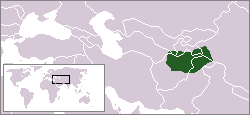
Bactria-320BCE

Bactria, 320 BC. Source: Wikimedia Commons

The following pieces are from the Metropolitan Museum of Art in New York City. They are all from the same archeological find, so I’ll only list that information in the first caption.

DT917

Panel fragment with the god Shiva/Oesho. Period:Kushan Date:ca. 3rd century A.D. Geography:Bactria, Culture:Kushan Medium:Terracotta, gouache Dimensions:H. 57.2 cm, W. 41.6 cm, D. 5.7 cm Classification:Ceramics-Paintings. Source: The Met

Company Painting

Here is an example of the style of painting which emerged in India under the British East India Company:

Great Indian Fruit Bat

hb_2008.312
Date: ca. 1777–82
Geography: India, Calcutta
Culture: Colonial British
Medium: Pencil, ink, and opaque watercolor on paper
Dimensions: Mat size: Ht. 27 1/4 in. (69.2 cm)
W. 35 1/2 in. (90.2 cm)

“In 1777, Sir Elijah Impey, chief justice of Bengal between 1774 and 1782, and his wife, Lady Mary, hired local artists to record the specimens of Indian flora and fauna they collected at their estate in Calcutta. Over the next five years, at least 326 paintings of plants, animals, and birds were made for the Impeys. On most of these works, the name of one of three artists—Bhawani Das, Shaykh Zayn al-Din, or Ram Das—appears along with the Hindi name of the animal and the phrase, in English, “In the collection of Lady Impey at Calcutta.” Although this painting bears no such inscription, it is closely related to another painting of a bat by Bhawani Das, and it has always been associated with Impey patronage. One can imagine Bhawani Das and the anonymous artist of this painting working side by side, observing the animals, but whereas Bhawani Das’ painting depicts a tawny-colored female bat centered on the page with both wings outstretched, his fellow artist has created an asymmetrical composition in shades of gray and black of an emphatically male bat with one wing dramatically unfurled.” (Source: Metropolitan Museum of Art)

Quite a looker isn’t he? I recently saw an interesting corner of the Metropolitan Museum of Art which I hadn’t seen before. It was a room labeled “Company Painting in Nineteenth-Century India.” For some reason I just hadn’t come across this room in prior wanderings. I decided to show you all some of the drawings and paintings I saw, with some historically related works interspersed for comparison.

The Company paintings are worthy of our notice because they reflect Indian aesthetic culture in this fascinating, relatively narrow slice of time between the Mughal state and the British state, when India was under Company rule. Mughal trained painters were able to modify their craft to suit British tastes, but this slight change  put them (generally speaking) out of the genre of imaginative, decorative court art and into the genre of scientific sketches, administrative records, or more rarely, a sort of elite tourist kitsch. The Indian artists in this collection have been forced by circumstance to depict less conventionally beautiful plants and animals, and in a more realistic style. The cultural change from luxuriant Mughal court system into the impersonal knowledge aggregating machine of the colonial period is reflected in painting. Its pretty cool.

They are also fascinating because it shows us a period in Indian history where British artists suddenly join Hindus, Muslims in a shared aesthetic genre depicting the Indic subject matter. Take a look at these scientific drawings of plants for example:

Ashoka Tree Flower, Leaves, Pod, and Seed

Date: first half 19th century
Geography: India, probably Calcutta
Culture: Colonial British
Medium: Opaque watercolor on paper
Dimensions: Page: H. 23 1/4 in. (59.1 cm) W. 17 5/8 in. (44.8 cm)
DP273291.jpg

Continue reading

Hegel on India and Hinduism

I was reading Hegel a while back and I thought my dear readers might want to see some of his content. At the end of this introductory bit I have just excerpted in total “Section II: India” and “Section II: (Continued) India Buddhism”  from “Part 1: The Oriental World” of G.W.F Hegel’s The Philosophy of History. So if you’d like to skip my blather, go down to the section “On India” right below the winged Zoroastrian symbol.

Introduction and preliminary analysis: 

Everyone seems to dislike that Hegel is overly obtuse and abstract, but when he discusses history he is actually taking in very concrete terms most of the time. This is not exactly a reliable source for specific information about Indian history or philosophy. In some ways it is a better study of how Europeans see India than it is a study of India. It suffers from a caricatured view of India as a land of contradiction, chaos, and conflict. For the most part his characterizations of India aren’t totally baseless though, as stereotypes often have a basis in reality. They are just stereotypical exaggerations or generalizations which lack any sort of nuance or qualification. He also seems to uncritically accept very early orientalist insights in Sanskritic culture as fact, and as reflective of the Indian society of the 1800s. To some degree this is excusable because Sanskrit translations and real detailed historical knowledge of India were still undergoing development in Europe. He had to have been over reliant on early translations of the Vedas, the Dharmashastras (particularly Manu), the Pali canon perhaps, and the writings of some few high-philosophers. Given his time period, his knowledge of Indian philosophy is actually impressive. He writes some rather detailed information here about the Samkhya, Nyaya, and Vaisheshika schools, so he at least knew that much. Yet perhaps I am being too generous to Hegel here. It is somewhat baffling to me how he derives an extreme idealist worldview from these three schools, Vaisheshika in particular. It was reading those philosophical schools which persuaded me that India has a sublimated tradition of naturalism. I feel that if he was also familiar with them it should have occurred to him that Hindu idealism is at least alloyed with a rationalistic form of naturalism.

Continue reading