This is the kind of post which needs to start with some maps and then contain even more maps:
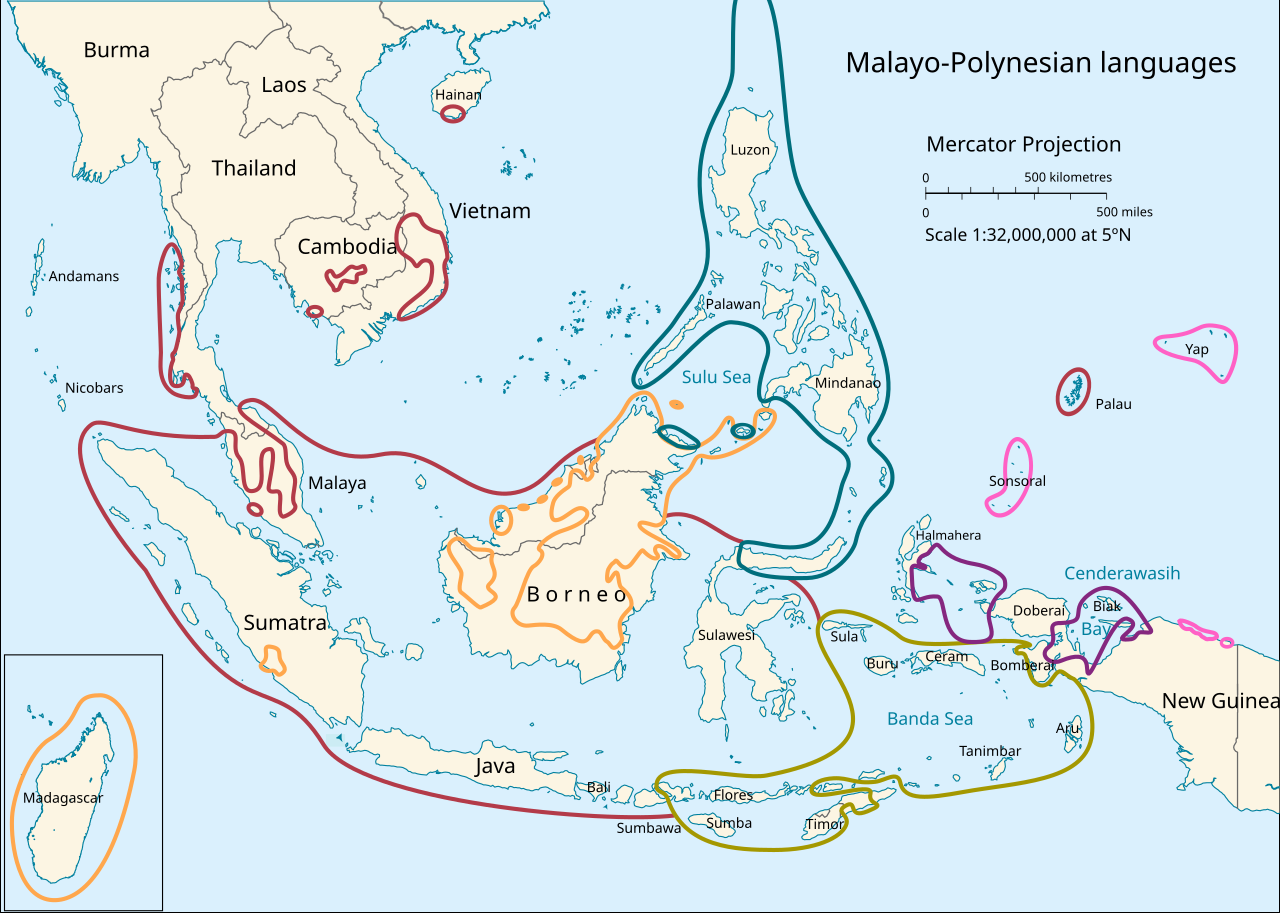
This map is useful because it shows that Malagasy (the primary language of Madagascar) is in the same sub-group as Bornean languages. There is a little pocket of this sub-group on Sumatra, but otherwise they seem oddly distant, with Sumatra and Java in between. The distance between the Indonesian archipelago and Madagascar is vast (4,700 mi or 7,500 km as the crow flies, if we start from Borneo), but this map doesn’t really represent that. See this other map:
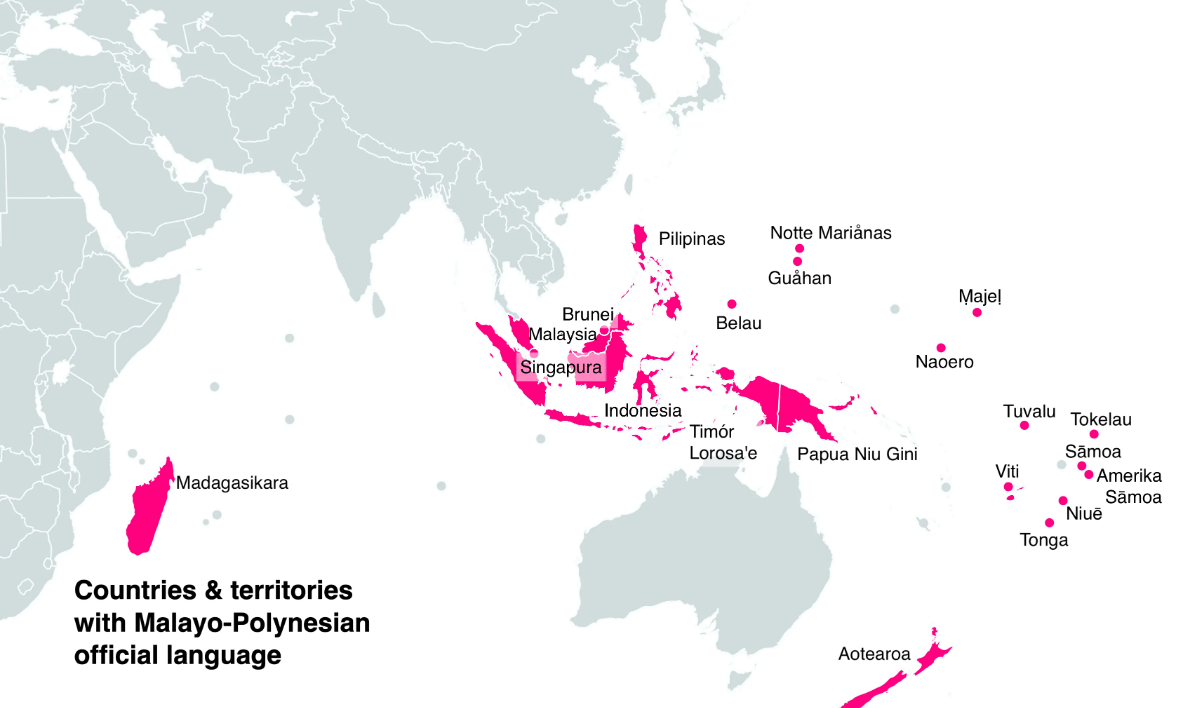
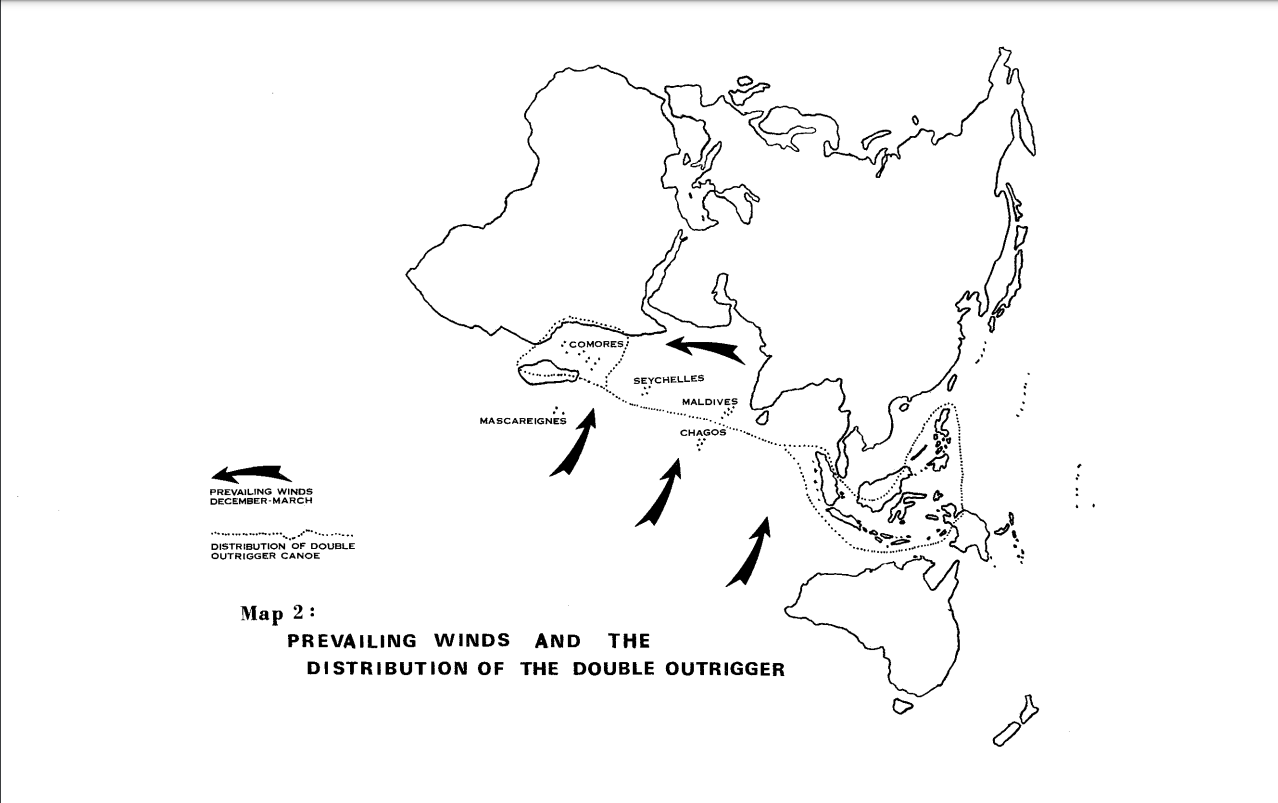
A lot of people (who are vaguely nerdy and interested in languages) know that Madagascar was settled by Austronesians from what is now Indonesia. This was certainly an impressive feat, and one which seems pretty challenging to do, even for the skilled seafarers of the ancient Pacific. But a third map, with a bit of a different perspective makes it a little more comprehensible:
But what I was curious about was this: At the time of Austronesian settlement of Madagascar, to what extent was the Austronesian culture Sanskritized? It turns out that this specific question doesn’t appear to be of much interest to academics. Bummer. However, there is a different, related question which is apparently more interesting to them. Namely: Can the presence of Sanskrit vocabulary in Malagasy shed light on how and when exactly this migration occurred? See the following block quote:
To return to linguistic analysis, one final area needs to be examined; this is the presence of thirty words of Sanskritic origin in the Malagasy language. Otto Dahl is the most recent linguist to compare Malagasy with Maanyan and other Malayo-Polynesian languages. Dahl separates the thirty words of Sanskritic origin into three categories. Thirteen words are of a religious or political nature and imply some form of court life. Ten words are calendar words (names of months and seasons) and display a connection
with Sanskritic loan words in Old Javanese. Seven words can be described as commercial terms; these are: ten thousand, debt, balance or remainder (of a sum of money), glass or bottle, betel, lemon/acid/vinegar, and ginger. Malagasy shares all of these Sanskritic loan words except ginger with other Malayo-Polynesian languages of Southeast Asia. This exception may be an indication of the commercial nature of the expansion to Madagascar. Whereas the Greek word for cinnamon, as noted above, is of Malayo-Polynesian, origin, the Greek word for ginger, like the Malagasy, is derived
from Sanskrit. Dahl concludes on the basis of the small number of Sanskritic loan words in Malagasy as compared with the much larger number of such words in other Malayo – Polynesian languages of Southeast Asia that the migration to Madagascar occurred at the very beginning of Sanskritic
influence in Southeast Asia.
Fascinating! So we actually a have rough answer to my original question. The original settlers of Madagascar were probably very lightly Sanskritized, as this occurred at the very start of Sanskritization. I wish we could dig more into that question. What does this mean about their family systems, their religion, their politics? But there is basically no writing on this subject. Sad. Anyways, when exactly did that happen and how would we know that? The below quote is from the same source as above:
Dahl then points to the earliest Sanskrit inscription found in Borneo as the key to dating the migration. He does this because the Yupa inscriptions found at Kotei in East Borneo list the names of three succeeding rulers, the first of which is of Malayo-Polynesian origin and the second and third of which are Sanskritic. Assuming that the inscriptions date from the beginning of Sanskritic influence, inasmuch as they display a transition from non-Sanskritic to Sanskritic royal names, the date of the migration would seem to depend on what date could be assigned to the inscriptions.
The only detailed study of these inscriptions available in a language other than Dutch is that of Vogel who, writing over fifty years ago, assigned the approximate date of A.D. 400 on palaeographical grounds. Of more interest than his self-admitted questionable chronological assignment, however, is Vogel’s comparison of the Kotei inscriptions with earlier Cham inscriptions and later Javanese inscriptions. Vogel concluded that the Chams played an important role in spreading Sanskritic influence into the islands. The first Sanskrit inscription of Champa can possibly be dated as early as the second century A.D. 82 On palaeographical grounds, Vogel sees a direct line of Sanskritic influence leading from South India to Champa, from Champa to East Borneo, and from East Borneo to West Java over a hundred year period.
Ok so sometime between 82 and 400? Still a pretty big window… And also, this theory relies on the premise that Sanskritization sort of radiated out of India into Southeast Asia and then into Borneo. Is that how it happened?
As it happens there’s an answer to that, and it comes from the other thing I’ve been reading. K.A. Adelaar’s article “Malay and Javanese Loanwords in Malagasy, Tagalog and Siraya (Formosa).” And it quietly takes the whole edifice above apart and steers us in a much more productive direction.
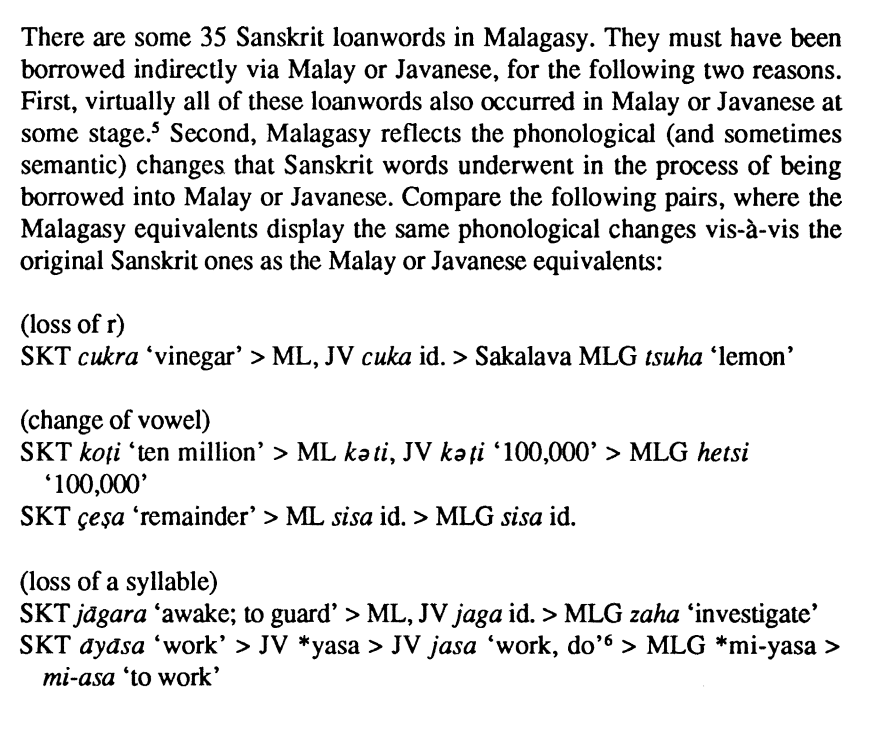
This is an elegant demonstration. The Malagasy words carry effects that only happened *from within* Malay and Javanese. Sanskrit “cukra” loses its r in Malay/Javanese “cuka”, and Malagasy “tsuha” has no r either. Sanskrit “jāgara” loses a syllable to become Malay/Javanese “jaga”, and Malagasy zaha has that same missing syllable! “Koṭi” is really cool. In Sanskrit it means ten million. In Malay and Javanese it got demoted to a hundred thousand for some reason and Malagasy carries that forward with hetsi. I really wonder how this happened. I think it would be funny if it inherited an accounting error that happened somewhere in the Java Sea. Anyways these Sanskrit words look Malay with a Malagasy accent or something like that.
So yeah, the direction of travel showing Sanskrit into Malay/Javanese, Malay/Javanese into Malagasy, is basically a fact. What remains as an assumption, and a pretty shaky one, is the second thing: Vogel’s theory implying a relay of South India -> Champa -> East Borneo -> West Java on a hundred-year timer. I don’t know, I find it difficult to get my head around that one. Vogel himself apparently conceded his dating was weird. But that doesn’t really matter because Adelaar doesn’t need any of it. He anchors instead to which variant of Malay the words came from. Its better, you’ll see.
Dahl treats the number of Sanskrit loanwords as a clock for the founding voyage. So having few words means they left early, therefore the migration happened at the dawn of Sanskritic influence, therefore lets go date the Yupa inscriptions and clock it at somewhere between 82 and 400 AD. But Adelaar shows the words in question came in secondhand through Malay and Javanese. And crucially, that this contact kept happening for centuries. Look at the next page:
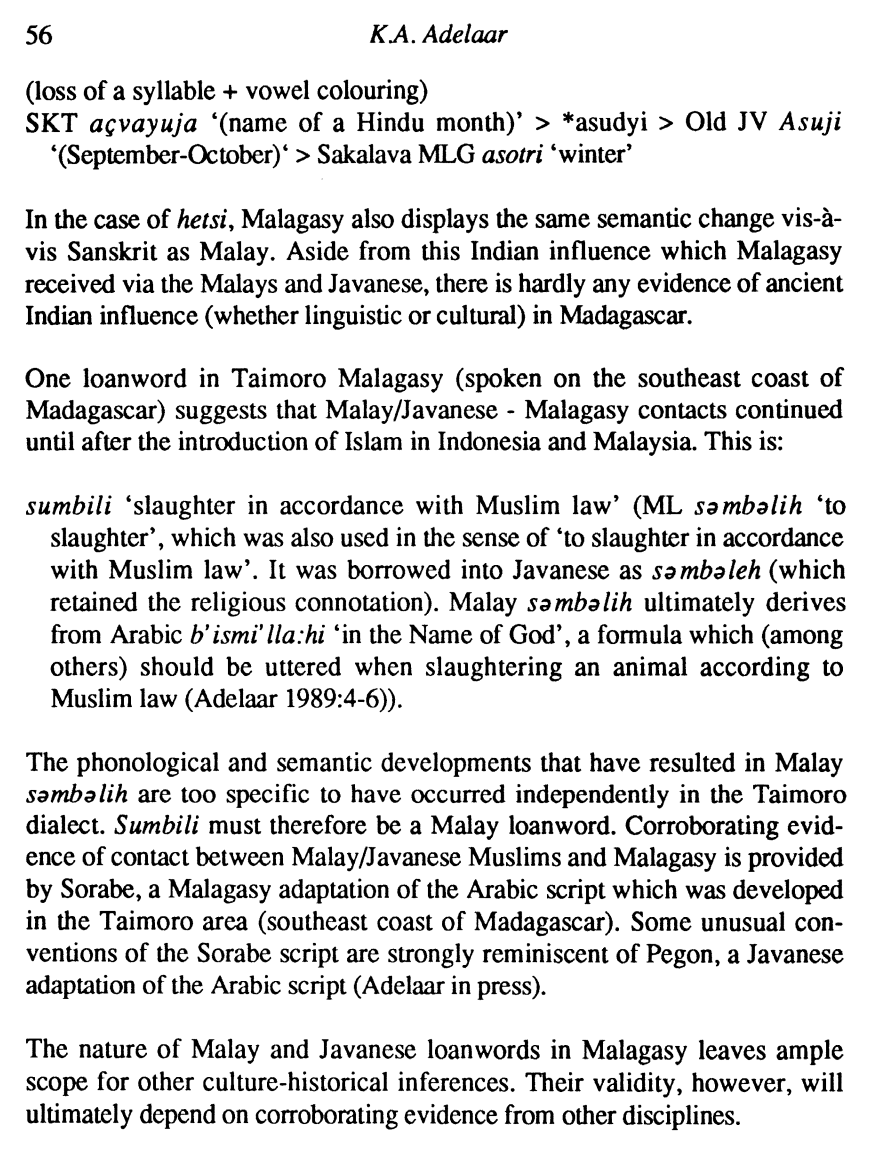
“Sumbili”, “to slaughter according to Muslim law,” ultimately from the Arabic “bismillāh”, borrowed into Javanese and then into Taimoro Malagasy. That’s cannot be a founding voyage word. That’s a word from *after Islam reached Indonesia*. Same with the “sorabe” script. Arabic again.
Which means I was thinking about the loanwords completely wrong earlier on. They can measure departure, but can also measure contact, including persistent contact.
I know this was supposed to be about language but just check the genetics. In A small cohort of Island Southeast Asian women founded Madagascar Cox et al. (2012) looked at Malagasy and Indonesian mitochondrial DNA and got a founding event around 1200 years ago (so, 800 or so), from a very small founding cohort. I mean… 30 women. 30. Roughly 93% of “Indonesian” descent. Then in Ancient crops provide first archaeological signature of the westward Austronesian expansion Crowther et al. (2016) found something else cool. Asian crops like rice and mung beans at Malagasy sites from the 8th to 10th centuries. Not 1st-4th centuries, or anything close to that.
So the crossing really happens somewhere in the second half of the first millennium AD (which, just to make this explicit, is *not* the dawn of Sanskritic influence in the islands. It’s well into it. Srivijaya is already doing its thing). Dahl confused the hell out of me and had the whole problem backwards. The way of looking at the problem is not “How did they carry so few Sanskrit words with them? I guess they must have left really early on”. It is instead “They left pretty late. So then why so few Sanskrit words?”
There’s an obvious answer, though it eluded me for years as I was intermittently researching this topic: The people doing the Sanskritizing, and the migrants were just largely different people.
Let me explain. First we have to just go over a few names of ethnic groups and languages.
Ma’anyan: The population whose language is closest to Malagasy is the Ma’anyan of southern / south central Borneo. Their language is called Ma’anyan, their ethnicity is also called Ma’anyan, and they are part of the broader “Dayaknese” ethnic group represented in the below map in red. They are pretty small in terms of population about 70,000 people, living inland, historically dry rice farmers and forest foragers. Not sailors. Not traders. Nobody who has looked has found any sign they ever were. So the idea that they were the ocean navigators who settled Madagascar makes no sense.
Banjar is another ethnic group, formed where Malay traders settled at Banjarmasin and mixed with the inland Barito speaking population.
Below is an ethnic group map.
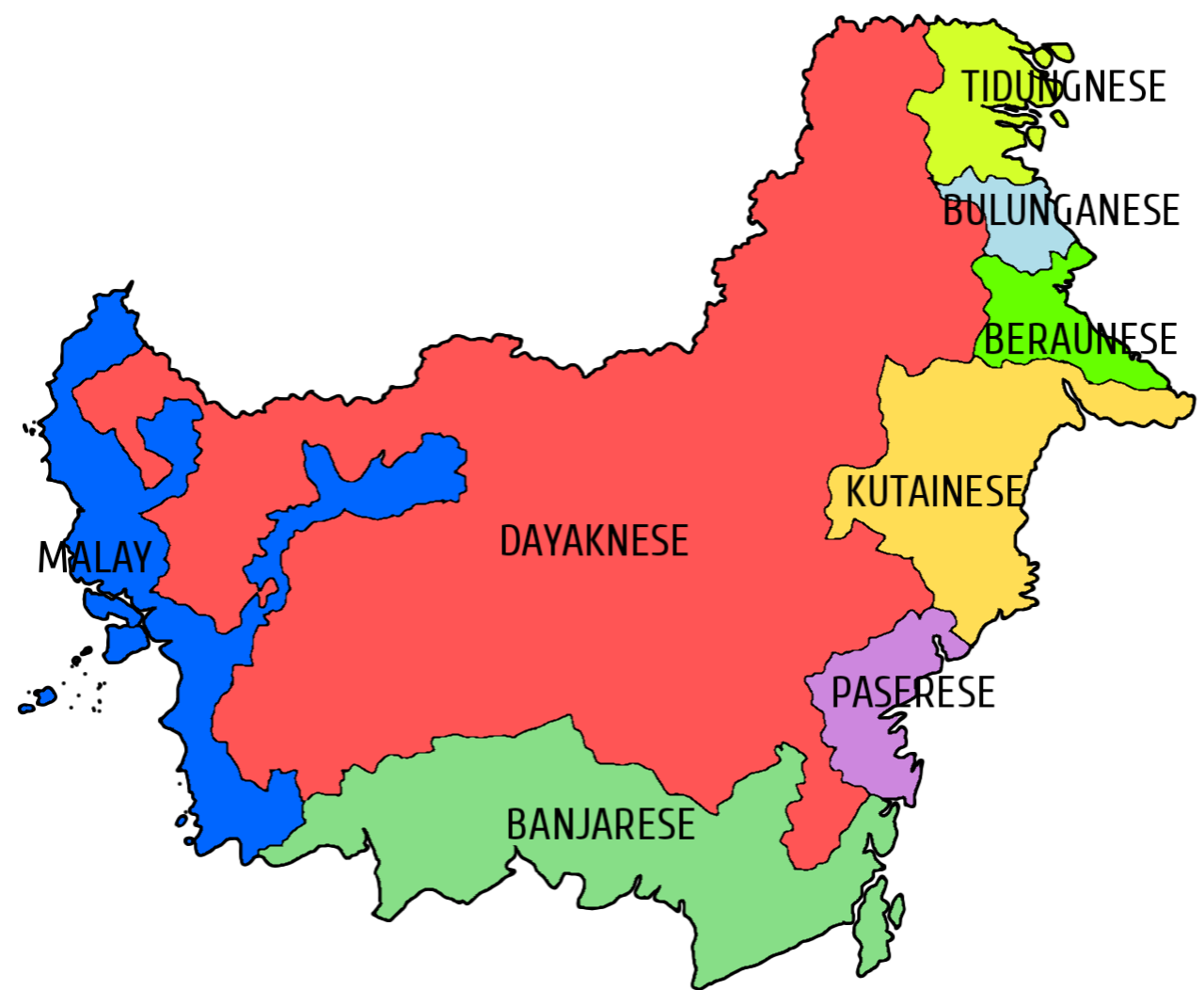
Barito is a language subgroup; Malagasy belongs to it, and Ma’anyan also belongs to it. You can see that where Banjarese ethnicity lies, they fall into a different language subgroup, which is Malayic.
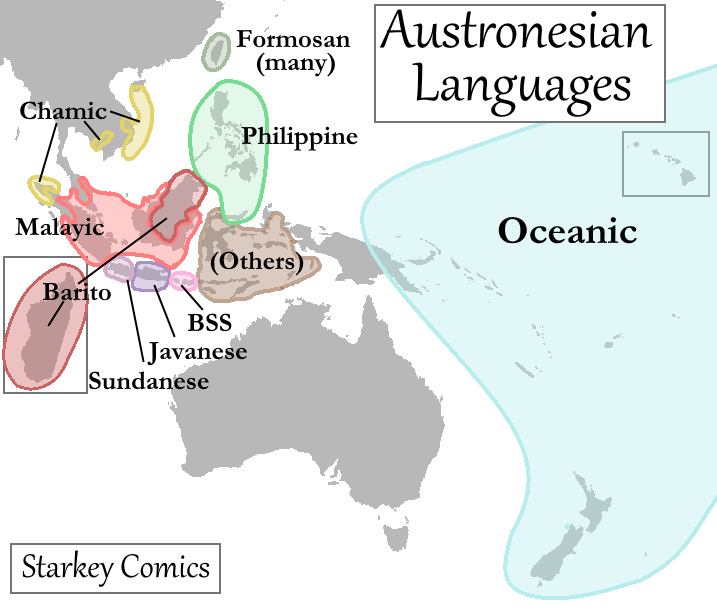
Now that we’ve got that settled, the weird thing: Malagasy’s language points to the Barito group (i.e. its related to Ma’anyan), but Malagasy genes point to the Banjar (Kusuma et al. 2016).
As I had briefly mentioned the Banjar were basically formed by an admixture of the inland Ma’anyan (Dayaknese) and the seafaring Malays, and they occupied the type of social position you’d expect from this interaction. Intermediate development, not captains or owners of ships, marginal and indirect Sanskritization even while Java and Sumatra were booming, that sort of thing. We would expect these types of people to be laborers on the ships owned and built by the high Sanskritic civilizations of the archipelago (or maybe even slaves).
So the story is Malay ships and Malay capital on top, Barito speaking underclass beneath, Sanskritized only secondhand and not much further than the wharf. Meanwhile, Java and Sumatra were raising stone temples. The ancestors of the Malagasy therefore, would likely not be owners or captains of these ships. They were the crew and/or the cargo
Adelaar reached the same place from language alone, way before the genetics, but still a bit later in his career (Adelaar 2009). His linguistic evidence is based on how vowels are transmitted and transformed between these languages. Banjar Malay has no schwa where Sumatran Malay does (I couldnt find a map which parses out all the differences between sub-groups within the Malay language. Sorry. If someone has one send it to me and I’ll post it). So Sumatran səmbah, ləmah surface in Banjar as sambah, lamah. And Malagasy has samba, lama. But those Banjar transmitted words are the minority of Malay derived words actually. Most of Malagasy’s Malay vocabulary came from Sumatran Malay, and it clusters almost entirely in one vocabulary domain: Maritime stuff. Rigging, winds, ocean phenomena, and the cardinal directions.
So lets go over the story again from the language angle. Barito speakers (something vaguely similar to Ma’anyan) pick up some features of the local Banjar Malay at home. Then they get absorbed into a Srivijayan type Sumatran Malay speaking social context, and pick up all the sailing words.
All of this sort of makes my initial questions and premise for writing this post seem kind of absurd. Of course such people arrive with only a handful of Sanskrit words… all of which have passed through Malay first. They were never at a court. They may never have been anywhere near a court. They were on boats. It also fixes Dahl’s date. He read the thin Sanskrit layer as “they left at the start of Indian influence.” But if the words came via Malay, then that’s obviously wrong. The clock starts when Sanskrit saturated Malay (which is in the ballpark of seventh century) not first contact with India. The middleman sets the time. Adelaar puts the reach to East Africa in the 600s and the settling of Madagascar in the 700s, and the archaeology has since landed in the same general window.
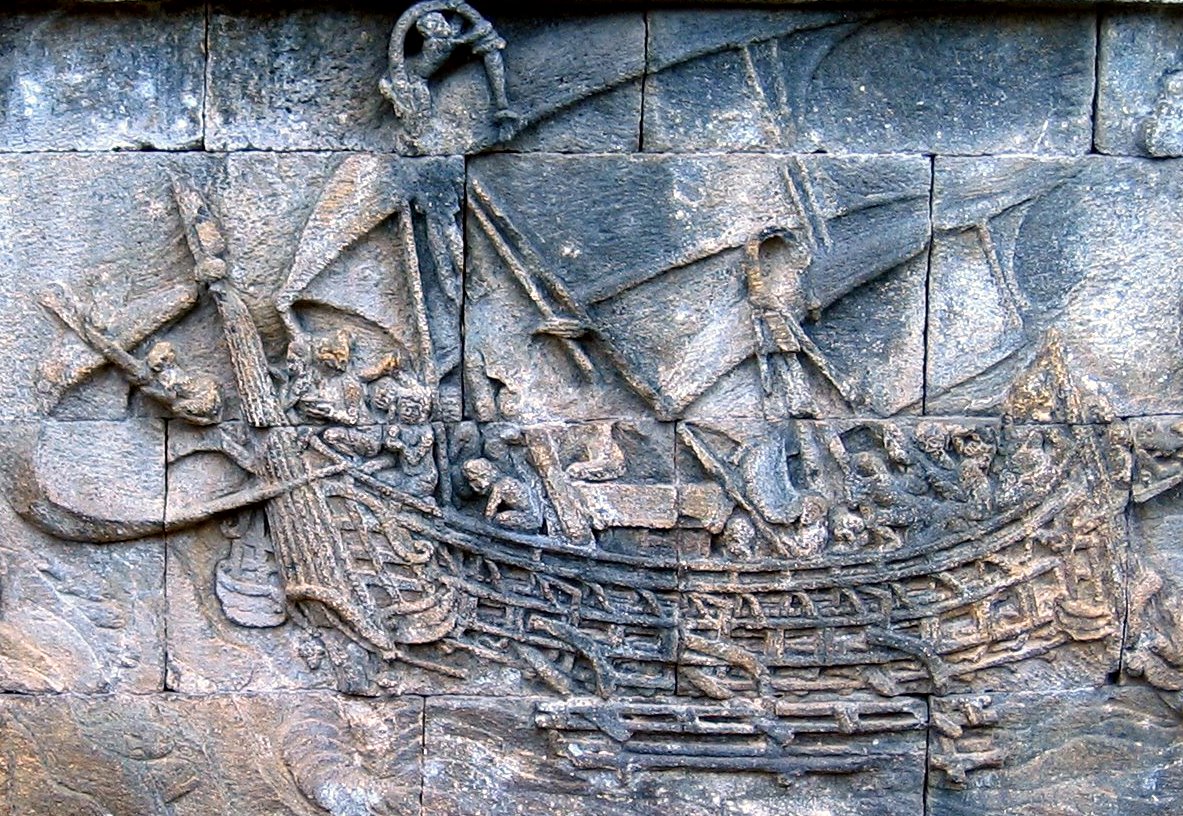
(Source The image of a ship on Borobudur bas relief. Something like this might have carried the initial settlers to Madagascar)
So what was the founding voyage actually like? Its pretty much impossible to piece that together. There’s no equivalent of a Viking saga documenting it. The theory which I find most implausible is that it was basically an accident. A ship just got lost. Cox et al. proposed this in the very paper that gave us the 30 women, which I find bizarre. There are two problems, and the paper even flags the first one. Why are women on board the ship, if its not a colonizing mission? “However, early written records imply that these trading voyages were dominated by men; there is no mention of women on board long-distance trading vessels [13]. There is no clear evidence suggesting that Madagascar was settled in multiple waves, but because ranto is mentioned in traditional Malagasy narratives, this may be a profitable direction for future simulations.” I therefore am baffled by the later quote: “It is therefore not beyond the realms of possibility that a single wayward vessel might have effected the settlement of Madagascar. This would certainly be consistent with the extremely small initial size of the Malagasy population, although perhaps not with the mixed-sex founding group suggested by Malagasy genetics.” Why even consider this when other options are on the table, which they also offer one such example of?:
An alternative hypothesis is that Madagascar was settled as a formal trading colony, perhaps under the auspices of the Srivijaya Empire (although Malagasy are not Hindu today), and possibly resembling later Arab trading centres in the region. Or perhaps Madagascar was settled as an ad hoc centre for refugees, drawn from those who lost land and power during the rapid expansion of Srivijayan influence. Such colonies would be established to be self-sufficient, and therefore, might be expected to include Indonesian women. However, there is little evidence—historical, archaeological or biological—of other Indonesian bases around the Indian Ocean, including the east African coast, although there may have been a Malay trading post in what is now Sri Lanka [50]. Founding such a centre in any official capacity on Madagascar—at the far extreme of Indonesia’s trading reach—therefore seems out of keeping with contemporary Indonesian trading practices. Along related lines, historical documents leave no record of refugees fleeing the Srivijaya Empire, although early chroniclers seldom paid attention to powerless groups as these refugees would likely have been.
Adelaar’s has his own theory. They didn’t sail to Madagascar initially, but rather they sailed to Africa, and got to Madagascar later, possibly much later. The evidence is that every single Malagasy dialect carries the same layer of Bantu influence in its phonology, and the island is remarkably monolingual for its size. According to him, you don’t get homogeneity like that if a mixed Asian-African society formed initially on the island. You get it if the mixing had already happened somewhere else and a settled, already-blended population then moved in. I’m not sure why this has to be the case, but that’s the theory. This could be the case, but then it displaces the question to elsewhere, where in Africa was this happening? Where is the lost Austronesian colony on the Swahili coast? How are the women and agricultural goods explained?
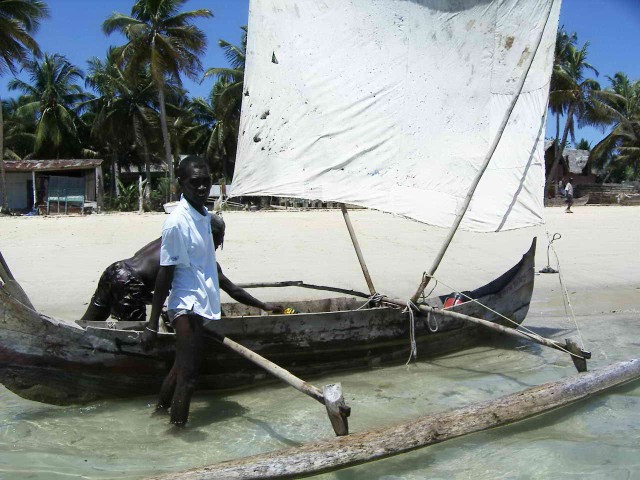
(Source Malagasy outrigger canoe which may or may not descend from the naval tradition which first colonized the island)
So what were these people like? Well, they had a rice and mung bean farming. They lost the technology for massive oceanic ships, but transformed them into outrigger boats. I suspect this technology was modified under local conditions, and lost in its original form because again, the colonists were not the ship owners or craftsmen. Likewise if they had Malay or Srivijayan Indosphere cultural traits, these would have been an ephemeral trait of a small Malay minority which evaporated. They had a calendar with Sanskrit month names, and the valiha zither (musical instrument) which descends from the Bornean balikan. They had no writing. No substantial political formation, no monumental architecture, no ceramic tradition traceable to home. Among instances of new settlement of a distant colony, this is one of the most unique events which history has ever produced.
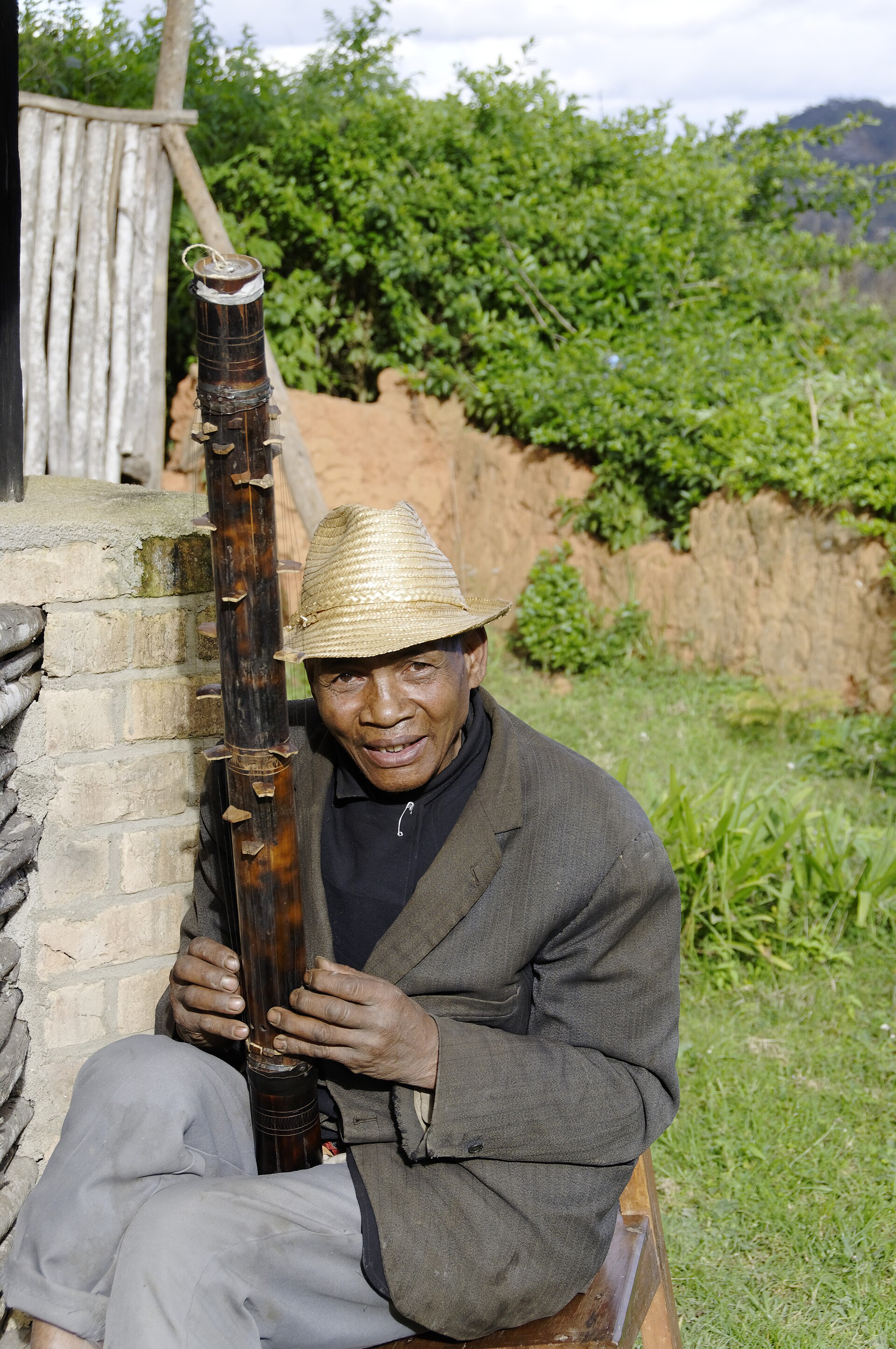
(Source A valiha player in Ambohimahasoa, central Madagascar)
Loanwords tell you what they didn’t know how to do. Their Malay vocabulary clusters in sailing. their Bantu vocabulary clusters in livestock and cooking. Dog, goat, cattle, sheep, donkey, chicken, guinea fowl, winnowing, pots, soot. But once again, they never developed seafaring of the kind their own crossing required, because it was never theirs to begin with. The ships and the skills belonged to the Malays. Contact with the archipelago did continue for centuries, which is how Arabic influence got there. But it continued because other people kept sailing to them. This is a colony that was delivered rather than launched, and whoever delivered it kept the boats.
—
**Sources and further reading**
Sources and further reading
Keith Taylor, “Madagascar in the Ancient Malayo-Polynesian Myths,” in Explorations in Early Southeast Asian History, pp. 25–60 (open access on JSTOR)
K.A. Adelaar, “Malay and Javanese Loanwords in Malagasy, Tagalog and Siraya (Formosa),” Bijdragen tot de Taal-, Land- en Volkenkunde 150/1 (1994), pp. 50–66.
Adelaar, “Towards an Integrated Theory about the Indonesian Migrations to Madagascar” (free PDF)
Cox et al., “A small cohort of Island Southeast Asian women founded Madagascar,” Proc. R. Soc. B (2012)
Crowther et al., “Ancient crops provide first archaeological signature of the westward Austronesian expansion,” PNAS (2016)
Kusuma et al., “Contrasting Linguistic and Genetic Origins of the Asian Source Populations of Malagasy,” Scientific Reports (2016)
Kusuma et al., “Malagasy Genetic Ancestry Comes from an Historical Malay Trading Post in Southeast Borneo,” Molecular Biology and Evolution (2016)
Plain-language summary of the Banjar findings by the researchers
Beaujard, “Madagascar and Africa, Austronesian migration“
Martin Walsh, “Cockatoos and crocodiles: searching for words of Austronesian origin in Swahili” (2019)
Fitzpatrick, S.M. & Callaghan, R., “Seafaring simulations and the origin of prehistoric settlers to Madagascar,” in Islands of Inquiry, Terra Australis 29 (ANU Press, 2008), pp. 47–58 (free PDF)
Kusuma et al., “Mitochondrial DNA and the Y chromosome suggest the settlement of Madagascar by Indonesian sea nomad populations,” BMC Genomics 16:191 (2015)


