
Cover art from the Ellora Caves Image source: Buddhism for Vampires
“If learned critics publicly deride
My verse, well, let them. Not for them I wrought.
One day a man shall live to share my thought:
For time is endless and the world is wide”
–Bhavabhuti (p.53)
I try not to saturate this blog with book reviews, but I have a justification in this case. This review contains a slew of poems excerpted from the book, which are worth far more than my review, and my numerous tangents. Hit “Continue Reading” and scroll down if you just want to check those out.
John Brough’s Poems from the Sanskrit[1], despite its confusing title, (what is the Sanskrit?) is actually a very charming anthology of translated Sanskrit poems, ranging from roughly the 4th through 10th centuries.
The translator’s stated purpose for compiling this volume is as follows: Normally Sanskrit translators, focus on conveying meaning at the expense of poetic or prosaic style. But since Sanskrit and English grammars differ considerably, meaning focused translations often come across as stilted or sometimes even unreadable. Sanskrit Poetry compounds this problem, because so much literary value is vested in the poetic structure itself (for example: The number, repetition, and weight of syllables.) This is a translation, which attempts to give equal weight to content and form.
Translating a Sanskrit poem into rhyming verse while keeping the original meaning intact is an impossible task. Perhaps a more accurate description of the book is: an anthology of English poems by John Brough, based closely on Sanskrit classics. The purist in me recoils at this prospect, but if you read the poems without wringing your hands over the potential “butchery” of the originals which preceded them, they are actually quite lovely on their own merits. And based on the samples and explanation of his technique as delineated in the introduction, I have faith that he has amply conveyed at least the basic sense of each work.
I’ll jump right into the verses and save my criticisms for the end:
I noticed some recurring patterns:
Anti-Clericalism: There are a surprising amount of poems in here, which are highly critical of priests, focusing on their hypocrisy foolishness, or exploitation. These are mostly secular poems, but it still surprises me. One has to wonder: Were they talking about priests generally or about “the bad ones” i.e. the heterodox ones?
“‘So, friar, I see you have a taste for meat.’
‘Not that it’s any good without some wine.’
‘You like wine too, then?’ ‘Better when I dine
With pretty harlots.’ ‘Surely such girls eat
No end of money?’ ‘Well, I steal, you see,
Or win at dice.’ ‘A thief and gambler too?’
‘Why, certainly. What else is there to do?
Aren’t you aware I’m vowed to poverty?'”
–Sudraka (p.79)
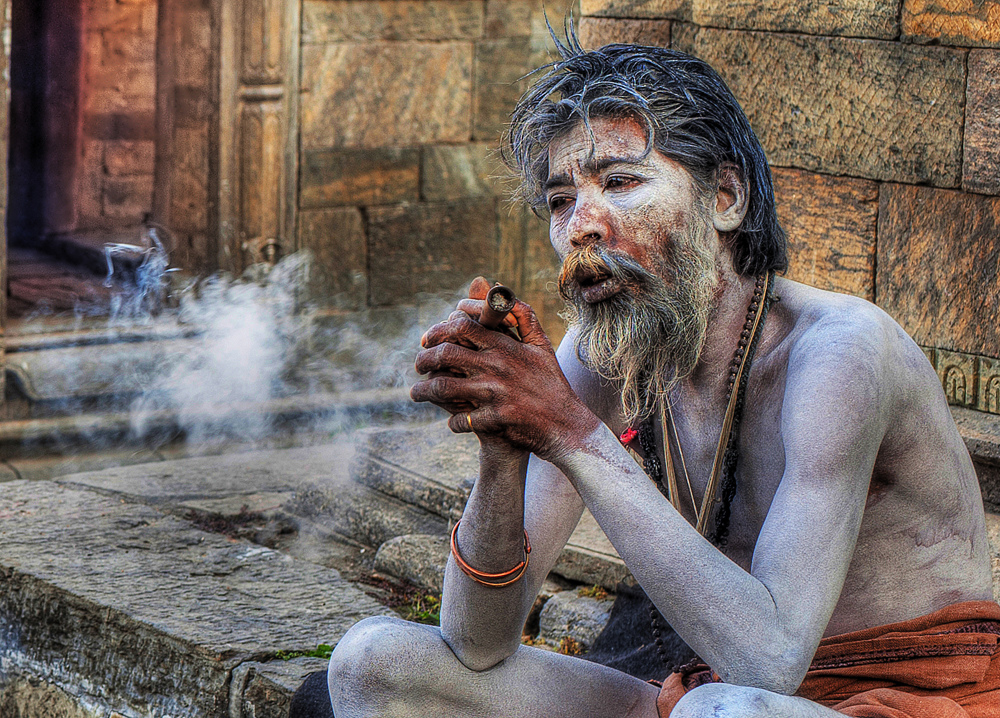
According to Doniger’s theory (described later), this is a “friar” similar to the one who is under critique in the above poem. He is an Aghori, a sect which split off from the Kapalika. The Kapalika would have been contemporaneous to Sudraka. Image source: Flickr
At some points this attitude of mockery towards priests spills over into secular sources of power as well:
“Strong drink may make a man forget
His mother or his wife,
Mistake a palace for the shack
He’s lived in all his life.
One day, a puddle in the sea;
The next, he’ll try to stand
Upon the ocean’s surface, which
To him appears dry lad,
To such a drunkard’s foolishness
There’s hardly any end:
He’ll even think, when he’s in drink
A king might be his friend”
– Bhartṛhari (p.66)
Anti-clericalism in particular occurs too frequently to brush it off as an artifact of Brough’s translation. Before investigating this I had always assumed that most of these poets were either court patrons, or worked out of religiously premised universities. Now I realize that some of these poets were kings themselves, which gave them an unusual degree of artistic privilege. I also discovered that some of these poets held non-mainstream beliefs which may have influenced their work. Dharmakirti for example may have been a Buddhist, and Bhartṛhari was likely either a Nyaya or a Mimamsa. Also, there is no denying that some minority of poets may have achieved fame solely through their own accomplishments, and without elite patronage, and attained a sort of artistic license by virtue of their freedom. With this in mind, it isn’t unfathomable that such writings were intended to (perhaps playfully) mock the orthodox religious order. A contrasting theory is put forward by Wendy Doniger on pages 278 through 280 her journal article The Origin of Heresy in Hindu Mythology. She asserts that such verses could either have been playfully self deriding, or meant specifically to target heterodox brahmins. Evidence towards her theory is the abundance of heterodox sects which engaged in asceticism during this period, and the fact that ascetics were, on many occasions, the explicit targets of poetic mockery.
Romance and Eroticism: The heavy majority of the poems in this volume have to do with love and sex. There are some reserved takes on the subject, which focus on pure romance:
“You are pale, friend moon, and do not sleep at night,
And day by day you waste away.
Can it be that you also
Think only of her, as I do?”
– Bhartṛhari (p.58)
But there are also quite a few which directly address sexuality directly:
“In this vain fleeting universe, a man
Of wisdom has two courses: first, he can
Direct his time to pray, to save his soul,
And wallow in religion’s nectar-bowl;
But, if he cannot, it is surely best
To touch and hold a lovely woman’s breast
And to caress her warm round hips and thighs,
And to possess that which between them lies”
-Bhartṛhari (p.113)
Take this perplexing verse. Initially, its hard to see how it could be about romance and/or sexuality at all:
“‘Did you sleep in the garden, dear,
On a bed of magnolia flowers?
I suppose you know that your breast
is smeared with the pollen dust?’
‘O, why will you try to be clever,
And scold me with hints like this?
Let me tell you I got these scratches
From cruel magnolia thorns.'”
-Amaru (p.136)
What is going on here? I refer you to the introduction:
“Indeed, there are some aspects of love-making quite frequent in Sanskrit poetry, of which, I suspect, it would be difficult to find even a hint among the love-poems of Europe. Apart from those, it may be remarked that biting is frequent: next day, the girl’s standard excuse is that she has been stung on the lip by a bee. So also i scratching: and the girl may either with some pride display to her friends the weals on her breasts and elsewhere, as proof that she really had been loved; or, if she is by nature more modest, she may attempt the excuse (though with little chance of being believed) that she has been scratched by the thorn-bushes in the garden.” (p.38)
Illustrations from the Kama Sutra. A text which describes in meticulous detail the proper times, places and techniques for biting, scratching, hitting, making animal noises, etc. Image Source: nieztejziemi.org

Women and Consent in the 7th century… and Today: Some poems positively describe what we would consider sexual assault in the modern west, although It surely read differently in an ancient Indian context:
“First find yourself a charming girl,
And while she says, ‘No, no!’
And while with trembling voice she cries,
‘You scoundrel, let me go!’
And while with rage her eyebrows arch,
And while she quorums and hisses,
Just go ahead and use your strength,
And steal yourself some kisses.
Then you will find that this is how
Mere mortal men obtain
Ambrosia, while the foolish gods
Once churned the sea in vain.”
–Amaru (p.133)
This is unsurprising. Cultural inertia has carried this through to the present. Forced kiss scenes are common in Bollywood films. Through the male character’s masculine, and sexually charged use of force upon the female character, he draws her out of her timidity, and reveals a hidden truth about herself— that she in fact loves him.
Examples of the nonconsensual, yet ultimately romantic kiss in Bollywood: (youtube links):
Devdas (not quite the same, but it is violence legitimized through romance)

This scene from Dil Se would not be out of place in 7th century Sanskrit poetry.
This next poem follows the process of resistance to capitulation from beginning to end:
“‘No! Don’t!’ she says at first, while she despises
The very thought of love; then she reveal
A small desire; and passion soon arises,
Shyly at first, but in the end she yields.
With confidence then playing without measure
Love’s secret game, at last no more afraid
She spreads her legs wide in her boundless pleasure.
Ah! Love is lovely with a lovely maid!”
-Bhartṛhari (p.114)
I’m curious as to how modern Western feminists and/or progressive cultural relativists will react to this. The fact is, force and romance arent as morally distinct in India as they are in the west. Relatedly, the concept of consent typically isn’t upheld as inviolable in South Asian cultures. Western, particularly Western feminist conceptions of “consent,” and “sexual violence” are in no way objective or universal. “Acceptable” mating strategies vary by culture.
The Western liberal seems to be in a pickle. Either embrace relativism and abandon the model of feminism which holds consent sacrosanct, or embrace feminism and openly declare your desire to spread your “superior” Western culture to uplift the backwards natives.
This final verse summarizes the ancient Indian view of women conveyed by these poets:
Loving the manly virtues, they delight
To point his fault out in the plainest way; They’ll give their souls to him they love, despite
The fact that their eyes will ne’er their hearts betray.
When they most long for love, their affirmation
Is constantly expressed as firm negation.
May Women smile on you: the most perverse,
Delightful creatures in God’s universe.
-Amaru (p.111)
Existential Angst: Its somewhat amusing to see the elites of a society make existential complaints, but modern western civilization has made it clear that such psychological pain, dhukka, is an aspect of the human condition which wealth cannot obviate.
“A man lives long who lives a hundred years:
Yet half is sleep, and half the rest again
Old age and childhood. For the rest, a man
Lives close companion to disease and tears,
Losing his love, working for other men.
Where can joy find a space in this short span?”
-Bhartṛhari (p.54)
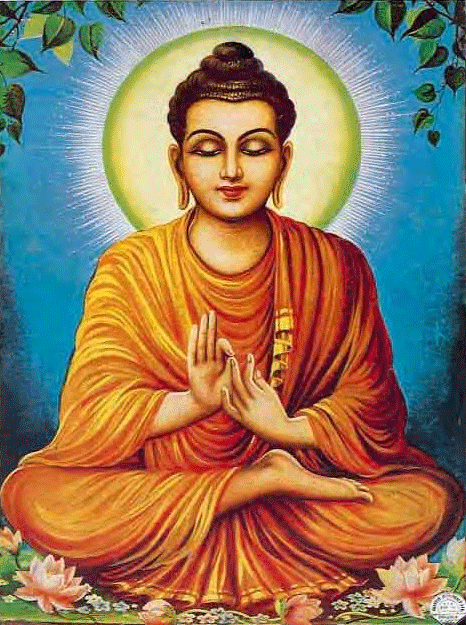
“Where can joy find a space in this short span?” Image source: Through the Looking Glass
Vignettes: Besides the romance angle, these are the most interesting poems for me. They offer a little peek into lives not that different from our own, except in temporal proximity. These might be called “microfiction” if they were written today. I love that they give just enough information so that you can make vaguely supported inferences about what else is going on in these people’s lives.
“Today adds yet another day
And still your father is unkind.
The darkness closes up the path.
Come, little son, let us go to bed.”
– Bhartṛhari (p.55)
And another:
“’Wont you awake and eat?’ I gently said:
But still she slept, though opening half an eye,
Then straightaway closed it. Turning with a sigh
She nestled warmly deeper in the bed.”
Bhartṛhari (p.77)
And my favorite one:
“’The road is rough; and, oh, the moon is bright
–‘Suppose my husband should discover!
People may talk. –But can I bear tonight
To disappoint my lover?’
And so she walked a step or two, and then
Turned and came back again.”
-Amaru (p.62)
Esoteric Academic References: The ideal Indian poet was meant to be highly educated in every academic subject available to them from logic and science, to grammar and philosophy. As a result, certain references or perhaps “in jokes” about esoteric subjects like Pāṇini’s grammar or Buddhist theology. These guys were ancient nerds and I love it:
“The grammar-books all say that ‘mind’ is neuter,
And so I thought it safe to let my mind
salute her.
But now it lingers in embraces tender:
For Pāṇini made a mistake, I find,
In gender.”
–Dharmakirti (p.64)
Criticisms and Conclusion: Before I start my criticism:
“A critic is a creature who has views
quite like a camel’s: flowers and fruit he scorns.
In the flower-garden of the honeyed Muse
He starves unless he finds a meal of thorns”
Bhartṛhari (p.78)
Ok, point taken Bhartṛhari. There are still a few problems though. Firstly, some degree of meaning is definitely lost as the result of Brough’s pursuit of poetic English form. Secondly, the “sing-song” tone which rhyme often conveys in English can potientally miscommunicate the tone of the original poem, if a more serious or somber tone was intended. I think that these two flaws could have been fixed if he had provided the Sanskrit text for each poem as well, or if he did two translations for each poem: one literal and one poetic. Given the overall quality of the anthology, these are negligible flaws.
However, there is one inexcusable flaw with this volume, which occurs in most Sanskrit translations but usually not to this extremity. Mythological Hindu characters or concepts are replaced with mythological Greek, Norse or otherwise European ones. For example, “ambrosia” comes up repeatedly, which I’m assuming is actually “amrit.” Venus shows up once (in the context of Shiva so I’m assuming it was actually Parvati?) “Jove’s nectar” comes up, which is a mystery to me. Likewise, elves and fairies make appearances, and who knows what that means? Apsaras? Gandharvas? We just don’t know because he doesn’t provide the Sanskrit. This could easily have been mitigated using footnotes, and significantly obfuscates the meaning of the poems.
This volume paints a picture of ancient India very different from the one we get from the epics, Manu Smriti, or from the British anthropologists of yore. Kings aren’t accorded the near universal reverence and obedience, which the religious texts would like us to believe, nor is the piety of holy men taken for granted. Premarital and extramarital sex seem tolerated enough to be written about with sympathy. The view on women seems basically consistent with the religious literature, but the more …immersive depictions of sex were also a welcome change (obviously excepting Kama Sutra.) The rules of the priests are ridiculed and violated with a casualness foreign of in the religious texts. One might venture to guess that religious portrayals of ancient India more often depicted a utopian (or dystopian?) ideal rather than a reality. This is not a new theory, but it is interesting to see some primary source evidence of it.
But honestly, this was an absolute pleasure to read. I highly recommend it. It was one of those books which I started reading more slowly towards the end to avoid finishing it. Buy it.
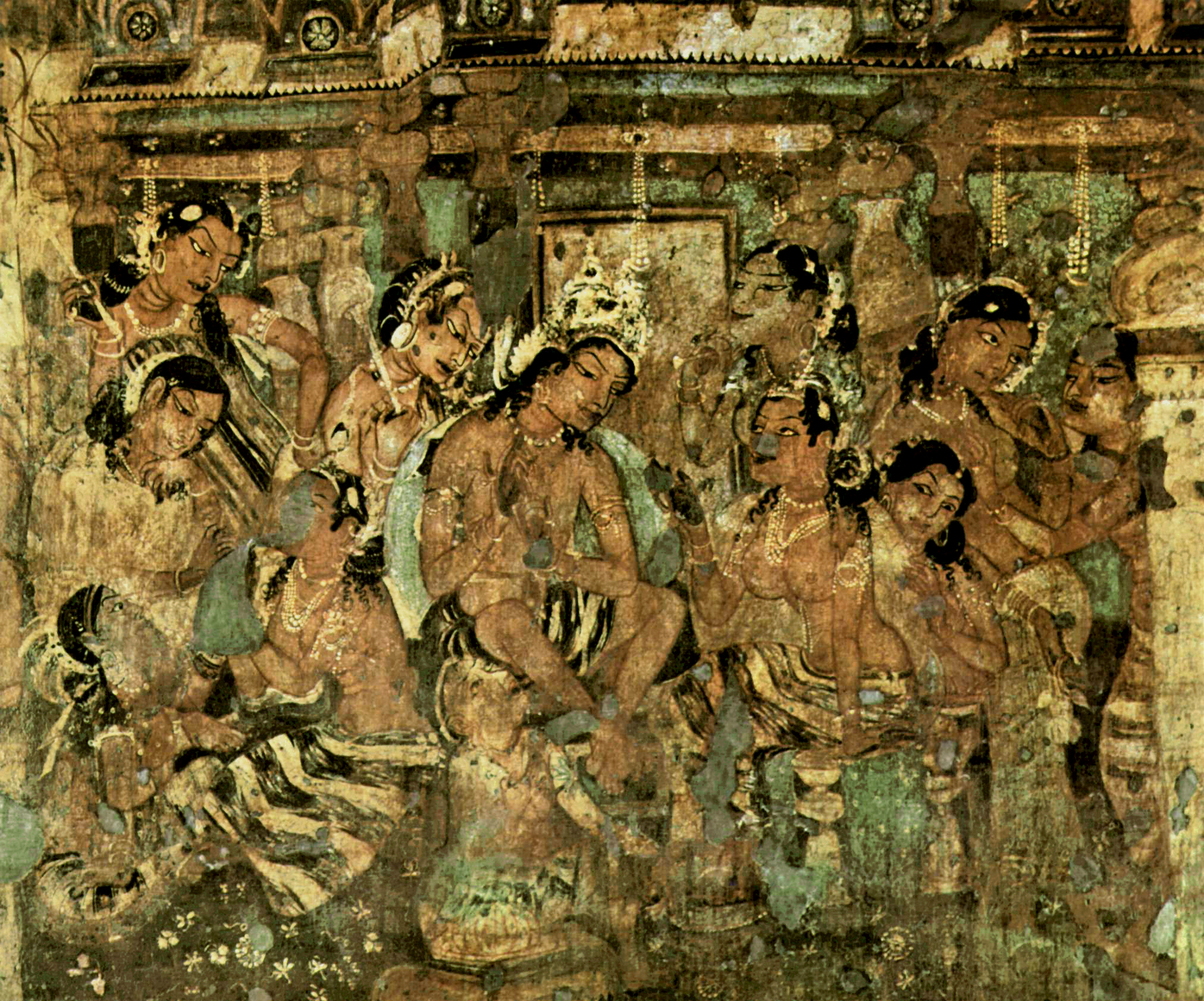
Mahajanaka renouncing the worldly life, from the Mahajanaka Jataka. 7th century, Ajanta Caves, India (from the same set of paintings as the book cover) Image Source: Wikipedia
I’ll close with this riddle from Kalidas. No answer was given in the book and I havent thought of a solution. It’s a real brain tickler. If you think you’ve figured it out, put the answer in the comments.
“I’m a footless traveller, very well read,
And yet no scholar (I’ve got no head);
Without any mouth, speaking truth or lies
–Riddle me this, and you’ll be wise.”
Kalidasa (135)
[1] All page numbers in this post come from John Brough’s 1968 edition of Poems From the Sanskrit, unless otherwise noted
 Videshi Sutra
Fantastic find Videshi. As I haven’t read the Sanskrit versions I shall rejoice in the translations. Thanks you for warnings about Sanskrit names and terms being replaced by Greek ones. Will stop me from cringing:) . Off to look for it onAmazon now…
And I think the answer to Kalidasa’s riddle could be 1) a book or 2) a story/ tale. ??
Anu,
Fantastic find perhaps, but a purely lucky one! It fell on my head when I was shuffling around the poetry volumes in a used bookstore. As for your answer to the riddle– very plausible! I didn’t think of those possibilities.
If you do end up buying it, let me know how you enjoyed it. It was one I savored greatly.
Wam regards
–Videshi
Wonderful
the taste the smell the inner-sound
of ancient present mudra times
poetry songs laughter irreverence
sex love tears longing fun rhymes
clear-eyed fearless human inspired
mother India’s fierce deep flowing play
(but Zeus Venus Mars & that gang
better left far setting sun west
of Gandhara, lest Ashoka’s dad’s
spirit re-wake wrathful mad instead)
Thanks for the hints the stimulations
from those great still here old gone poets
Classic Sanskrit trans-literated
in sometimes rhyming modern English
Necessary questions thorny anguish
yet in their own inter-connecting way
for us here today still quite fine
Aj,
Glad that you enjoyed the poems. Indeed, your comment is in its own way a wonderful poem! I agree, it is truly wonderful and in some ways miraculous that words from the ancient past can reach out and stir our minds with such potency.
All the best
-Videshi
[…] Poems from the Sanskrit, by John Brough (Sanskrit poems on unusually heterodox subject matter. I wrote a full review of it here) […]
Kalidasa(135): I think the answer of the riddle is “mind”
Ahhhh! Very good Deepankar! I think you may have solved it. In any case, that answer certainly applies.
Thanks for sharing your solution with us.
[…] not “incidental” or exceptional to Hinduism. Themes of eroticism and anti-clericalism show up much earlier in Sanskrit poetry, as I’ve documented. In terms of social effect, this type of (dare I say) countercultural Bhakti worship played a large […]