The early 20th century in Denver marks a fragmented period for the presence of Hinduism, a time when authentic Hindu philosophy and spirituality began to emerge alongside a flurry of sensationalist and dubious claims. The Vedanta Society made a brief but notable appearance, attempting to establish a foothold for genuine Hindu teachings, though its influence appears to have been transient. More dominant in this period, however, were hucksters and lecturers who used Hindu concepts and imagery in ways that blended Western spiritualism, occultism, and commercial opportunism. Even among these figures, it is difficult to discern where genuine spiritual intent ended and snake-oil salesmanship began. These fragments highlight a historical moment where the public’s fascination with the exotic and mysterious often overshadowed earnest efforts to introduce Hindu traditions, creating an ambiguous and complicated legacy that warrants further exploration.

The absolute earliest fragments are some scattered references (2) in very early (1894) newspaper about Hindu beliefs or publications, but they are very sparse, and view the subject hazily and at a distance.
Some other very early articles contextualizing the extremely early Vedantic and Theosophical period in the context of the concern, anxiety, or even panic surrounding New Thought, occult, and other novel turn of the century religious movements are as follows:
Older Christian Science (1899)
Age of Spiritual Hunger (1903)
But for where there is more meat to the story, I will start with something a little more concrete:
The earliest reference I’ve been able to find of a Hindu actually visiting Colorado is actually a Brahmo Sajami, B. B. Nagarkar, who visited in 1894, having previously represented that tradition at the Chicago Congress of Religions the previous year. Despite the Brahmo Samaj being one of the first to bring Hindu thought to Denver and perhaps the US in general, its influence would eventually be eclipsed by the Ramakrishna movement, which gained prominence in the early 20th century, particularly through the work of Swami Vivekananda. Nevertheless, Nagarkar’s visit marks an important early moment of direct engagement between Hinduism and Colorado, predating the later widespread interest in Vedanta and other aspects of Hinduism that would follow with the Ramakrishna Mission and other movements.
As early as 1901 there were at least some isolated people in Colorado who were aware and appreciative of Hinduism or Vedanta, as the writer of this book review section on Vivekananda’s book “My Master”, is an example of. Another such piece is published in 1902
1909: a Vedanta Society was founded in Denver in the fall of this year, and it is accompanied in the newspaper record with a flurry of activity.
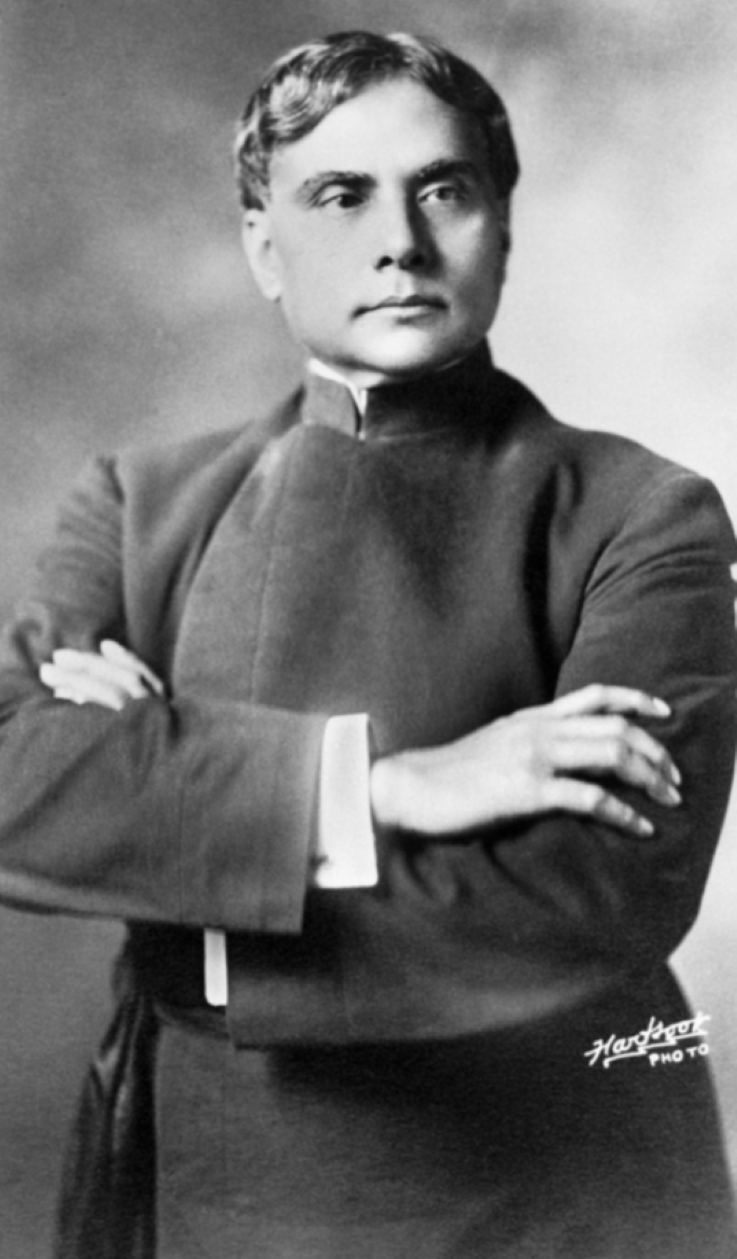
It shows up in the newspaper The Rocky Mountain News (Daily), Volume 50, Number 243, August 31, 1909 as a “New Incorperation”: “Vedanta society; Stuart A. Smith. Christ Nel son. Elizabeth Thomas, L. W. Van Dyke; not for profit; Denver.” It seems like this Vedanta Society likely was hosted in the home of Stuart A. Smith (who appears to be a woman). Swami Abhedenanda paid a visit there in 1909 and gave a lecture there in October of 1909, as well as in the convention hall in the old Albany hotel (which no longer exists). Interestingly, a basic Indian vegetarian recipe given by the same Swami was recorded in a newspaper on August 24th. On August 22, another event is noted as taking place in the same Vedanta Society, though the subject is unclear. It is in the “Clairvoyants” section of the newspaper, which isn’t very meaningful since so much about India and Hindu religion at this point is discussed in this type of almost circus-coded occult mystical framing in newspapers, and I wasn’t able to find any additional information about the speaker there, recorded as “S.N. Makherjeya” (another Bengali name, and we can assume is somehow connected with the Ramakrisha organization). However, that conflation was not without cause, as in 1909 we see another reference to Vedanta coming from a reference to a speech given by Dr. McIvor-Tyndall who apparently lectured on the topic, amongst others at the Psychic Church on California Street.
Side note: What was going on on California Street? Examining the collection of newspaper entries from the time, it’s clear that this particular block of California Street in Denver had developed into something of a hub for spiritualist and occult activities. Between 1819 and 1821 California Street, the Psychic Church made its home, a location also serving as a base for “Cashmere,” a self-described “teacher and healer.” Nearby, at 2115 California Street, Emma Lee, known as a “Gipsy” astrology and palmist, worked her trade, while 1548 California Street hosted daily consultations from Professor F.D. Hynes, a well-known psychic in the area. Just a couple of blocks down at 517 17th Street, Princess Zilpah, the “Astral Death Trance Seeress,” practiced her art, and Madam Miller operated out of 1826 California Street. Several other similar establishments dotted the area, reinforcing the idea that California Street was a kind of “psychic row” during this period.
This concentration of psychic and occultist activity is a curious snapshot of the times, reflecting the public’s fascination with metaphysical and mystical practices at the turn of the century. The area, now mostly transformed into parking lots, was once alive with spiritualist enterprises—some “snake oil,” others perhaps genuine. It’s also notable that a different kind of spirituality was taking root just two blocks away, at 2420 California Street, where the local Vedanta Society, hosted Swami Abhedenanda. This would have been a very different sort of spiritual environment compared to the psychic healing and fortune-telling taking place in the nearby buildings, adding another layer of complexity to the religious and mystical landscape of the time.
This confluence of occult interests, spiritualist gatherings, and emergent Hindu teachings makes California Street a particularly intriguing focal point, and the transformation of this area—into what is now a landscape of modern parking lots—mirrors the larger marginalizing transition in public perception and the eventual social marginalization of these spiritualist movements. Yet, for a brief moment in history, it was a place where new age western metaphysical currents intersected with the mainstream curiosity about Eastern religion.
In 1915 Swami Abhedenanda returned, on his way from New York to California. Perhaps not coincidentally, 3 days before his speech the Denver Public Library logged 1 Paramananda, 1 Ramakrishna, 1 Vivekananda book, and 1 book containing selections of Valmiki as new entries.
Interestingly, in 1916 Rabindranath Tagore briefly visited Denver, but apparently didn’t lecture on any of his philosophical writings, instead speaking on “The Cult of Nationalism”.
In 1924, and therebouts there existed a lecturer in the Denver area by the name of Dr. Samuel L Joshi, who was apparently a Brahmin raised by Christians, a Columbia graduate, and a scholar capable of lecturing on a wide range of subjects ranging from history to comparative religion to art-history.
Alongside Joshi, there also seemed to be an increase in Hindu-esque snake oil salesmen, occultist schemes and scams and whatnot. I dont want to entirely dismiss these as having no spiritual or philosophical value, but the tenor and tone of them is completely not academic, cheap, and suspicious to me personally.
1926: we see an advertisement again leaning into the occult coded way of presenting Hinduism during this time period. Yogi Gherwal giving a lecture on “Hindu Philosophy and the Occult Sciences” given at the “First Church of Super-Mind Science”, a small and elusive organization which itself seems to have been an offshoot of “Super-Mind Science Temple”. This is a similarly elusive organization founded by William Estep, a potential scam artist, murderer, and mystic, with a system seemingly derived from both Theosophy and Yoga. Estep’s system, an apparent eclectic mix of Theosophy and Yoga, appealing to the period’s fascination with spiritual synthesis and sensationalism.

Also in 1926 we see an advertisement for another kitchy occultish Hindu lecturer, which similarly reeks of hucksterism and scam artistry, of the sort which would naturally fuel the distrust against these types of new religious traditions in general, and apparently Hindu ones in particular. This one is “Superakasha Yogi Wassan”, who will demonstrate his abilities with a magic trick involving holding an immense amount of weight on his chest, and who purports to teach the “yogi way” to super-health, fortune telling, and keeping young, but also breath control and spiritual development. These types of presentations cater to a public appetite for spectacle but simultaneously could easily fuel skepticism about the authenticity of these teachings.

By 1927 however, it appears as though this Vedanta Society had likely dissipated, or was so tiny so as to escape the attention of the newspapers, as an article from a Denver paper in 1927 making mention of various Vedanta Societies in American cities makes no mention of one in Denver. This decline may reflect the challenges Vedanta groups faced in distinguishing themselves from the more flamboyant, commercialized, and “low church” and “left hand path” forms of spiritualism and pseudo-Hinduism circulating at the time. These trends likely undermined the credibility of serious Vedantic movements, associating them in the public mind with the spectacle and opportunism of figures like Wassan and Estep.
This period highlights the challenges in establishing genuine philosophical or spiritual traditions within a cultural landscape rife with sensationalism and mistrust. Legitimate teachings often struggled to gain a foothold amid the noise created by spectacle-driven presentations and commercialized spiritual movements. However, this analysis is far from complete. These are merely notes and impressions pieced together from some smattering of available materials I’ve examined, reflecting only a fragment of the complex dynamics at play in this fascinating but understudied era in the history of the American West.
 Videshi Sutra
